JPMorgan and Citi’s Tokenized Deposit Network: The Bank Answer to Stablecoin Payments
 Karim Daniels

America’s largest banks are coalescing around a shared tokenized-deposit network that aims to give corporates programmable, instant settlement in dollars—without leaving the regulated banking perimeter. If it works as designed, it could absorb a chunk of stablecoin payment flows while bridging to public blockchain liquidity when compliance allows.
The plan, led by The Clearing House with support from JPMorgan and Citigroup among others, targets a first-half 2027 debut. For treasurers and fintechs, that timeline is close enough to merit planning, but far enough to keep multi-rail optionality with existing stablecoin partners.
This piece unpacks how bank-issued tokenized deposits differ from stablecoins, where interoperability is already emerging, what value this could unlock for businesses, and which risks remain unresolved.
| Point | Details |
|---|---|
| Network launch window | Major U.S. banks back a tokenized-deposit network to be operated by The Clearing House, with a target start in H1 2027 The Block (reporting on WSJ). |
| What’s a tokenized deposit? | A on-chain representation of a commercial bank deposit—redeemable 1:1 at the issuing bank, subject to KYC/AML. It stays within bank supervision, unlike many public stablecoins. |
| Public-chain links are forming | A May 2026 pilot redeemed a tokenized Treasury fund on the XRP Ledger in under five seconds, tying public settlement to interbank dollar delivery outside bank hours CoinDesk. |
| Liquidity backdrop | Distributed tokenized RWAs reached ~$33.7B, with U.S. Treasuries near ~$15.35B; combined distributed + represented tokenized assets were ~ $406B as of May 2026 Rekord – 'State of RWA 2026'. |
| Bank-grade tokenized cash + funds | J.P. Morgan launched an Ethereum-based tokenized government money-market fund (JLTXX), seeded with $100M and positioned to meet stablecoin reserve standards under the GENIUS Act J.P. Morgan Asset Management. |
What tokenized deposits are—and aren’t
Editor's note: Pilots like the OUSG redemption on XRPL and early conversations around tokenized MMFs convinced me that the technical stack is ready; the gating factor is governance and policy. In workshops with payment providers, the most useful pattern was multi-rail design—treat tokenized deposits, stablecoins, and RTP as interchangeable back-ends, decided by rules. That mindset reduced vendor lock-in and made risk teams more comfortable. — Karim Daniels
Tokenized deposits are digital representations of funds you already hold at a regulated bank. They mirror a customer’s deposit liability on a shared ledger, enabling near-instant transfer and automated workflows. A stablecoin, by contrast, is typically issued by a nonbank entity against reserve assets and circulates openly on public chains.
Core differences vs stablecoins
- Issuer and supervision: Tokenized deposits come from banks subject to banking supervision and deposit rules. Stablecoins may be issued by money transmitters or trust companies, with evolving oversight.
- Redeemability: A tokenized deposit is a direct claim on a bank deposit account. Stablecoin redemption depends on the issuer’s reserve program and terms.
- Perimeter and access: Bank tokens will likely be permissioned, restricting use to KYC’d entities and Treasury-approved corridors. Stablecoins are broadly composable on public chains.
- Programmability: Both can be programmable. Banks will focus on controlled programmability (rules, whitelists, time locks) that meet compliance requirements.
Pro tip: If your payment flow requires open DeFi composability today, expect a hybrid model for the next few years: public stablecoins for open ecosystems; tokenized deposits for bank-permissioned, higher-value B2B corridors.
Inside the Clearing House initiative: architecture, access, timeline
The Clearing House (TCH)—operator of ACH, CHIPS, and RTP—has emerged as the prospective hub for a shared tokenized-deposit rail. Reporting in June 2026 indicated JPMorgan, Citigroup, Bank of America, and Wells Fargo are among backers, with a first-half 2027 go-live targeted The Block (reporting on WSJ).
Probable network design
- Permissioned ledger: Participation restricted to supervised institutions and their KYC’d clients, preserving auditability and sanctions compliance.
- On-us and off-us settlement: Instant within-network transfers; interbank netting or atomic settlement mechanisms between participants.
- Programmable controls: Payment conditions (escrow, delivery-vs-payment, spend controls) encoded at the token or workflow level.
- Bridges to existing rails: Integration points to Fedwire/CHIPS/RTP/ACH so balances can move between tokenized and traditional accounts.
Who gets access
- Phase 1: Large corporates, financial institutions, and regulated fintechs integrating via bank APIs or network SDKs.
- Phase 2: Potential expansion to mid-market and payment facilitators as risk policies, limits, and messaging standards stabilize.
Businesses should expect onboarding similar to high-limit RTP programs: due diligence, whitelisting, transaction monitoring, and contractual controls on use cases.
Interoperability is not optional: public chains and RWA liquidity
Even if the bank network is permissioned, commercial demand rarely lives on one rail. The last 18 months showed credible experiments linking bank-grade assets and public blockchains.
- Cross-border redemption: In May 2026, Ondo Finance, JPMorgan’s Kinexys, Mastercard and Ripple processed a redemption of Ondo’s tokenized Treasury fund (OUSG) that settled on the XRP Ledger in under five seconds—while coordinating interbank dollar delivery outside normal hours CoinDesk.
- Tokenized funds for treasuries: J.P. Morgan Asset Management launched an Ethereum-based tokenized government money-market fund (ticker JLTXX) in May 2026, seeded with $100 million and positioned to satisfy stablecoin reserve requirements noted under the GENIUS Act J.P. Morgan Asset Management.
- RWA scale-up: Tokenized real-world assets reached about $33.7B distributed on-chain as of May 2026, with tokenized U.S. Treasuries near $15.35B, and an estimated ~$406B when including distributed + represented tokenized assets Rekord – 'State of RWA 2026'.
These milestones suggest a future in which bank tokens interoperate—directly or via gateways—with public chains for liquidity, settlement finality, or collateral use, while preserving compliance. The practical question for product teams is how to layer controls: wallet whitelists, travel-rule messaging, and policy-based bridges.
Who wins early: practical use cases for enterprises and fintechs
High-velocity B2B settlement
- Marketplaces and PSPs: Move escrowed funds instantly to sellers on weekends with clear settlement finality. Replace a two-day ACH payout with programmable release conditions.
- Supply-chain finance: Combine invoice tokenization and tokenized deposits for delivery-versus-payment on milestones, lowering dispute risk.
Treasury operations
- Intraday liquidity: Sweep idle balances between operating accounts and tokenized deposits to compress cash buffers without losing availability.
- Yield adjacency: Keep operating cash on a bank token rail while parking reserves in tokenized funds like JLTXX via bank-connected channels, subject to your policy and regulation J.P. Morgan Asset Management.
Cross-border and after-hours
- Intercompany flows: Settle between subsidiaries across time zones with programmable hold/release and bank-grade audit trails.
- Pilot corridors: Leverage emerging links to public chains for last-mile delivery where bank coverage is thin, as pilots like the OUSG redemption on XRPL hint CoinDesk.
Pro tip: Run a sandbox sprint mapping two to three payment journeys (payouts, supplier, intercompany). Define what “instant” means for your risk team—credit limits, sanctions checks, and reversal policies—before you write your first API call.

Regulation, governance, and the policy edge
Tokenized deposits sit inside bank charters and established prudential oversight. That does not remove risk, but it changes where risk lives. Instead of reserve attestations and issuer bankruptcy remoteness (familiar stablecoin questions), attention shifts to bank credit exposure, operational resilience, and network governance.
Policy considerations
- Stablecoin statutes vs bank money: Several jurisdictions are considering or advancing stablecoin frameworks. A bank token rail may sidestep some licensing constraints for corporate users but could limit open composability.
- Reserve quality and tokenized funds: The emergence of tokenized government money-market funds like JLTXX—positioned to qualify under the GENIUS Act language—signals how bank-grade liquidity might be instrumented on-chain for reserves and treasury use cases J.P. Morgan Asset Management.
- Data and privacy: Permissioned ledgers promise auditability but raise questions on data sharing, message standards, and portability between banks.
Expect strong KYC/AML, sanctions screening, and travel-rule messaging. Programmability will likely include policy guardrails (allow/deny lists, purpose codes, jurisdictional gates).
Operational checklist: preparing for bank token rails
For CFOs and treasurers
- Define use cases: Weekend payouts, supplier pre-funding, cross-entity netting. Rank by financial impact and risk tolerance.
- Liquidity policy: Clarify how much working capital can sit in tokenized form intraday vs end-of-day; set sweep rules.
- Counterparty diversification: Avoid single-bank dependence; prepare for multi-bank token issuance and redemption.
For product and engineering
- Wallet and key management: Decide between bank-custodied wallets, enterprise MPC, or HSM-managed keys. Map entitlements and segregation.
- Messaging standards: Align on ISO 20022/JSON schemas that carry compliance data alongside token transfers.
- Policy engines: Build allowlist/denylist services, velocity controls, and programmable escrow modules.
- Reconciliation: Implement dual-ledger reconciliation across tokenized balances and traditional accounts.
Risk and compliance
- Access controls: Role-based approvals for mint/burn/transfer; four-eyes for large movements.
- Monitoring: Real-time sanctions and anomaly detection tuned for instant settlement windows.
- Business continuity: Failover plans if the token network, a bridge, or a participant bank goes down.
Pro tip: Simulate a “stuck transfer” day. How do you reverse, re-route, and notify counterparties across tokenized and traditional rails without losing audit traceability?
Competition and complements: banks vs USDC/PYUSD and legacy rails
Tokenized deposits will compete with, and sometimes complement, public stablecoins and real-time payments (RTP). Each rail optimizes for different trade-offs.
| Attribute | Tokenized Deposits (TCH) | Public Stablecoins (e.g., USDC/PYUSD) | RTP/ACH/Wires |
|---|---|---|---|
| Issuer liability | Direct bank deposit claim | Issuer reserve claim per T&Cs | Bank liabilities on existing rails |
| Access | Permissioned (KYC’d entities) | Open public-chain addresses (subject to issuer controls) | Bank-account holders |
| Settlement window | Near-instant, 24/7 (network design-dependent) | Instant on-chain; off-ramps vary | RTP instant; ACH batch; wires business hours |
| Programmability | Controlled, policy-rich | Highly composable in DeFi | Limited native programmability |
| Cross-chain reach | Via permissioned gateways and selected bridges | Native to multiple chains/bridges | None |
| Compliance framing | Within banking supervision | Evolving, issuer-specific | Well-established |
A pragmatic approach for many enterprises will be multi-rail orchestration: route by geography, counterparty KYC posture, cost, and speed; hold balances where policy permits and yield is acceptable.
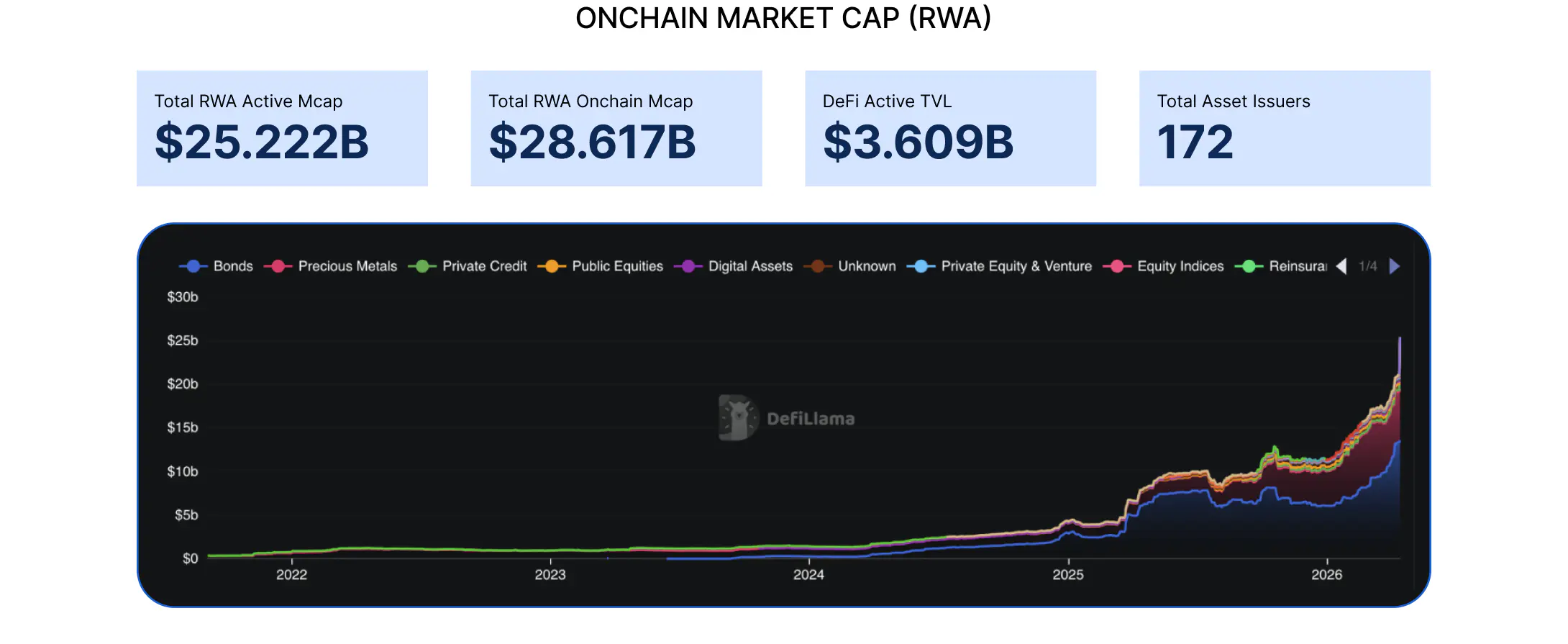
DefiLlama chart of on‑chain RWA market cap (~$28.6B) and recent growth — visual evidence of the tokenized‑asset base banks aim to serve with tokenized deposit rails. — Source: DefiLlama Research
Risks and open questions to watch
- Network fragmentation: If banks deploy divergent token standards or controls, interoperability lags and benefits dilute.
- Operational concentration: A central hub introduces single points of failure—even with robust redundancy.
- Counterparty exposure: Tokenized deposits are still bank exposures; diversify issuers and set intraday and end-of-day limits.
- Bridge risk: Public-chain links invite smart-contract, oracle, and policy-enforcement risks; insist on transparent controls and clear liability.
- Privacy vs auditability: Fine-grained programmability can reveal workflow metadata; balance reporting needs with data minimization.
- Regulatory drift: Stablecoin rules and bank guidance may evolve unevenly by jurisdiction, complicating cross-border flows.
Mistakes to avoid:
- Assuming instantaneous liquidity equals finality across all participants; confirm final settlement semantics bank-by-bank.
- Underestimating onboarding time; permissioned rails still require rigorous KYC, legal agreements, and systems certification.
- Building only for one rail; design abstractions so you can pivot between tokenized deposits, stablecoins, and RTP as policy or economics change.
Stay close to the signal
Institutional payments are changing fast. For ongoing coverage of bank tokenization, stablecoin policy, and real-world pilots, you can follow updates from Crypto Daily at cryptodaily.co.uk.
Frequently Asked Questions
Are tokenized deposits the same as a stablecoin?
No. A tokenized deposit is a claim on funds held at a commercial bank, typically on a permissioned ledger. A stablecoin is issued by a nonbank or specialized entity against reserves and circulates on public blockchains.
When could the network go live?
Reporting in June 2026 indicated a target launch in the first half of 2027 for a tokenized-deposit network run by The Clearing House and backed by major U.S. banks The Block (reporting on WSJ). Timelines can shift based on testing and approvals.
Will my business need crypto wallets?
Probably some form of enterprise wallet, but many banks will abstract key management through custodial or MPC solutions. Expect role-based controls, whitelisting, and audit trails aligned to your existing treasury policies.
Can tokenized deposits connect to public blockchains?
Yes, via permissioned gateways or approved bridges. Interop is already being tested, such as a May 2026 pilot that redeemed a tokenized Treasury fund on the XRP Ledger in under five seconds while coordinating bank dollar delivery CoinDesk.
What’s the advantage over RTP or ACH?
Programmability and 24/7 settlement with bank-grade controls. Tokenized deposits can embed escrow, conditional release, and policy enforcement natively. That said, RTP may still suffice for many domestic, low-complexity payments.
How does this affect stablecoin issuers?
Bank tokens may capture compliant B2B flows and reserves management, while public stablecoins retain an edge in open crypto-native ecosystems. Expect coexistence, with bridges and integrations blurring lines over time.
Is there yield on tokenized deposits?
Tokenized deposits themselves reflect demand deposits and typically do not carry yield. However, treasurers may pair them with tokenized money-market funds such as JLTXX when policy permits J.P. Morgan Asset Management.
Disclaimer: This article is provided for informational purposes only. It is not offered or intended to be used as legal, tax, investment, financial, or other advice.
Related Stories