Zcash Zakura Targets 50,000 TPS for Private Payments
 Darnell Whitaker

Zcash has a new full node on the block. It’s called Zakura, and its team just planted a bold flag: private payments should scale like card networks, on the order of tens of thousands of transactions per second. Big promise, gritty engineering.
If you’re trying to understand what that means in practice, this piece breaks it down. We’ll cover what Zakura is, how it plans to chase 50,000 TPS, what the benchmarks say so far, where the bottlenecks still live, and what all of this could change for users, wallets, and exchanges.
Short version: the software is moving. The protocol will need to move with it.
Zakura is a new Zcash full-node implementation focused on performance and network throughput. Its 1.0.0 release dropped on July 15, 2026, along with a public target to support payments at the scale of card networks, roughly 50,000 TPS. Early numbers show faster sync and new network plumbing on the way, but hitting that throughput sustainably will also require broader protocol and ecosystem changes. It’s a serious step, not a finish line.
- Zakura 1.0.0 shipped on July 15, 2026 Zakura (announcement).
- Benchmarks claim nearly 5x faster sync vs Zebra, e.g., 4h20m vs 20h46m for block sync Zakura (announcement).
- An experimental P2P layer targets sub-500ms worst-case block propagation and adds mempool aggregation for high-throughput bursts Zakura (announcement).
- The team frames “more than 50k TPS” from Visa and Mastercard as its floor for global payments Zakura (announcement).
- Today’s validation costs are real. Zebra 6.1.0 reports a near-limit block of simple txs taking 52+ seconds to validate on fast hardware Zcash Foundation (Zebra 6.1.0 Release).
What is Zakura, and why is it a big deal for Zcash now?
Zakura is a fresh full-node implementation for Zcash that prioritizes raw speed and network handling. It’s not a fork of the Zcash chain. Think of it as another engine for the same car, tuned for acceleration and long-haul mileage. Version 1.0.0 landed mid-July 2026 with a roadmap that leans hard into throughput and realistic operator workflows Zakura (announcement).
Why now? Because private payments have always lived with a tradeoff: you get confidentiality, but each transaction is heavier. Verification of zk-proofs is CPU-bound, block gossip has to keep up, and disk I/O gets chewed by shielded data. If you want to match mainstream rails, you have to attack every bottleneck at once: sync speed, validation time, propagation, mempool policy, and operator tooling.
The early signals are promising. The Zakura team published benchmarks claiming nearly five times faster sync than Zebra in their test environment. One example run: 4 hours 20 minutes for a full block sync on Zakura vs 20 hours 46 minutes on Zebra. They also showed snapshot restore times clocking in at 37 minutes 9 seconds for an archive snapshot and 1 minute 50 seconds for a pruned snapshot Zakura (announcement). That’s operator time given back.
But speed alone isn’t the story. Zakura is also rethinking the P2P layer to keep blocks flying around the network faster and more predictably, which becomes critical once you turn the TPS dial up.
How does Zakura actually chase 50,000 TPS?
The team frames 50,000 TPS as a floor by pointing to Visa and Mastercard volumes. The idea isn’t that Zcash flips a switch tomorrow and hits that number. It’s about building the node and network stack that can credibly support that class of throughput once the rest of the pipeline is ready. In concrete terms, that means lowering end-to-end latency across three loops: validation, propagation, and mempool-to-block packing.
On propagation, the plan is an experimental transport layer that shoots for sub-500ms worst-case block propagation across peers, plus mempool aggregation that holds up under bursty load. That’s a high bar, but if you can keep worst-case block gossip under half a second in practice, you free up headroom for bigger blocks or tighter intervals before orphan rates spike Zakura (announcement).
On validation, the work is about smarter parallelization and fast-paths for common transaction patterns. Zcash’s shielded transactions involve verifying zk-proofs, which is computationally expensive. Zebra’s own release notes underline the challenge: a near-limit block with minimal single-input transactions can take more than 52 seconds to validate on fast hardware today Zcash Foundation (Zebra 6.1.0 Release). Zakura’s pitch is to push those numbers down with better engineering, then keep pressure on the rest of the stack.
Finally, operator ergonomics matter. Faster initial sync, quick snapshot restores, and sane telemetry make it more likely that exchanges, PSPs, and custodians will actually run high-performance Zcash nodes in production. Without that, you never get the real throughput anyway.
Can the current Zcash protocol handle that scale today?
Short answer: probably not at sustained 50,000 TPS, not without further changes. And that’s not a knock on Zakura. It’s just physics and protocol parameters. If blocks contain thousands of transactions with zk-proofs, the network has to verify them, store them, and propagate them. The more you pack in, the more validation cost and bandwidth you pay.
The Zebra 6.1.0 datapoint is a useful reality check: under a synthetic heavy block, validation eats 52+ seconds even on fast machines Zcash Foundation (Zebra 6.1.0 Release). Zakura’s code can trim a lot of that through parallelization and optimized data paths, but at some point you still run into cryptographic verification costs and block size policy.
So yes, the node can get dramatically faster, and that unlocks options. But true global-scale private payments likely involve a combination of node speedups, protocol-level changes, and possibly layered approaches like rollups or batched proving. Zakura’s target sets the ambition, not the current ceiling.

What network plumbing needs to change for high-throughput private payments?
Network propagation is the unsung hero. If blocks don’t reach most nodes quickly and predictably, the effective throughput collapses as orphan rates rise and mempools diverge. Zakura’s experimental P2P transport aims for worst-case block propagation under 500ms and introduces mempool aggregation to tame spiky flows when traffic surges Zakura (announcement).
That kind of target forces hard choices. You need better peer selection, smarter relays, and aggressive bandwidth use without turning the network into a CDN copy of a single operator. You also need mempool policies that don’t crumble under floods of small transactions. Think adaptive fee filters, compact block relay tricks, and careful handling of transaction dependencies.
All of this has to coexist with privacy. You can’t leak metadata while trying to go faster. That means subtle design: minimize timing signals, avoid deterministic ordering that fingerprints nodes, and keep gossip patterns balanced.
Pro tip: if you test Zakura’s networking in a mixed fleet, isolate experiments and watch orphan and inv/msg latencies closely. A tiny propagation regression can erase big validation wins.
What separates Zakura from Zebra in practice?
Both are full nodes that follow Zcash consensus. The reported differences today are about performance targets, ops workflows, and how aggressive the roadmap is on network throughput. Here is a quick comparison snapshot using the public notes from both teams:
| Aspect | Zakura 1.0.0 | Zebra 6.1.0 | Notes / Source |
|---|---|---|---|
| Release timing | July 15, 2026 | July 17, 2026 (release post referenced) | Zakura, Zebra |
| Target positioning | Aims to support ~50k TPS payments scale | Performance-focused, but no public TPS target | Zakura |
| Block sync example | ~4h20m | ~20h46m | Benchmark environment in Zakura post Zakura |
| Snapshot restore | Archive ~37m09s, Pruned ~1m50s | Not specified in same terms | Zakura |
| Validation under stress | TBD. Focus on reducing cost. | Near-limit simple-tx block >52s on fast hardware | Zebra |
| P2P transport | Experimental, targets sub-500ms worst-case | Standard stack | Zakura |
It’s worth repeating that benchmarks are environment-dependent. Your mileage will vary. The takeaway isn’t a scoreboard. It’s that performance is now a first-class goal with concrete measurements attached.
What are the risks and tradeoffs to watch?
Throughput always tempts centralization. If the only way to keep up is a monster server on a fat pipe, you lose diversity. Zakura’s approach tries to claw back headroom via code efficiency and network design, which is the right order of operations. But if the ecosystem leans into materially bigger blocks or super-tight intervals, you can still squeeze out hobby-grade operators.
There’s also the privacy angle. High-throughput networks can leak patterns if relay behavior becomes predictable. The engineering tightrope is to go faster without turning node timing into a fingerprint. Mempool decisions, fee markets, and priority rules all carry metadata risk if they’re too rigid or too chatty.
Operationally, expect higher baseline CPU usage and more disk churn if throughput truly rises. Observability becomes a day-one requirement, not a nice-to-have. And from a regulatory standpoint, any scale-up of private payments usually draws extra attention to on- and off-ramps. Exchanges and PSPs will want clear playbooks.
- Run staged rollouts. Start with a single Zakura node shadowing your production fleet.
- Track latencies: block propagation, mempool acceptance, and end-to-end confirmation.
- Watch resource ceilings: CPU saturation during proof verification, memory spikes, and disk I/O.
- Set alerts on orphan rate and peer churn. Early signals save outages.
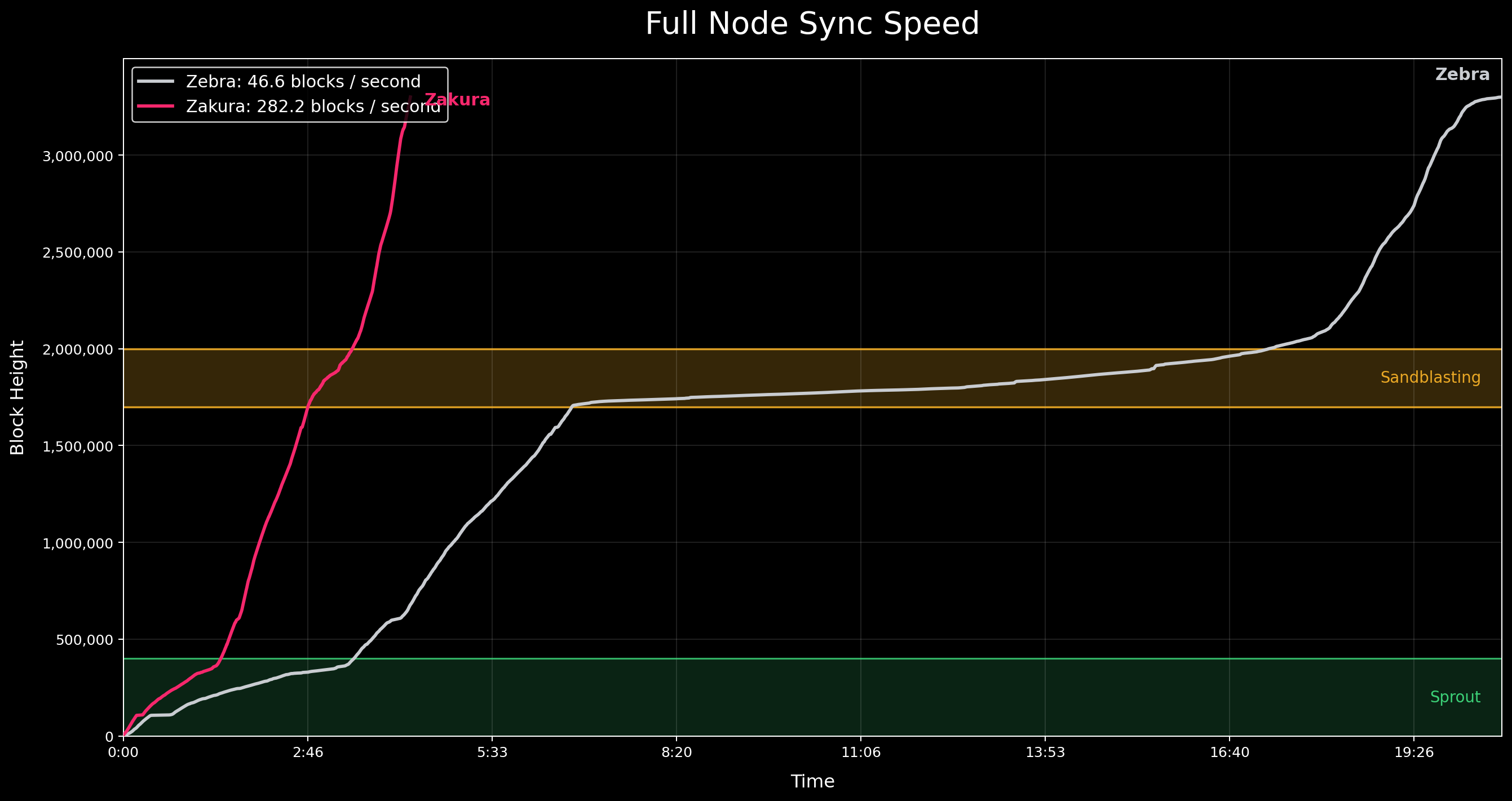
Full-node sync speed chart showing Zakura ~282.2 blocks/sec vs Zebra ~46.6 blocks/sec — visual evidence of Zakura’s ~5× faster sync performance, relevant to scaling toward 50k TPS. — Source: Zakura (announcement)
What does this mean for fees, confirmations, and the user experience?
If the network can validate and propagate blocks faster and more consistently, you open the door to tighter confirmation expectations and a smoother checkout flow. That doesn’t automatically cut block times or rewrite fee markets, but it makes the system less brittle when demand surges. Wallets can show better fee estimates and more confident “payment seen” states.
For merchants and PSPs, the interesting bit is private receipts at near card-like UX. You still need policy around how many confirmations are acceptable for risk tolerance, and you’ll want solid double-spend detection. But a network that stays snappy under load gives operators real options: authorize now, settle in a few blocks, and move on.
End users mostly care about two things: that payments go through quickly, and that they remain private. If Zakura’s approach shortens cold-start syncs and keeps nodes caught up, more services can plug in Zcash support without wrestling a days-long bootstrapping process. That’s how you get extra endpoints, extra liquidity, and a friendlier UX at the edges.
How does this stack up against other rails in 2026?
Different tools, different tradeoffs. Bitcoin plus Lightning aims for speed via channels and off-chain routing, but native privacy is limited without extra layers. High-throughput L1s can push eye-popping TPS, though privacy is usually optional or partial. Monero keeps privacy front and center but has its own performance profile and network design. Zcash with Zakura is taking the path of making private-by-default transactions cheaper to run and faster to move.
If Zakura’s roadmap lands, Zcash could offer something rare: strong privacy with operational characteristics that don’t scare exchanges and payment processors. That’s a competitive wedge. But the 50k TPS banner is a multi-year climb that includes protocol, clients, wallets, and infra providers rowing in the same direction.
Common Mistakes
- Assuming 50,000 TPS is live today. It’s a target. Benchmarks show speed-ups, not a present-day network ceiling. Plan capacity accordingly.
- Upgrading production fleets without staging. New full-node implementations need burn-in time. Shadow test, record metrics, then roll wider.
- Ignoring propagation metrics. Validation wins can be erased if blocks arrive late. Monitor worst-case, not just averages.
- Under-provisioning storage and I/O. Faster nodes process more data. Provision SSDs generously and watch write amplification.
- Missing privacy side-effects. Aggressive mempool rules or deterministic ordering can leak patterns. Review policies with a privacy lens.
If you want more ongoing coverage on infrastructure that actually ships, we break this stuff down every week at Crypto Daily.
Frequently Asked Questions
Is Zakura a new blockchain or a fork of Zcash?
Neither. It’s a full-node implementation that follows Zcash consensus. You can run it alongside other Zcash nodes in the same network. No chain split implied by installing the software.
Do I need to migrate from Zebra or other nodes right now?
No. There’s no forced migration. Operators can evaluate Zakura in test or staging, compare resource profiles and behavior, and decide if and when to adopt it. Mixed fleets are common in healthy ecosystems.
Does the 50,000 TPS target require protocol changes?
Most likely, yes. Node-level speed helps a lot, but sustained high TPS generally leans on protocol decisions like block sizing, fee markets, and possibly layered constructions. Zakura’s work reduces friction and buys headroom, but it’s not a magic wand.
What’s the current reality on validation costs?
They’re meaningful. For example, Zebra 6.1.0 notes a block near the size limit packed with minimal single-input transactions could take over 52 seconds to validate on fast hardware, which underscores why optimization matters Zcash Foundation (Zebra 6.1.0 Release).
How do I safely trial Zakura in production-like conditions?
Spin up a parallel node, bootstrap from a snapshot if supported, verify binaries, and mirror the same peers as production where possible. Compare block arrival times, mempool shapes, CPU usage, and downtime rates for at least a few days of normal traffic plus one stress window.
Will wallets or exchanges need to change anything?
Most RPC patterns remain similar, but throughput-centric nodes can expose different operational characteristics. Expect to revisit fee estimation, mempool policies, and monitoring. For exchanges, recheck deposit confirmation rules once you see live performance.
Is any of this investment advice?
No. This is about infrastructure and performance characteristics. Zcash remains volatile, and throughput targets are engineering goals, not guarantees of future price or adoption.
Disclaimer: This article is provided for informational purposes only. It is not offered or intended to be used as legal, tax, investment, financial, or other advice.
Related Stories