Licensed Web3 Casinos and What Anjouan Regulation Covers
 Crypto Daily
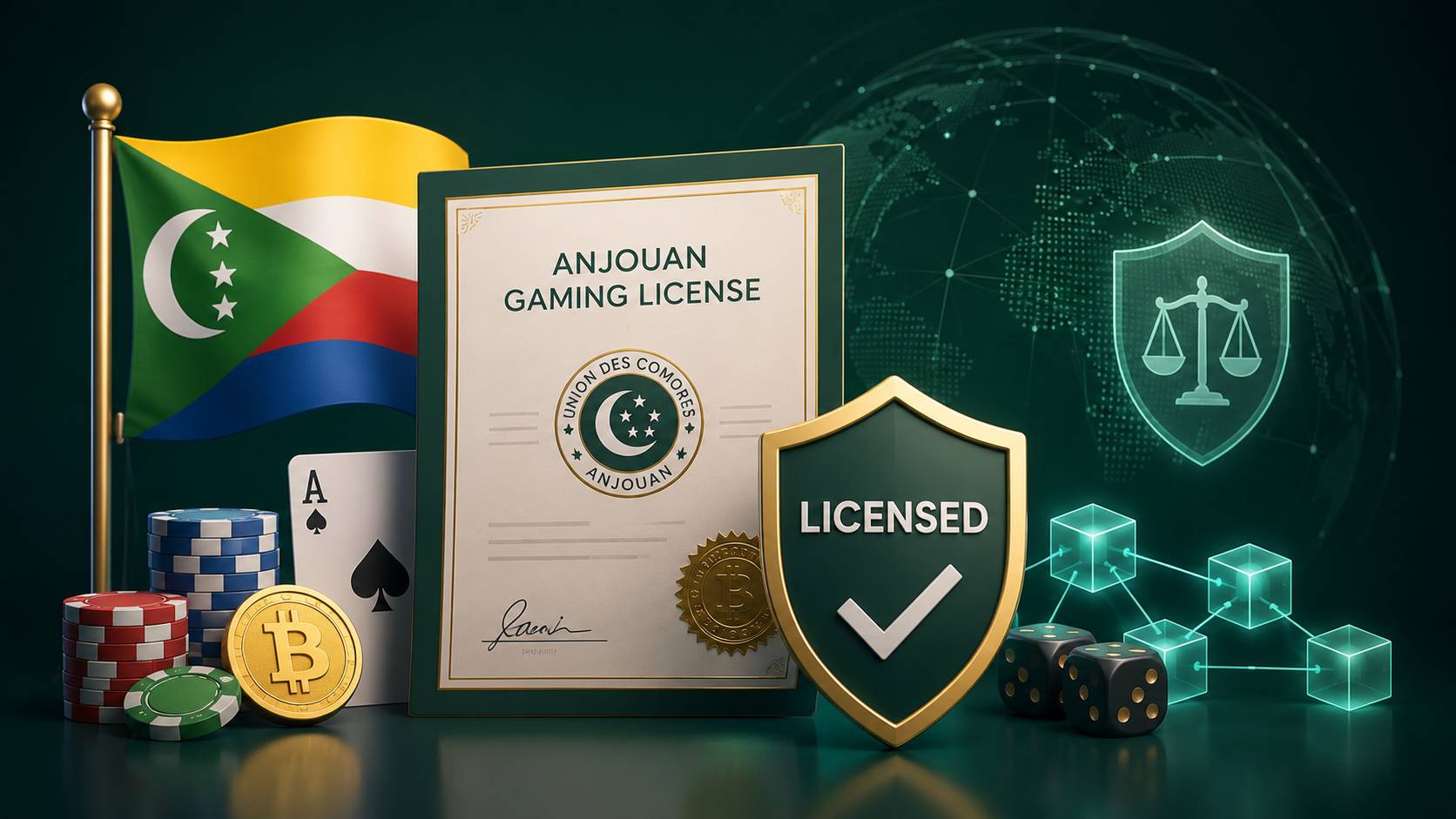
Most web3 casinos that describe themselves as licensed are licensed in Anjouan, an autonomous island in the Union of the Comoros. The word appears on footers across the industry, and almost nobody reading it knows what it actually buys them.
An Anjouan licence is a real statutory authorisation with real obligations attached. It is also a lighter regime than Malta or the United Kingdom, and the distance between those two facts is where a player's expectations should sit.
A Statutory Regime, Running Since 2005
Anjouan has operated a remote gambling framework for two decades. The legal foundation is the Computer Gaming Licensing Act of 2005, paired with money-laundering prevention legislation from the same year.
Together they define which activities need authorisation, how applications work, and what a licensee owes afterwards.
Supervision runs on two tiers. The Anjouan Betting and Gaming Board handles gaming oversight and technical integrity, while the Anjouan Offshore Finance Authority provides financial supervision, fit-and-proper assessment, and anti-money-laundering compliance.
A designated administrator processes applications and maintains the register of licensed companies.
The authority can suspend or revoke a licence where an operator fails to meet its conditions. That is not a nominal power on paper; it is the mechanism that makes the rest of the framework mean anything.
One Licence Covers Every Vertical
The structural difference from other regimes is scope. Several jurisdictions require a separate product licence for each activity.
Anjouan instead issues a single comprehensive authorisation covering online casino, sportsbook, live casino, poker, lotteries, and virtual games, across both operator-facing and supplier-facing activity.
That design is the reason the jurisdiction attracts crypto-first platforms. One permit, one framework, one set of conditions, at roughly €17,000 in fees against considerably higher costs in Curacao or Malta, with shorter processing.
Cost is not a criticism by itself. It does explain the population: startups, crypto-native brands, and platforms that want a route to market without a Tier-1 regime's overheads.
Scope and Its Limits, Side by Side
Reading the scope precisely beats treating the word licensed as a binary.
|
The licence does cover |
The licence does not cover |
|
Anti-money-laundering and counter-financing obligations |
Authorisation to target locally regulated markets |
|
Responsible gaming requirements on the operator |
Membership of national self-exclusion schemes |
|
Fit-and-proper assessment of owners and directors |
Deposit protection of the kind Tier-1 regimes mandate |
|
Technical certification and fair-play conditions |
A well-resourced independent disputes body |
|
Suspension and revocation powers for non-compliance |
Player recourse comparable to Malta or the UK |
Recent changes have tightened the middle ground. The jurisdiction introduced recognition certificates for business-to-business suppliers and strengthened anti-money-laundering and identity-check requirements through 2025 and 2026, which cuts against the idea that offshore licensing stands still.
The Excluded Territories Are the Part Players Miss
An Anjouan licence carries a restricted list, and it is longer than most players expect. The United States, the United Kingdom, France, Germany, the Netherlands, Spain, Australia, Austria, the Comoros Islands, and jurisdictions on the FATF blacklist all sit outside it.
The reason matters. An Anjouan authorisation supports an offshore operating structure; it does not by itself authorise player acquisition in a country that requires its own local licence.
Market access is judged on more signals than a footer badge, including player location, payment routing, language, and marketing.
For a player, the practical translation is short. A licensed platform is not licensed everywhere, and the licence says nothing about whether you personally are permitted to use it. That question is answered by the law where you live, not by the operator's credential.
Licensing Is One Signal Among Several
A licence is a real signal, and it is worth knowing precisely which signal. It tells a player four things:
-
A named legal entity stands behind the brand, not an unnamed operator reachable only through a support form.
-
Terms are published, so the rules governing a withdrawal can be read before depositing instead of being discovered afterwards.
-
An authority can suspend or revoke, which is what gives those published terms any weight at all.
-
AML and responsible gaming obligations attach, and they are conditions of holding the licence, not a voluntary policy.
That is meaningfully more than an unlicensed site offers. It is also not the same as a guarantee of good behaviour, and the distance between those two is where disappointed players usually live.
In practice, regulation is one of several checks, alongside published terms, withdrawal policy, and, on a Web3 platform, whether the code has been independently audited. No single one carries a platform on its own.
Dexsport Answers All Four Checks
A worked example lands harder than a principle. Dexsport clears every axis above instead of leaning on the badge alone:
-
Licence: Anjouan, bringing a named operator, published terms, AML and responsible gaming obligations, and an authority able to act.
-
Code: independently audited by CertiK and Pessimistic, which is a layer no gaming licence examines.
-
Custody: non-custodial, so funds settle to a wallet the player holds. A dispute and your balance never share an address.
-
Record: a public on-chain desk, where a wager and its outcome are logged independently of any dashboard.
Very few platforms in this category clear all four. Most present the licence and stop, which is precisely why the checklist is worth running.
The four also compound. A licence constrains the operator's conduct, an audit examines the code that the operator runs, self-custody settles where the money physically sits, and the ledger records what actually happened.
Dexsport runs a hybrid model, setting odds off-chain and writing settlement on-chain, and that design is what makes the fourth check possible at all: a payout you can verify against a public ledger instead of taking on trust.
Reading a Licence Badge Properly
Anjouan regulation is genuine and it is light. It imposes AML duties, responsible-gaming requirements, and fair-play conditions on operators, backed by suspension powers, and it does not deliver the deposit protection or dispute machinery a Tier-1 regime does.
Knowing which of the two you are getting is what reading the badge is for.
Confirm what is legal where you live, keep stakes within a set budget, and play only if you are of legal age, since KYC or AML checks may apply. Responsible gambling sits with the player on any regime, and it sits there more heavily on a lighter one.
Disclaimer: The information here is provided for general purposes only and is not legal, tax, investment, or financial advice. Licensing frameworks, restricted territories, and platform terms vary and change over time, so confirm current details before depositing. Betting carries risk, and rules vary by country, so check the law where you live. Please gamble responsibly, within your means, and only if you are of legal age.
Related Stories