Uniswap Price Outlook for November: $5 Holds the Line as UNI Burns Stall on X Layer
 Alex Carter

Three Things to Know
- Uniswap Labs said a bridge mismatch on X Layer has trapped protocol fees and halted the matching UNI burns.
- UNI sits under both its 50-day and 200-day averages, and momentum gauges still favor sellers.
- Traders are watching whether the round $5 floor survives, since the chart shows little support beneath it.
Uniswap's automatic token burns on X Layer have stopped. The fee releaser relied on a bridge route that the network rejects, so collected fees sit stranded and no UNI gets destroyed. A fix exists only in draft code.
The timing hurts. UNI just suffered a harsh week, and crypto sentiment has sunk into extreme fear. Traders now face one question: can buyers keep defending the round-number floor while repairs crawl through review?
A Bridge Mismatch Leaves $300,000 in Fees Unburned
Uniswap Labs disclosed on Nov. 6 that protocol fees collected on X Layer could not be released. The fee switch on that network went live through Proposal 95, which executed on March 8.
Burns follow a simple loop. Searchers supply UNI to claim accrued fee assets, and the UNI they hand over is destroyed. The releaser contract installed for X Layer tried to move tokens through an OP Stack bridge route. X Layer's version of that bridge rejects ERC-20 transfers, including UNI, because the network moves tokens through Agglayer instead.
A code change labeled PR 167 estimates that about $300,000 in fees could be swept into the TokenJar. It warns that restarting with the fixed 2,000 UNI payment could hand the whole backlog to the first searcher. The proposed repair adds a new XLayerReleaser routed through Agglayer. A declining auction would start at 80,000 UNI and fall toward a 2,000 UNI floor with a two-day half-life. The price would reach that floor in about 10.8 days.
None of this is approved or live. As of Nov. 15, the main fix (PR 169) remained a draft. Two related code changes were still open.
UNI Trades Under Both Averages After a Brutal Month
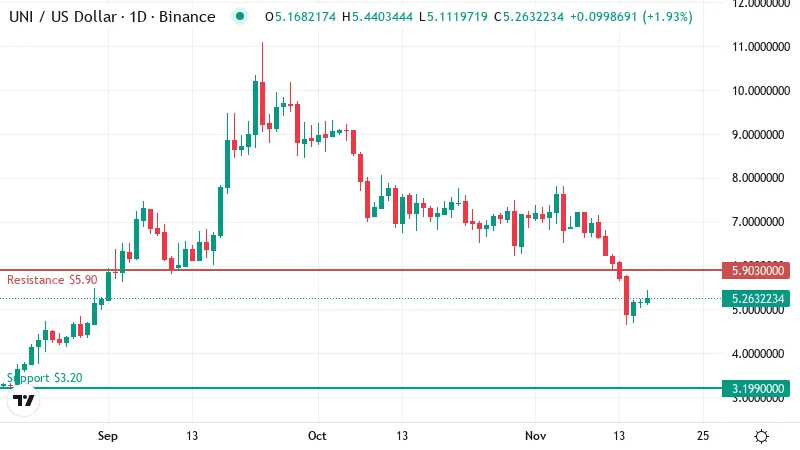
UNI traded near $5.25 at last check, up about 2% over the past day. That small gain does little to repair the damage. The token has lost roughly 25% in a week and about 26% over the past month.
Nearly all of the monthly decline came in the last seven days. Buyers who held through October gave back most of their gains in a single sharp leg lower.
A moving average smooths out daily swings to show the typical price over a set period. UNI now trades below its 200-day average near $5.73, a line that often separates long-term uptrends from downtrends.
UNI sits even further from its 50-day average. That line sits around $6.74, well above the current price. With UNI under both averages, each one now acts as a ceiling, and any rally has to climb through them before the trend can turn.
Broader sentiment offers no cushion. The Crypto Fear & Greed Index reads 12, deep in "Extreme Fear" territory. Traders are cutting risk, and smaller tokens like UNI tend to feel it first.
The glitch lands at an awkward moment. Each burn shrinks the supply, which gives holders a simple reason to own UNI. That argument weakens just as the price needs support.
Stalled burns alone do not explain the slide, but they remove one reason for buyers to step in early.
Sellers Still Steer Momentum Despite the Bounce
The bounce has not changed the tone of the momentum gauges. RSI, a 0 to 100 gauge of momentum, sits near 34. That reading is weak, but it stays above the oversold line at 30.
That leaves room for further losses before sellers look exhausted.
MACD, a tool that compares short and long price trends, is still below its signal line. That means momentum is still pointing down even after the latest uptick. Trend strength readings also confirm a real downtrend, and sellers are the ones driving it.
The signals suggest a short break in the selling, likely driven by traders covering short positions. A true turn would need RSI to climb back toward neutral and momentum to flip higher. Until then, the bounce looks like relief inside a falling market.
$5.90 Caps the Recovery While $3.20 Waits Below
The first ceiling sits near $5.90. That level marks where recent rallies stalled and sellers took control. A close above it would also put UNI back over its 200-day average, which would be the first real sign of repair.
Above that, the next resistance waits around $6.61. Clearing both would move UNI back toward its 50-day line and test whether buyers can hold gains.
Below the price, the picture is thinner. The round $5.00 area acts as the near-term floor. Buyers stepped in there during the latest drop, and traders tend to defend round numbers.
Losing that floor would open a wide gap down to the next support near $3.20, with few clear stopping points between.
A break below that level would leave UNI without a marked floor.
What Decides the Next 72 Hours
Two levels will set the tone for the coming sessions.
- Bullish: If buyers keep defending the round-number floor and UNI posts a daily close above the first ceiling, the path opens toward the second resistance zone. That close would also put the token back over its 200-day line. A slip under the round-number floor cancels this setup.
- Bearish: A daily close beneath that same floor would expose the wide gap down to the lower support. This view fails if UNI reclaims the first ceiling.
Repairs Matter Less Than Holding $5
UNI leans bearish until buyers reclaim the first ceiling on a daily close. The X Layer fix could restore burns, but the draft code still needs review and a governance vote. That makes it a slow catalyst. Delays there, paired with extreme fear across crypto, could tip the token through its floor before any repair goes live.
Disclaimer: This article is provided for informational purposes only. It is not offered or intended to be used as legal, tax, investment, financial, or other advice.
Disclaimer: This article is provided for informational purposes only. It is not offered or intended to be used as legal, tax, investment, financial, or other advice.
Related Stories