Sui Price Outlook for December: One Level Remains Critical After Hashi Goes Live
 Alex Carter

Quick Take
- Hashi is now live on Sui mainnet, letting Bitcoin holders borrow USDC without selling their BTC.
- SUI still trades below both key moving averages, and momentum keeps pointing lower.
- One support level now decides whether buyers have any floor left in December.
Bitcoin holders can now borrow USDC against their coins on Sui. The Hashi protocol went live on mainnet this week, opening a door to the largest pool of capital in crypto.
The launch lands at an awkward moment for SUI. Sellers have controlled the token for a month, and the new product has not changed that. Traders now want to know whether the chart can hold long enough for Hashi demand to show up.
Why Is Sui Falling Even After Hashi Went Live?
Sui is falling because a month of steady selling has outweighed the Hashi launch, at least for now. The new Bitcoin lending product has not turned the chart.
On Wednesday the token traded near $0.69, down about 3% in a day. The token has lost roughly 15% over the past week and about 34% over the past month. Sellers have kept control through the whole stretch.
New infrastructure rarely moves price on launch day. Hashi needs Bitcoin holders to deposit BTC, take loans and generate fees before it shows up in network activity. That process takes weeks or months.
Price works on a shorter clock. Traders are reacting to broader selling today, so the long-term story and the daily tape point in different directions.
What Is Hashi and Who Can Use It on Sui?
Hashi is a lending tool on Sui that lets anyone holding Bitcoin borrow USDC, a dollar-pegged stablecoin, without selling their BTC. The protocol runs on Sui mainnet as Bitcoin finance infrastructure for the network.
The appeal is simple. A Bitcoin holder can unlock cash for spending or trading while keeping exposure to BTC. The coins serve as collateral, and the loan comes out in stablecoins.
For Sui, the upside lies in who might show up. Bitcoin is the largest pool of capital in crypto, and most of it sits idle. If a slice of it moves onto Sui as collateral, the network could gain liquidity, users and fee income.
That potential remains untested. The project has not disclosed deposit figures, loan volumes or the names of the people behind it.
How Low Can SUI Go in December?
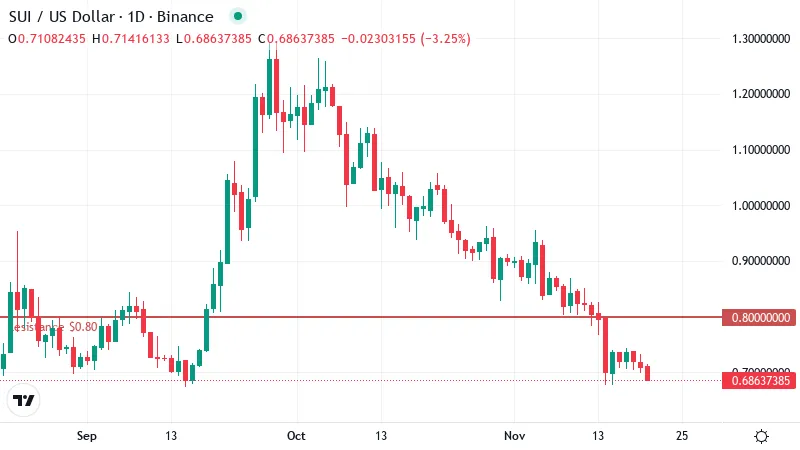
SUI trades below its 50-day average near $0.87. It also sits under its 200-day average near $0.94. Both lines now act as ceilings overhead. Trend strength readings confirm a real downtrend, and sellers are the ones driving it.
RSI, a 0 to 100 gauge of momentum, sits at 31. That puts the token close to oversold territory, where selling often starts to tire. Momentum is still pointing down, though, so the chart shows no reversal signal yet.
The key floor sits near $0.56, the green line on the daily chart. The data shows no clear support below it. A break under that level would leave buyers without an obvious place to step in.
Any bounce faces resistance first near $0.80. Above that, sellers are likely waiting around $0.95, close to the 200-day line. SUI would need to clear both before the Hashi story can show up in price.
What Should SUI Traders Watch This Week?
Three things will tell traders whether the Hashi news can start to matter.
- The green support line. A close below it would open the way to further losses.
- The first red resistance line. A move back above it would be the first sign that sellers are tiring.
- Early Hashi usage. Rising BTC deposits and USDC loans would show real demand reaching Sui.
Disclaimer: This article is provided for informational purposes only. It is not offered or intended to be used as legal, tax, investment, financial, or other advice.
Disclaimer: This article is provided for informational purposes only. It is not offered or intended to be used as legal, tax, investment, financial, or other advice.
Related Stories