Can Bitcoin Reclaim $80K Before the SEC Rewrites the Rules for Crypto Funds?
 Alex Carter

Three Things to Know
- Grayscale opened in-kind contributions on ten crypto funds while the SEC weighs tighter rules for novel products.
- Bitcoin trades under its 50-day average, and momentum still favors sellers.
- A thin cushion above the 200-day line may decide whether this stays a routine pullback.
Grayscale Investments now lets large holders swap coins for shares in ten of its crypto funds. The move lands as the SEC openly asks whether its rules still fit products that reach well beyond bitcoin.
Bitcoin funds sit in the most established corner of that market. The coin itself looks tired after weeks of slow selling. Traders want to know if buyers can retake the short-term trend before regulatory caution weighs on sentiment.
Grayscale Opens the In-Kind Door as the SEC Questions Its Own Rulebook
Grayscale Investments widened in-kind contribution access to ten digital asset products on October 21, 2026. The list runs from the Bitcoin Mini Trust ETF and the Ethereum Staking Mini ETF to funds tied to SOL, XRP, LINK, DOGE, AVAX, SUI, HYPE and ZEC. Eligible investors can hand over coins they already own in exchange for fund shares through an authorized participant. That swap can avoid a taxable sale.
Most retail buyers will not see the feature soon. Minimums start near $80,300 for the Solana product and climb to about $364,800 for the Bitcoin Mini Trust ETF. The change builds on the SEC's July 2025 decision to allow in-kind creations and redemptions for crypto ETPs.
The regulator is also questioning its own framework. On June 30, 2026, the SEC opened a request for comment on novel ETFs. It posed 27 questions before the window closed August 31. The agency asked whether funds holding mostly non-securities should be commodity trusts. It also floated concentration caps and a slower path to automatic effectiveness. Staking funds drew scrutiny over lock-ups and their ability to meet redemptions.
Rules for newer products may tighten, while bitcoin funds face less uncertainty.
Bitcoin Slips Under Its 50-Day Line but the 200-Day Still Holds
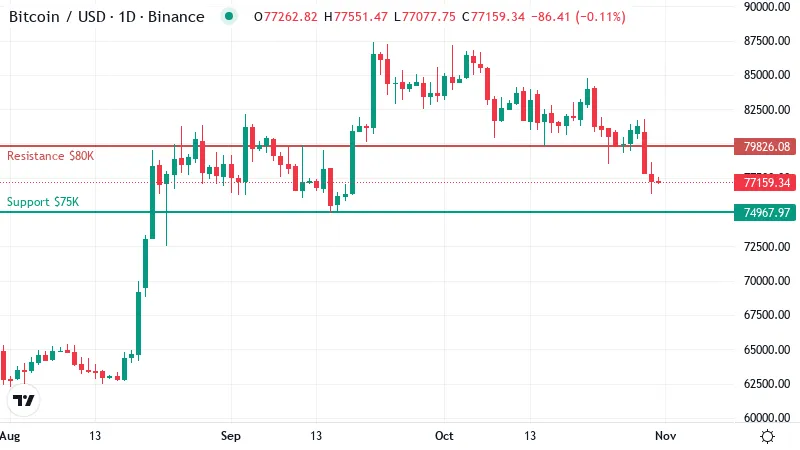
Bitcoin traded near $77,000 on Friday, flat over the past 24 hours. That quiet session followed a rough stretch. The coin lost about 5% over the week and roughly 8% over the past month.
The monthly decline came in small steps, with no single panic session. Steady drift like this often reflects tired demand rather than forced liquidations.
A moving average smooths out daily noise by tracking the average closing price over a set number of days. The 50-day average shows the recent trend. The 200-day average shows the long-term one. Traders watch both to judge whether a move has staying power.
Bitcoin now sits below its 50-day average, which runs near $80,000. That line has turned into a ceiling. Any rally toward it will likely meet sellers who bought higher and want out at breakeven. A clean move back above it would hand buyers the short-term trend.
The longer picture looks healthier. Bitcoin still holds above its 200-day average, which sits near $76,000. As long as price stays above that line, the multi-month uptrend remains intact.
That cushion is thin, though. Only about $1,000 separates the current price from the 200-day line. A daily close beneath it would shift the story from a routine dip to a possible change in trend.
Sellers Still Hold the Momentum Edge
RSI, a 0 to 100 gauge of momentum, reads 34 on bitcoin's daily chart. That puts the coin in weak territory, just above the oversold zone that starts at 30. Sellers have the upper hand without pushing the market to an extreme. That leaves room for more downside before a relief bounce.
The MACD tells a similar story. It measures how quickly short-term prices are moving relative to longer-term ones. Right now it sits below its signal line, which means momentum still points down.
Trend strength offers one caveat. Readings show no strong trend in either direction. Bitcoin is drifting and chopping without a hard breakdown. That pattern fits a market waiting for clarity, including any word from the SEC on how far its stricter ideas will reach.
Why $75K Matters Most
The first line to watch sits just below the market. Bitcoin's nearest support rests near $75,000, only a short step under the 200-day average. The two levels together form one defensive zone, and buyers have reason to guard it.
Losing that zone would hurt. The next floor in the data sits near $65,000, so a break could open a wide air pocket with few obvious places to stop. A slide that deep would also put the long-term uptrend in serious doubt.
Upside targets look closer and smaller. Nearest resistance lines up with the 50-day average, so a move through it would deliver two signals at once.
The next resistance waits near $82,000, close enough to cap a first rally. Buyers would need to clear that level before talk of a fresh leg higher holds up.
Two Paths for the Next Three Days
- Bullish: A close above the 50-day average would put the next resistance level in play. The setup fails if price slips back under the 200-day average.
- Bearish: A close below nearest support would expose the deeper floor flagged earlier. Sellers would then control both the short and long-term picture. The setup fails if bitcoin climbs back above the 50-day line.
Bitcoin Needs Proof Before It Gets the Benefit of the Doubt
Bitcoin remains in a pullback inside a longer uptrend. Buyers need a firm close back above the 50-day line to regain control.
The risks lean the other way for now. A stricter SEC stance on novel funds could sour sentiment across crypto. With support so close underneath, a wrong call on the bounce would cost more.
Disclaimer: This article is provided for informational purposes only. It is not offered or intended to be used as legal, tax, investment, financial, or other advice.
Disclaimer: This article is provided for informational purposes only. It is not offered or intended to be used as legal, tax, investment, financial, or other advice.
Related Stories