Tokenized Funds for Pension Portfolios: Why Collateral Mobility Matters More Than 24/7 Trading
 Lena Carter

Pension funds are not chasing the same things as day traders. They care about stable collateral, predictable cash flows, and moving assets precisely when funding and margin windows open and close. If tokenization helps, it is usually not because you can trade at 3 a.m. It is because your collateral can move at 3 a.m. if it has to.
That sounds like a small nuance. It is not. The practical win here is collateral mobility, not the headline of 24/7 markets. Think shorter settlement cycles, cleaner margining, and less dead, idle capital sitting on the sidelines.
So let’s cut through the noise and look at how tokenized funds, especially money market funds, could slot into pension portfolios without introducing drama.
| Point | Details |
|---|---|
| Mobility over trading hours | Moving collateral quickly between venues and custodians often beats the benefit of trading non stop, especially for margin and liquidity buffers. |
| Capital efficiency | Industry analysis cited by GDF and ISDA suggests up to about 200 bps of capital could be unlocked via faster settlement and always on collateral flows GDF / ISDA report. |
| Real world traction | Broadridge’s DLR processed $7.5T in June repo volumes, showing market plumbing is going digital at scale Broadridge. |
| Tokenized MMFs are growing | Tokenized money market funds have topped $15B AUM, and broader RWA ex stablecoins is around $31B, per reporting CoinDesk. |
| Policy backdrop | The CFTC is even asking about 24/7 futures, but pensions mostly want operational certainty and collateral portability CFTC. |
Why 24/7 trading is not the point for pensions
Round the clock trading is a nice headline, but it rarely makes a chief investment officer sleep better. For pensions, the question is not can we trade at midnight, it is can our collateral be where it needs to be by the next margin call, or within the same hour if the market jolts.
There is a policy trend toward extended hours. The CFTC even opened a comment process in June on whether standardized futures could run 24/7 and how to handle perpetuals on certain commodities, with comments due in late July CFTC. That might matter for market microstructure over time. But for pensions, extended hours can actually add operational burden unless collateral, settlement, and custody process the same way. You do not want a mismatch where trades can happen at 2 a.m., but your collateral release is stuck waiting on office hours.
The big unlock is removing those mismatches. Tokenized funds can help because the asset is programmable and can settle on rails that are not throttled by batch windows. That is the whole game.
How tokenized funds unlock collateral mobility
Tokenized MMFs as portable, high quality cash
For many pensions, the workhorse is cash and cash like instruments. Tokenized money market funds sit in that sweet spot. They hold the same underlying assets as their off chain equivalents, but the ownership interest can move faster between approved wallets and venues, often with more precise settlement timing. That mobility can cut waiting time that used to be measured in hours or even days.
It is not just theory. An industry report and sandbox run by Global Digital Finance and ISDA, with input from more than 300 participants across about 120 firms and a 48 firm sandbox cohort, laid out practical pathways for collateral mobility using U.S. tokenized MMFs GDF / ISDA report page. Their published analysis points to meaningful capital unlocks when collateral can move and settle faster.
Capital relief and daylight liquidity
The same report also noted that big daylight liquidity buffers exist in legacy rails. For context, Fedwire daylight buffer averages have been cited around 630 billion dollars historically in the analysis, which is expensive to support. If you can reduce daylight exposures via faster collateral movement and near instant settlement finality within permissioned networks, you may lower those buffers and free capacity for other uses GDF / ISDA report.
That is where the estimate of up to roughly 200 basis points of capital potential comes from in industry analysis referenced by the report. Of course, results vary by balance sheet, counterparty set, and how you implement. But the direction of travel is clear.
Programmable workflows you can actually use
Once money like fund shares can be moved on a shared ledger, you get composability. Margin calls can trigger collateral moves under smart contract logic. No need to re enter the same instruction five times across systems. You can tag assets for specific purposes, set haircuts in code, and see audit trails that help operations teams reconcile quickly.
Think of it less as trading crypto style and more as upgrading your collateral conveyor belt so it runs on time, all the time.
Proof points from the market plumbing
We tend to look for real world volume as a smell test. In June, Broadridge reported that its distributed ledger repo platform handled 7.5 trillion dollars in volume, with an average daily volume of 357 billion dollars, up 68 percent year on year Broadridge. That is not a pilot on a whiteboard. It is large participants using digital rails to fund and collateralize positions at scale.
Repo and margin are cousins. If repo flows can live on shared ledgers with predictable settlement, the same architecture can support tokenized fund shares posted as collateral. The message for pensions is simple. You are not being asked to jump to an untested rail. You are adding a tokenized cash sleeve to a rail that is already moving trillions.
Also notable, tokenized MMFs have quietly built a real base of assets, with more than 15 billion dollars in AUM per recent industry reporting, and on chain RWA categories outside of stablecoins around 31 billion dollars CoinDesk. Scale will not fix every problem, but it tells you who is showing up.

Design choices that matter, not buzzwords
Choose the wrapper before the chain
The legal wrapper is the anchor. For U.S. money market exposure, pensions will usually want an established ’40 Act fund structure or equivalent in their jurisdiction, with a known transfer agent and a recordkeeping method that regulators already understand. The token is a share representation, not a new asset class. Make sure your investment guidelines allow it.
Permissioned versus public and access controls
Public chains offer open liquidity. Permissioned networks can offer tighter KYC, whitelists, and stronger control over who can hold or move shares. For pensions posting collateral to known counterparties, a permissioned setup is often simpler from a compliance lens. Some models use a public chain with strict transfer restrictions. Either way, confirm that travel rule and sanctions filters work in practice, not just on a slide.
Settlement finality and cutoffs
What does final settlement mean on your chosen rail. Who is the notary or sequencer, who signs off on state, and what are the cutoff times that your custodians and counterparties will honor. You want the boring details. If your fund NAV strikes at a certain window, know when share transfers post to the register and when they are recognized for collateral eligibility.
Valuation, NAV, and oracles
Money market funds price daily and sometimes intraday in stress. You need reliable valuation feeds and a clear process for how the on chain share mirrors the off chain NAV. If the oracle lags, your haircut might be stale. Bake in conservative haircuts for stress scenarios and make them adjustable by agreement.
Pro tip: Ask for a dry run of the full instruction path for a collateral call. From your OMS to custodian to fund admin to chain and back. Time it. The stopwatch never lies.
An operating model for a pension, step by step
- Define use cases. Start with a narrow track like posting tokenized MMF shares as initial margin to a single counterparty, or as overnight liquidity backstop for FX hedging.
- Map the stack. Identify the fund provider, transfer agent, primary custodian, digital asset custodian or wallet, settlement network, and each counterparty that must whitelist your address.
- Write the playbook. Document cutoff times, approval flows, who clicks send, and what happens if a transfer fails. Include a fallback to legacy rails.
- Negotiate haircuts and eligibility. Get collateral schedules updated in writing. Agree on stress add ons and a dispute mechanism for NAV or oracle issues.
- Pilot with real but small size. Pick a window where you know margin calls typically hit. Move collateral on the new rail and reconcile within your accounting system.
- Expand to multiple venues. Once you trust the workflow, roll it out to a second counterparty to confirm portability. Monitor settlement timing closely.
- Automate guardrails. Add policy checks so transfers above a threshold require two signers, and set alerts for address changes or contract upgrades.
Comparing liquidity and risk, plain and simple
| Instrument | Primary use | Settlement profile | Key risks | When it helps most |
|---|---|---|---|---|
| Tokenized MMF shares | Collateral and cash sleeve | Faster transfers on approved rails, subject to fund cutoffs | Smart contract, operational errors, legal wrapper alignment, oracle lags | Margin calls, repo funding, liquidity buffers that need precision timing |
| Bank deposits | Operating cash | Same bank rails, batch windows | Counterparty and concentration risk, potential transfer delays | Payroll, vendor payments, short term cash but less portable for collateral |
| Direct T bills | Yield and liquidity | Settle on securities rails, not instantly mobile across venues | Settlement cutoffs, allocation frictions, custodian dependencies | Buy and hold cash management when you do not need quick rehypothecation |
No instrument is perfect. The point is to pick the tool that matches the job. If the job is to meet moving, intraday, multi venue collateral demands, tokenized MMFs can fit well, provided the legal, operational, and risk boxes are all ticked.
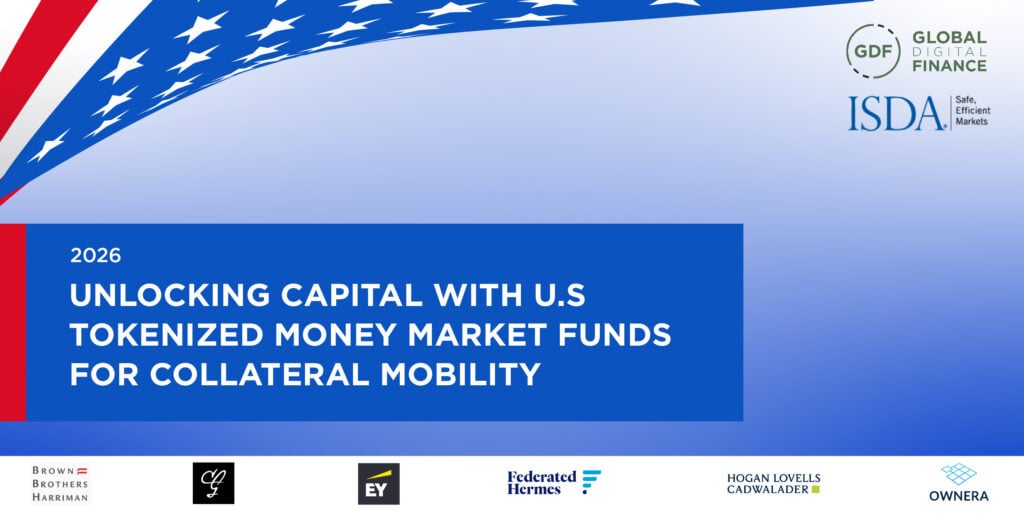
Cover image of the GDF / ISDA report “Unlocking Capital with U.S. Tokenized Money Market Funds for Collateral Mobility” (July 2026) — shows the published report and sponsor/logos, confirming the industry sandbox and institutional participation that underpin the collateral‑mobility findings. — Source: GDF / ISDA report (cover image)
Mistakes to avoid when piloting tokenized funds
- Chasing 24/7 trading as the goal. For pensions, it is a distraction. Focus on settlement windows and collateral calls.
- Skipping the wrapper review. Make sure the fund’s prospectus and your policy statements explicitly allow tokenized share classes or representations.
- Underestimating address whitelisting times. Counterparties need to approve addresses. Build in days, not hours, the first time.
- Ignoring operational rehearsals. Run tabletop exercises for failed transfers, oracle outages, and rollbacks.
- Letting the oracle set the haircut. Agree on conservative haircuts that do not collapse if the feed lags or the chain congests.
- Forgetting about upgrades. Smart contracts change. Track versioning and require notice periods and re approvals for material updates.
What to watch in 2026, policy, plumbing, and scale
The policy conversation is moving. The CFTC request for comment on 24/7 futures and certain perpetual contracts signals that regulators are thinking about continuous markets, even outside crypto native assets CFTC. That said, the more immediate institutional pull is balance sheet efficiency. Fidelity’s Giselle Lai said it plainly in a recent interview, noting that for pensions and insurers the tokenized fund play is balance sheet management and collateral mobility, not retail style 24/7 trading. The same coverage pegged tokenized MMFs over 15 billion dollars and broader on chain RWA outside stablecoins around 31 billion dollars CoinDesk.
On the plumbing side, the Broadridge DLR volumes highlight that distributed ledger based financing can handle institutional size today Broadridge. And industry collaboration is not just talk. The GDF and ISDA effort pooled insights from more than 300 contributors across roughly 120 firms, plus a 48 firm sandbox to prove out how tokenized MMFs can move as collateral across venues GDF / ISDA report page. Expect more of these playbooks to get standardized into legal docs and ops checklists.
Big picture, 2026 looks like the year the narrative shifted. Less hype about round the clock trading, more roll up your sleeves work on capital efficiency, daylight liquidity, and workflow automation. That is where pensions live.
If you want deeper reads and level headed takes as this all evolves, Crypto Daily follows the tokenization beat closely. You can check our ongoing coverage at Crypto Daily.
Frequently Asked Questions
Do pension funds actually need 24/7 trading to benefit from tokenization
Not really. The main benefit is moving collateral with fewer timing frictions, not placing trades in the middle of the night. Faster settlement and more portable cash like fund shares can reduce liquidity buffers and streamline margining.
How could collateral mobility lower capital needs
If collateral can move and settle faster, you can hold smaller daylight buffers and reduce duplicate funding across venues. Industry analysis cited by GDF and ISDA suggests up to about 200 basis points of capital could potentially be unlocked by these efficiency gains, though it depends on each balance sheet and setup.
Are tokenized money market funds risk free
No. Even if the underlying fund is conservative, you add smart contract and operational risks, and you have to align transfer restrictions and oracles. There is also regulatory and counterparty risk. Treat it like any new rail with a full risk assessment and staged rollout.
Which chains or networks should a pension use
Pick the network that your custodians, fund providers, and counterparties actually support. Many institutions prefer permissioned or restricted environments for KYC and control. The wrapper and transfer agent rules should drive the choice more than the chain brand.
How does NAV and pricing work on chain
The token typically represents a share in an off chain fund that prices through its normal process. On chain records follow the official register. Oracles relay NAV and pricing, but haircuts and eligibility should not depend on a single feed. Build redundancy and review clauses into agreements.
Could 24/7 futures change the picture for pensions
It could matter at the margin. Continuous markets may help some hedging programs. But unless collateral, settlement, and custody also operate seamlessly across hours, extended trading alone will not move the needle for most pensions.
What should be the first step for a pension considering tokenized funds
Start with governance. Get investment policy statements and collateral schedules updated. Then run a controlled pilot with a small tokenized MMF sleeve, one counterparty, and clear fallbacks.
Disclaimer: This article is provided for informational purposes only. It is not offered or intended to be used as legal, tax, investment, financial, or other advice.
Related Stories