North Korea Crypto Hackers: How Stolen Funds Were Laundered
 Karim Daniels

If you are trying to make sense of how North Korea-linked crews move stolen crypto today, you are not alone. The playbook has gotten faster, more cross-chain, and a lot harder to catch in the first hour.
We will walk through the end-to-end flow, why the biggest 2026 heists looked the way they did, where the cash-out points sit, and what signals help you spot this traffic. This matters right now because North Korea-linked activity dominated losses in the first half of the year, and regulators have turned up the heat.
Keep this practical. No scare tactics — just how it works, where it breaks, and what you can actually do.
DPRK-linked groups typically drain funds from an exploit, push assets through cross-chain bridges and no-KYC swaps to fragment and scramble exposure, consolidate into liquid stablecoins, then cash out through OTC brokers who convert into dollars or yuan in small chunks. The pattern leans on speed, chain-hopping, and counterparties outside strict KYC perimeters. TRM Labs flagged this exact route dominating the largest 2026 heists.
- Bridge first, swap often, fragment amounts, then reconsolidate
- Prefer liquid stables for exit, often after several hops
- Use OTC brokers and P2P cash-out rails, with smurfed transfers
- Exploit-to-bridge lag is short; speed beats freezes
What does a DPRK laundering run actually look like end to end?
Think in stages. First, the compromise: a validator key leak, a bridge bug, or a governance permissions slip. The attacker drains to fresh, unlabeled addresses. That early move is fast and sometimes messy, but it shifts funds out of the victims direct control.
Next comes the scramble. Funds hit one or more cross-chain bridges. Why? Liquidity and distance. Moving away from the source chain breaks simple heuristics. Then they route into no-KYC swap aggregators or high-liquidity DEXs to convert into stables and liquid majors. Amounts get split into smaller packets, occasionally peeled through multiple wallets before reconsolidation.
Then the exit. After enough noise, flows meet a human counterparty. Thats often an OTC broker willing to take stablecoins and return fiat, or a broker that provides prefunded exchange accounts and cash-out services. According to CoinDesk, recent arrests in North Korea referenced cash conversions into U.S. dollars and yuan via Chinese OTC brokers, with transfers intentionally split into small amounts to stay under the radar.
Warning: the first hour matters most. If funds clear one or two bridges and hit liquid stables, your freeze window narrows to minutes, not days. Have a contact sheet and an escalation plan ready before you need it.
Why did Aprils big exploits dominate the dollar losses?
Because infrastructure-level hits shift big numbers in one go. In April, the Drift and KelpDAO incidents alone totaled roughly 577 million dollars across both events around 285 million and 292 million respectively. TRM Labs counted those two as the bulk of H1s stolen value and assessed that about 66% of H1 2026 hack losses overall were tied to DPRK-linked activity.
Big drains compress time. Attackers do not sit on nine-figure bags. They move quickly into bridges and no-KYC swaps, then slice flows into thin strands. That sorting and slicing early on explains why you often see sudden volume spikes on a few bridges followed by a haze of middling transfers. The mechanics favor whoever acts faster.
It also concentrated attention on the plumbing itself. When bridges and staking wrappers get hit or used as first-hop laundromats, defenders are playing catch-up. That meant April had fewer incidents but wildly oversized dollar impact, exactly what the analytics showed this year.
How do cross-chain bridges and no-KYC swaps fit into the picture?
They are the blur tool. A bridge moves assets between chains, but more importantly, it shifts context. Heuristics tied to the source chain lose resolution. No-KYC swaps and DEX aggregators take that further by converting into new assets without centralized onboarding friction, often across multiple hops.
Here is a helpful side-by-side to keep the roles straight:
| Tool | Primary role | Obfuscation strength | Bottlenecks | Compliance risk |
|---|---|---|---|---|
| Cross-chain bridge | Hop chains, escape heuristics | Moderate to high when fast and split | Liquidity, bridge monitoring, pausing | Medium; some bridges collaborate with law enforcement |
| No-KYC swap/DEX | Asset conversion without CEX | High if multi-hop and fragmented | Slippage, MEV leak, on-chain surveillance | Medium; front-ends may geoblock, contracts do not |
| Mixers/tumblers | Break address links via pools | Variable; large pools help, sanctions shrink options | Sanction risk, pool size | High if designated or sanctioned |
| OTC brokers | Fiat off-ramp, reconsolidation | High if off-ledger finality | KYC pressure, cash logistics | High; counterparty screening weak points |
TRM Labs noted that the biggest heists in H1 routinely followed this order: bridge first, swap second, then onward to exchanges or OTC. It is not that mixers disappeared, it is that bridges and swaps are faster and do not block on pool depth or sanctions lists the same way.
Bottom line: every additional hop buys the attacker time. Defenders need to cut the route earlier, ideally before the second or third conversion into stables.

Where do the cash-out points live, and who takes the other side?
Most laundering stories end with a broker. OTC desks bridge the crypto world and the cash world. They take on the risk of handling tainted assets in return for fees and speed, often using networks of shell accounts, money mules, or friendly exchangers.
Recent reporting shows how this looks in practice. CoinDesk described July arrests in North Korea tied to laundering state funds, where suspects allegedly converted crypto into U.S. dollars and yuan through Chinese OTC brokers. Transfers were split into small amounts to duck alarms. That lines up with what analytics firms have echoed for years: layering on-chain buys you time; layering off-chain tries to end the trace.
Does this always use stablecoins? Often, yes, because stables make pricing and settlement easier. But in practice, cash-out desks follow liquidity. If there is demand for a particular token pair or a corridor into a certain bank, they will route accordingly. Your risk surface is the brokers network and their screening, not the asset label.
What signals help compliance teams spot DPRK-linked flows?
You are fighting speed. You need signals that fire fast and cut false positives enough to act. Blend ML and simple heuristics. And do not ignore the little transactions; that is where the smurfing hides.
- Fresh-address to bridge hop within minutes of a known exploit
- Multi-bridge chain-hopping within 12 hours, especially into high-liquidity stables
- Bursts of small, regular transfers to broker-linked deposit addresses
- Patterns that match historical DPRK TTPs logged by analytics vendors
- Use of specific no-KYC swap front-ends shortly after a major incident
- Reconsolidation of splits into a handful of exit wallets before off-ramp
Regulatory guidance this summer also turned up the volume. Canadas FINTRAC reiterated FATF concerns and urged enhanced AML and CFT measures for potential DPRK-linked transactions on July 15, 2026. If you operate in that perimeter, you are expected to heighten screening for sanctions-evasion risk and report anomalies accordingly. See the advisory from FINTRAC (Canada).
None of this is perfect. But the combination a fast exploit watchlist, bridge activity alerts, OTC deposit label maps, and a genuine 247 escalation path moves the odds in your favor.
How are regulators and analytics firms responding in 2026?
Two shifts stand out. First, analytics are more candid about the path of travel. TRM Labs spelled out that bridges and no-KYC swaps sat at the center of the largest H1 heists. That helps exchanges and protocols know where to look first.
Second, regulators pulled the sanctions thread tighter. FINTRACs July advisory renewed pressure on reporting entities to screen for DPRK risk and escalate red flags. Internationally, that tracks with broader FATF messaging: get serious about beneficial ownership, monitor cross-chain patterns, and close obvious OTC gaps. It is not uniform enforcement across borders, but the direction is clear.
Behind the scenes, there is also more playbook sharing. Exchanges coordinate faster on freezes, some bridges can pause or throttle suspicious flows, and incident response channels are less ad hoc than they were a couple years ago. None of that stops a perfect attack, but it trims the window where launderers feel untouchable.
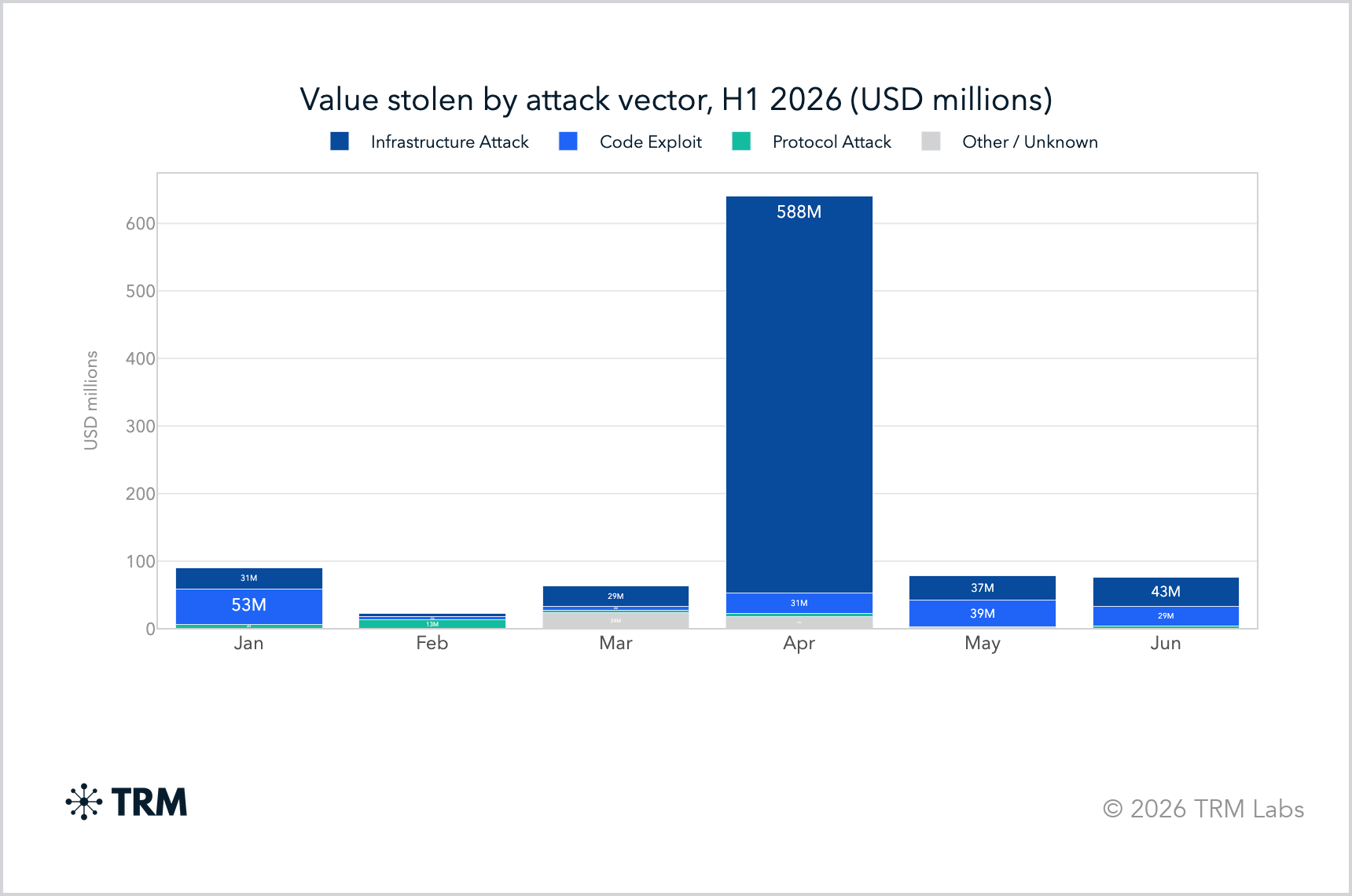
TRM Labs chart (H1 2026) of monthly value stolen by attack vector — shows April’s infrastructure/key‑compromise thefts (including Drift & KelpDAO) concentrated the bulk of dollars and illustrates the laundering attack‑vector concentration investigators must trace. — Source: TRM Labs
Can protocols and users make laundering harder right now?
Yes, and it does not require reinventing cryptography. Protocols need circuit breakers, not heroics. Exchanges need better deposit intelligence before funds arrive, not after. Users just need to avoid being the soft target that starts the whole mess.
For protocols: add rate limits on sensitive contract functions, implement time-locked admin actions, ship emergency pause mechanics, and pay real money for external audits and live bug bounties. Treat key management like production secrets, because that is exactly what they are.
For exchanges and OTC desks: enrich deposits with taint-aware scoring at mempool time when possible, run triage on bridge-originated flows, and gate withdrawals from fresh accounts that receive suspect funds in the first 24 hours. Have an incident playbook, with names and numbers, not just a wiki page.
For users: be stingy with approvals, block default approvals on novelty dApps, and revisit your revokes monthly. Phishing still funds a depressing amount of the ecosystems worst days.
Common Mistakes
- Chasing mixers only. DPRK-linked flows often lean on bridges and swaps first. Track those early hops, or you will miss the moment to freeze.
- Ignoring small transfers. Smurfing into countless sub-1k or sub-10k chunks is the point. Build alerts around patterns, not just size.
- Assuming the exit is a big CEX. Cash-outs frequently happen via OTC brokers well before any centralized exchange touch.
- Underestimating speed. If your escalation takes a day, you are escalated out of the game. Tighten to minutes.
- One-size-fits-all heuristics. Copying a Tornado-era rulebook to cross-chain traffic will drown you in false positives. Calibrate by chain, bridge, and liquidity.
If you want ongoing coverage with fewer scare headlines and more signal, you can always check in with Crypto Daily for level-headed reporting and context.
Frequently Asked Questions
Do DPRK-linked hackers still use mixers at all?
They do, but less predictably. Sanction designations and shrinking pool sizes made mixers riskier and sometimes less effective. The recent pattern has favored bridges and no-KYC swaps first, then selective use of mixers if the pool is large enough to hide in and the risk is acceptable.
Why do so many flows reconsolidate right before cash-out?
Operational simplicity. Brokers prefer to receive in a handful of wallets they control or monitor. After spreading funds to shake surveillance, launderers often gather them back into a small set of addresses to settle with OTC desks or to stage funds for fiat conversion.
Is it realistic to freeze funds after a bridge hop?
It is possible but harder. Some bridges and exchanges will act on strong signals, yet once assets land in liquid stables and pass through a couple of swaps, the certainty drops. Your best shot is coordinated action during the first hop or two, especially if the source exploit is confirmed and tagged quickly.
How did H1 2026 compare to prior years?
Fewer huge incidents, but bigger per-incident dollar values. TRM Labs counted 207 hacks totaling about 972 million dollars in H1, and assessed roughly 66% as tied to DPRK-linked actors. The concentration came from a handful of infrastructure compromises dominating losses.
What changed on the regulatory front this summer?
More explicit warnings and expectations. Canadas FINTRAC re-upped guidance to screen for DPRK exposure and escalate suspected sanctions evasion. That tone lines up with global FATF messaging: plug OTC gaps and scrutinize cross-chain activity.
Are OTC brokers always complicit?
No. Some desks have solid compliance and actively reject tainted funds. The risk sits with informal or lightly supervised brokers operating across borders. The July case reported by CoinDesk outlined brokers who allegedly helped convert stolen funds to fiat and split transfers to avoid detection. That is the behavior to watch.
Could mandatory bridge KYC solve this?
It would help some edges but not the core. Attackers would route to permissionless bridges or proxy through unwitting users. Practical gains are more likely from better monitoring, faster incident response, and targeted enforcement on recurring off-ramps rather than blanket KYC at every hop.
Disclaimer: This article is provided for informational purposes only. It is not offered or intended to be used as legal, tax, investment, financial, or other advice.
Related Stories