Base B20 Token Standard: How Native Tokens Differ From ERC-20
 Elliot Veynor

Base just switched on something big for token builders: a native token standard called B20. If you’ve been minting ERC-20s for years, B20 looks familiar on the surface — but the guts are different. This piece breaks down what changed, why it matters for issuers and traders, and what to watch next.
We’ll compare B20 to ERC-20 in plain English, walk through how the factory actually works, and flag early on-chain patterns from launch week. There’s a checklist for safe deployment and a few traps to avoid if you’re buying into new B20 tickers.
Editor's note: I watched Base’s B20 go live in early July and the first hours were exactly what you’d expect: a torrent of meme mints, identical supplies, and thin pools that moved on whispers. Our desk tested provenance checks against the 0xB20f factory and the 0xB200 token prefix, which saved time we usually waste on contract spelunking. Conversations with infra teams in July pointed to quick wallet parity but slower explorer upgrades for showing policy states. I’m keeping an eye on the fee-in-B20 plan from Base’s Cobalt notes; if that ships, user onboarding for new tokens could get a lot smoother. — Elliot Veynor
B20 is Base’s native token standard that runs as a precompile inside the node, not as a user-deployed Solidity contract. It mirrors ERC-20 function selectors so wallets and indexers treat B20 like a normal fungible token, but it adds issuer-level controls like transfer policies, role-based permissions, supply caps, freeze-and-seize, memos, and built-in permit. Base activated B20 on July 8, 2026, and has more features queued on the roadmap.
- Native precompile with ERC-20 parity for UX compatibility
- Issuer Toolkit: allowlists/blocklists, roles, caps, freeze-and-seize, memos, ERC-2612 permit
- Deterministic addresses via a factory at 0xB20f…; B20 tokens start 0xB200…
- Early activity skewed to memecoins; no real RWAs or stablecoins in first sample
- Planned ability to pay fees in B20 tokens is on Base’s roadmap
How does B20 actually work under the hood?
B20 lives inside Base’s node as a native precompile. Instead of deploying a Solidity ERC-20 contract, issuers call the B20 factory, which mints a token implementation backed by the node’s Rust code. Because the interface mirrors standard ERC-20 selectors, most wallets, indexers, and tools see a B20 token and interact with it like any fungible asset.
The factory sits at a fixed address — 0xB20f000000000000000000000000000000000000 — and tokens created by it have deterministic addresses with a distinctive 0xB200… prefix. That makes basic provenance checks faster and reduces the chance of collisions or weird proxy patterns you sometimes see with contract-based mints. These deployment details, including the selector parity and Issuer Toolkit, are documented in developer explainers and Base references (Chainstack).
Base officially activated B20 on July 8, 2026 as part of its Beryl upgrade cycle, and the upgrade changelog flags it as live on mainnet (Base — Upgrades changelog). The same roadmap notes future improvements tied to Cobalt planning entries, including a path to pay fees in B20 (more on that later).
What separates B20 from ERC-20 in practice?
Function names look the same. Everything else — the execution model, deployment flow, and built-in controls — is different. Think of ERC-20 as “you ship a contract with whatever features you add,” while B20 is “the chain ships the core logic and you flip switches from an issuer console.”
The biggest upgrade is the Issuer Toolkit. Out of the box, B20 supports role-based access, transfer policy rules (allowlists or blocklists), supply caps, freeze-and-seize via burnBlocked, optional on-chain memos, and ERC‑2612 permit for gasless approvals (Chainstack). All of that is native, so issuers don’t need to stitch together third-party libraries and hope audits catch edge cases.
| Aspect | B20 (Base) | ERC-20 (typical) |
|---|---|---|
| Implementation | Native precompile in node (Rust) | Solidity/Vyper smart contract deployed by user |
| Selector compatibility | Matches ERC-20 function selectors | Standard ERC-20 |
| Issuer controls | Built-in roles, policies, caps, freeze-and-seize, memos, permit | Only if coded in; varies across tokens |
| Addressing | Factory: 0xB20f…; tokens deterministic, start 0xB200… | Arbitrary contract addresses per deployer |
| Audit surface | Shared native logic maintained by the chain | Each contract is custom and needs its own audit |
| Gas/efficiency | Potentially leaner execution via precompile | Depends on contract code; often heavier |
| Fees in token | Planned on Base roadmap (EIP‑8130 path) | Chain-dependent; not standard |
For end users, near-term UX should feel familiar: balances, transfers, approvals, spending via permit. The difference is what issuers can do behind the scenes — from predefining allowed counterparties to freezing assets in compliance events. Whether that’s a feature or a red flag depends on your use case.
What did launch week show on-chain?
On day one, B20 mostly turned into a mint cannon for memecoins. DEXTools pulled registry logs from the first ~7 hours after activation and counted roughly 2,000 B20 tokens created. In a 250-token sample, 98.4% used 18 decimals, 64% set total supply to exactly 1,000,000,000, and there were zero genuine stablecoins or RWAs in the set (DEXTools News).
None of that means B20 can’t host serious assets. It just shows what happens when you lower mint friction on a chain that already loves retail flow. Expect noise before signal. Standards tend to get stress-tested by meme traders first, then picked up by more structured projects once the edges are known.
For now, assume most fresh B20 tickers are experiments or outright punts. If you’re allocating, use small sizes, confirm transfer policies aren’t trapping you, and check who holds the issuer roles before you touch a pool.
How should issuers use the B20 toolkit without painting themselves into a corner?
Issuer power cuts both ways. B20 makes it easy to ship guardrails, but misconfigured policies can wreck UX or liquidity. Start with the minimum viable controls and ramp up only when there’s a clear requirement.
- Decide roles early. Map who can mint, pause, set policies, and rotate keys. Document recovery paths.
- Prefer allowlists for pilots, then loosen to blocklists once you’re comfortable with circulation risks.
- Set a supply cap and stick to it. If you’ll raise it later, pre-announce conditions and timelines.
- Use memos sparingly. They’re useful for provenance, but keep private data off-chain.
- Enable permit (ERC‑2612) for smoother DEX flows and fewer failed approvals.
Pro tip: Verify provenance before integration. True B20s minted through the factory come from 0xB20f… and the token address will start 0xB200…. If those two checks fail, treat it as a regular contract token and proceed carefully (Chainstack).
If you’re aiming at regulated use cases, don’t rely on “freeze-and-seize exists” as your whole compliance story. You’ll still need documented procedures, event logs, and disclosures so users understand the circumstances under which you’ll exercise those controls.
What are the risks and trade-offs for holders and developers?
Centralized levers. Freeze-and-seize, blocklists, and role hierarchies can be useful, but they introduce issuer discretion. That’s a problem for censorship-resistance purists and a feature for compliance-minded teams. Either way, investors deserve clear disclosure.
Migration friction. If you’re porting an ERC-20 to B20, there’s no magic “convert” switch. You’ll likely mint a B20 version, set up migration or swap flows, and communicate carefully. Expect double-ticker confusion unless you make the path obvious.
Tooling lag. Selector parity means wallets and indexers should basically work. But specialized features — like reading policy states or listing issuer roles — may need explorer updates. Some analytics and bridges could take a beat to support the B20 factory metadata.
Execution assumptions. Precompiles can reduce custom contract risk and, in some cases, improve efficiency. Still, you’re trusting the chain’s implementation and upgrade process. Read the Base changelog and follow upgrade notes so you’re not surprised by behavioral tweaks (Base — Upgrades changelog).
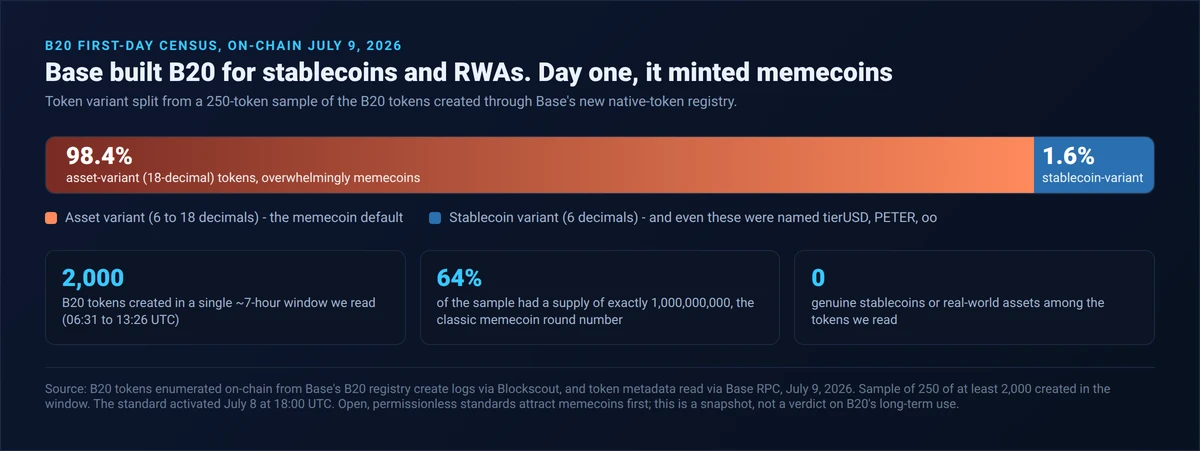
Infographic of DEXTools’ July 9, 2026 first‑day B20 census — shows ~2,000 tokens created in a ~7‑hour window, 98.4% asset (18‑decimal) variant and 64% with a 1,000,000,000 supply, illustrating the day‑one memecoin surge. — Source: DEXTools News
Will fees in B20 tokens actually arrive, and what would that change?
Base’s roadmap calls out planned B20 enhancements tied to the Cobalt phase, including the ability to pay transaction fees in B20 assets as part of an EIP‑8130 rollout path. It’s listed as a planning entry, not a live feature, but it’s on the official board (Base — Upgrades changelog).
If enabled, fee payment in B20 could soften the classic cold-start problem for new tokens. New users wouldn’t need ETH for gas to move or stake a token; they could pay in the asset itself. That’s great for UX and community growth, but it adds economic design questions around gas pricing, slippage on fee conversions, and abuse vectors. Treat it as a meaningful “watch this space,” not a done deal.
Common Mistakes
- Not verifying the factory path. If a token doesn’t originate from 0xB20f… and the address doesn’t start 0xB200…, you might be looking at a contract clone. Check event logs and the factory registry before integrating.
- Assuming immutability. B20’s roles and policies mean controls exist by design. If you require permissionless behavior, read the policy state before buying or providing liquidity.
- Over-tight transfer rules. Aggressive blocklists or narrow allowlists can trap user funds or kill pool depth. Pilot with small cohorts and monitor revert reasons on transfers.
- Ignoring permit. Skipping ERC‑2612 means more failed approvals and higher friction. Enable it and make sure your frontends request signatures correctly.
- Supply optics games. Launching with 1,000,000,000 supply because “that’s what memes do” tells on you. Pick decimals and supply that fit your economics, not a template.
- Assuming bridges support B20 on day one. Many bridges prioritize standard ERC-20s. Confirm B20 integration before trying to move assets cross-chain.
If you want ongoing coverage of Base upgrades, token standards, and the knocks they take in the wild, we track it closely at Crypto Daily.
Frequently Asked Questions
Can I convert an existing ERC-20 into a B20 without breaking markets?
There’s no in-place conversion. The usual path is to mint a B20 version, set up a swap or migration contract, and communicate a clear cutoff plan. Some teams dual-list during a transition window, but that adds confusion, so keep the overlap short and explicit.
Do B20 tokens work everywhere ERC-20s do?
For basic transfers and approvals, yes — B20 mirrors ERC-20 selectors, so wallets and most dApps treat them as fungible tokens. The issuer-only features are new, so explorers and analytics may need updates to surface policy state or role assignments. Expect that to improve over time.
How do I verify a token is a real B20 and not a lookalike?
Check the provenance. Confirm the mint came from the factory at 0xB20f000000000000000000000000000000000000 and that the token address begins with 0xB200…. Cross-check registry events and avoid tokens that can’t prove a factory origin (Chainstack).
Are transfer memos public, and should I worry about privacy?
Memos are optional metadata. If an issuer enables them, they become part of the token’s on-chain data surface, which is public by default. Don’t include sensitive information; use them for operational breadcrumbs like issuance notes or compliance references.
What happens if an issuer’s admin keys are compromised?
Role-based controls cut both ways. Good setups separate duties and include emergency procedures: freeze suspicious flows, rotate keys, and publish an incident notice. If you hold a token, check whether the issuer has documented recovery steps before you size up exposure.
Can B20 exist outside Base?
B20 is native to Base as a precompile. Other chains would need to implement their own equivalent. You can bridge value or wrap representations to other networks, but those wrappers won’t have Base’s native issuer controls unless the destination chain supports them.
Did launch data imply B20 is only for memes?
No — it implied that mint friction invites experimentation. Early logs showed thousands of quick mints with meme-style parameters and no serious RWAs or stablecoins in a small sample (DEXTools News). Expect more sober use cases as tooling and policy patterns settle.
Disclaimer: This article is provided for informational purposes only. It is not offered or intended to be used as legal, tax, investment, financial, or other advice.
Related Stories