S&P 500 Tech Reversal: CPI, Iran Risk and SpaceX IPO Put AI Momentum on Trial
 Andrei Popescu

AI winners stopped going up all at once. By the U.S. close, traders were no longer asking what to buy, but what to de‑risk before Wednesday’s CPI and a blockbuster SpaceX debut.
Semiconductor bellwether Broadcom jolted the complex after its latest numbers, knocking S&P and Nasdaq futures and forcing a rethink of AI’s straight‑line narrative. Then came the calendar: CPI at 8:30 a.m. ET, SpaceX pricing the next day, and geopolitics simmering in the background.
Momentum still matters—but so do funding costs, liquidity events, and the risk premium attached to headlines out of the Middle East.
Editor's note: Broadcom’s wobble was a reminder that “good” isn’t enough at peak expectations. On the crypto side, softening real yields brought flows back to BTC, but alt liquidity remained patchy. With a mega IPO like SpaceX in the mix, I’m focused on how allocations are funded and whether risk broadens beyond the AI complex or simply steps aside. — Andrei Popescu
U.S. large-cap tech has been the market’s center of gravity. That concentration makes the current reversal consequential beyond equities: options dealers, systematic funds, and even crypto desks key off the same macro impulses. Into this week, three drivers converged—macro data (CPI), idiosyncratic earnings shocks (Broadcom), and a record-setting private-to-public liquidity event (SpaceX).
When leadership narrows and then stumbles, the next catalyst often dictates whether we rotate within risk or de‑risk across the board.
Who’s affected? AI-heavy megacaps and semis first, then software and small caps via factor knock‑on, with spillovers to rates, credit, and high‑beta crypto pairs.
Why AI‑Led Tech Just Hit Resistance
Earnings vs. expectations in the AI supply chain
On June 3, Broadcom reported fiscal Q2 revenue of $22.19 billion (period ended May 3, 2026), a headline that still underscored massive AI demand but met unforgiving expectations Broadcom investor release (PRNewswire). Shares plunged roughly 12–14% in the following after‑hours and pre‑market sessions, dragging semiconductors and AI‑exposed stocks, and pressuring index futures into the next open Investing.com (reporting Reuters).
That single print reminded markets: when positioning and multiples stretch, “good” isn’t enough; you need “exceptional” or “surprise.”
Positioning and breadth concerns
AI leaders drive a disproportionate weight in the S&P 500 and Nasdaq. Options flow has been skewed toward upside in AI bellwethers, with dealers long gamma on the way up—and vulnerable to flipping on the way down. Once a key supply-chain name misses even slightly, the reflex is to de‑gross and reduce exposure to look‑alikes.
Macro Catalysts in Focus: CPI and Labor
Labor data sets the stage
U.S. nonfarm payrolls increased by 172,000 in May and unemployment held at 4.3%, per the June 5 Employment Situation report. It’s a slower-but-stable picture that leaves inflation as the deciding factor for rates path and equity duration trades U.S. Bureau of Labor Statistics.
The CPI hour
May CPI was scheduled for release Wednesday, June 10, 2026 at 8:30 a.m. ET—an event everyone on the risk curve was watching U.S. Bureau of Labor Statistics. A cooler print can relieve pressure on long-duration tech; a hot print can reprice cuts and force another valuation check.
| When | What | Why it matters |
|---|---|---|
| June 3 | Broadcom FQ2 revenue $22.19B | AI supply chain health check; expectations reset PR |
| June 4 | Semis and futures hit after AVGO drop | Momentum breaks; dealers and quants adjust risk Reuters |
| June 5 | May payrolls +172k; UR 4.3% | Mixed macro tone; puts CPI in spotlight BLS |
| June 10 | 8:30 a.m. ET — May CPI release | Rates re‑pricing risk for growth multiples BLS |
| June 11 | SpaceX IPO pricing expected | Liquidity magnet for growth risk SEC EDGAR |
| June 12 | SpaceX first trading (targeted) | Price discovery; potential flow diversion SEC EDGAR |
- CPI prints above/below consensus.
- Rates term premium adjusts; 2s/10s and real yields move first.
- Valuation multiples in long-duration tech reprice.
- Options dealers rebalance; intraday volatility amplifies.
- Systematic and ETF flows follow; breadth either improves (rotation) or narrows (de‑risking).
- Crypto beta reacts to the same impulse via USD liquidity and risk propensity.

SpaceX’s IPO as a Liquidity Magnet
Term sheet and scale
SpaceX filed IPO economics on June 3: roughly 555.6 million Class A shares at a fixed $135 per share, targeting about $74.4–$75 billion in proceeds. Pricing was expected June 11 with first trading targeted for June 12 (ticker SPCX). The terms imply an equity value in the vicinity of $1.75–$1.77 trillion based on the authorized share structure disclosed in filings SEC EDGAR — SpaceX.
Why that matters for AI momentum
A mega‑IPO can temporarily reallocate risk capital, particularly in growth sleeves. If investors fund the purchase by trimming mega‑cap tech or semis, AI leaders could face near‑term supply even if the IPO trades well. Conversely, a successful debut can support risk appetite and improve secondary market liquidity.
Geopolitics and the Iran Risk Premium
Why Iran headlines matter for pricing
Markets are sensitive to potential disruptions linked to Iran, especially through the energy channel (e.g., the Strait of Hormuz). Even without a discrete escalation, elevated headline risk can lift the equity risk premium, dampen cyclicals, and tighten financial conditions via higher oil and shipping costs.
Transmission to tech and AI
Higher energy costs raise opex for data centers and chip fabrication and can weigh on margins if not hedged. Combined with higher discount rates from sticky inflation, that’s a double hit to long-duration growth valuations.
Implications for Crypto and Digital Asset Flows
Correlation and liquidity channels
Bitcoin and high‑beta altcoins have exhibited regime‑dependent correlation with U.S. tech. In de‑risking episodes sparked by macro shocks, crypto often sells in sympathy as dollar liquidity tightens and funding costs rise. Conversely, a benign CPI can ease real yields and re‑open the risk window.
AI narrative vs. token fundamentals
AI‑themed tokens tend to overshoot moves in AI equities despite having different cash‑flow logic. Traders should separate compute‑supply narratives from token economics and smart‑contract risk. If semis correct on earnings quality while crypto rallies on thematic enthusiasm, dispersion can be wide—and fragile.
Stablecoin dominance as a tell
Into event risk, rising stablecoin dominance and basis compression usually signal de‑grossing. A strong CPI miss or a messy mega‑IPO could push that pattern further, while a clean CPI and smooth IPO allocation process might reverse it.
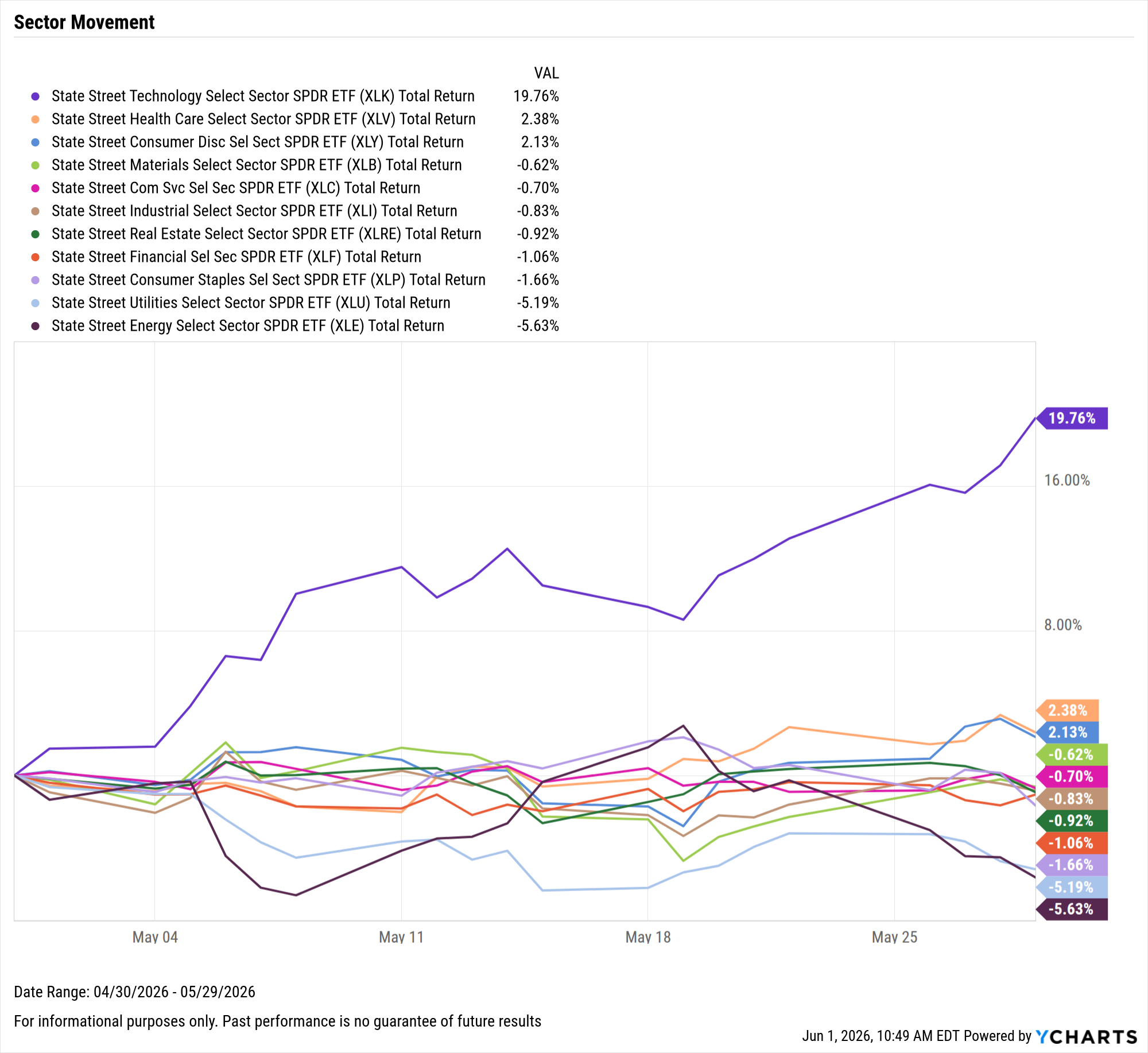
S&P 500 sector movement (Apr 30–May 29, 2026) showing Information Technology’s +19.76% surge — useful because it visualizes the concentrated tech/AI leadership that a June reversal (CPI, Iran risk, SpaceX IPO) threatens to unwind. — Source: YCharts
What the Next Two Weeks Could Look Like
Scenario map
Soft CPI, steady labor, and a well‑received SpaceX print could broaden market leadership: software, small caps, and selective cyclicals play catch‑up while AI megacaps consolidate. That path keeps crypto beta supported, with higher dispersion among alt L1s and AI‑linked plays.
Alternatively, a hot CPI with a risk‑off IPO allocation dynamic could extend the tech drawdown. In that case, investors may prefer quality balance sheets, cash‑generative software with pricing power, and shorter‑duration exposures. Crypto could see dominance rotate toward BTC and stablecoins, with altcoin liquidity pockets thinning.
What to watch in real time
- Rates reaction within the first 10 minutes post‑CPI, especially real yields.
- Dealer positioning: intraday gamma flip zones around AI bellwethers.
- IPO allocation chatter and indications of interest for SPCX.
- Oil curve moves on any Iran‑related headlines; WTI and crack spreads as leading indicators.
- Stablecoin net issuance and BTC futures basis on major venues.
Risks & What Could Go Wrong
- Inflation re‑acceleration: A hot CPI keeps real yields elevated and compresses growth multiples.
- Earnings downgrades: More AI supply‑chain names guide cautiously, extending the de‑rating.
- IPO indigestion: The SpaceX allocation and first‑day trade divert liquidity from secondary tech.
- Geopolitical shock: An Iran‑linked escalation spikes oil and volatility, forcing de‑risking across assets.
- Policy surprise: Hawkish central bank rhetoric tightens financial conditions faster than expected.
- Crypto‑specific stress: Smart‑contract exploits or regulatory actions amplify cross‑market risk aversion.
In tight, momentum‑led markets, one negative surprise rarely travels alone; liquidity can vanish faster than models assume.
For ongoing coverage across equities, macro, and digital assets, Crypto Daily tracks these catalysts and their spillovers in real time. Visit Crypto Daily for cross‑asset research and market updates.
Frequently Asked Questions
What triggered the latest pullback in S&P 500 tech?
A combination of an earnings shock in the AI supply chain and event risk ahead of CPI. Broadcom’s revenue update on June 3, 2026 reset expectations and hit semiconductors, while traders de‑risked into the June 10 CPI release and a large SpaceX IPO window.
How could the CPI print affect AI stocks specifically?
AI leaders are long‑duration assets. A hotter CPI can lift real yields and compress multiples, while a cooler print eases the discount rate pressure, potentially stabilizing or broadening leadership.
Why does the SpaceX IPO matter for public tech even before it trades?
Its scale may attract capital from growth mandates. If investors fund allocations by selling liquid megacaps or semis, that supply can weigh on AI momentum near term—regardless of SpaceX’s long‑term outlook.
What did the latest U.S. jobs report signal?
May payrolls rose by 172,000 with unemployment at 4.3%, suggesting moderating but resilient labor conditions. It sharpened the focus on CPI as the decisive input for the rates path.
How does Iran risk feed into tech valuations?
Through energy and risk premium channels. Higher oil and shipping costs can pressure margins for data centers and fabs, while elevated geopolitical uncertainty lifts discount rates applied to long‑duration cash flows.
What’s the read‑through for crypto traders?
Macro shocks that hit AI equities often bleed into crypto via liquidity and risk appetite. Watch real yields after CPI, IPO allocation chatter, and stablecoin flows for signals on whether risk is rotating or being reduced.
Is this investment advice?
No. Markets are volatile and subject to multiple risks, including macro, geopolitical, regulatory, custody, and smart‑contract vulnerabilities. Do your own research and consider professional guidance.
Disclaimer: This article is provided for informational purposes only. It is not offered or intended to be used as legal, tax, investment, financial, or other advice.
Related Stories