
Blockchain Transaction Fees Aren't Fair. The Real Problem Is That Users Can't See the Market
 CryptoDaily
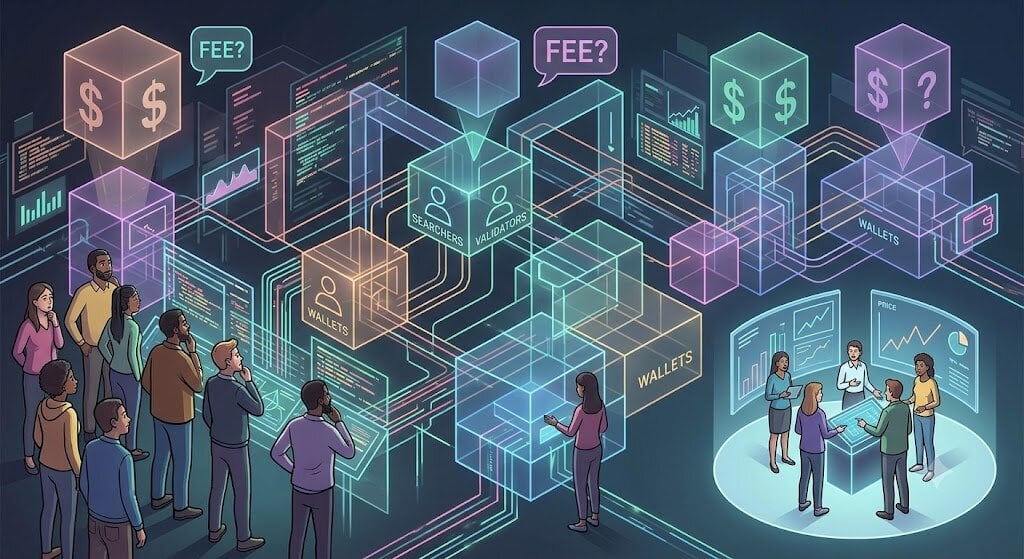
Solana has built its reputation on speed and low transaction costs. But beneath those headline metrics lies a less visible issue that affects nearly every user: most people have little idea how much they actually need to pay to get a transaction confirmed.
Priority fees have become an increasingly important part of Solana's transaction market. During periods of congestion, users increase fees to improve their chances of landing in the next block. That behavior is perfectly rational. The problem is that users are often making those decisions without access to the information that would help them bid efficiently. While fee volatility is a natural part of any blockchain where demand fluctuates, uncertainty around pricing often leads users to pay far more than necessary simply to avoid the risk of a failed transaction.
Many traders view overpaying as cheap insurance. Missing an arbitrage opportunity, a token launch, or an NFT mint can be far more expensive than adding a few extra cents or dollars to a transaction fee. As more users adopt that mindset, overpayment becomes normalized, pushing fee expectations higher across the network.
This isn't simply a blockchain issue. Economists refer to it as information asymmetry, a situation where one group has access to significantly more information than another. Traditional financial markets have spent decades reducing these imbalances through transparent exchanges, reporting requirements, and publicly available pricing data. Blockchain networks often highlight the transparency of on-chain data, but the process leading up to transaction inclusion is frequently much less visible.
Transaction ordering has become increasingly sophisticated. Validators, searchers, block builders, wallets, and infrastructure providers all play a role in determining how transactions reach the blockchain. While these systems improve network efficiency, they also create layers of complexity that the average user rarely sees. The result is a fee market where many participants are effectively bidding without a clear view of prevailing market conditions.
That doesn't mean every user should pay the same fee. Congestion pricing serves an important purpose by ensuring that users who value faster execution can pay for priority when blockspace is limited. The issue is whether participants have enough information to make informed decisions. Imagine participating in an auction without knowing what anyone else is bidding. You could still win, but chances are you'll consistently pay more than necessary. The same dynamic can emerge in blockchain transaction markets when pricing signals remain hidden.
The effects extend beyond users. Validators rely on transaction fees and MEV revenue to sustain their operations, searchers compete to identify profitable opportunities, and wallets attempt to recommend appropriate fee levels. When information is unevenly distributed, every participant operates with incomplete visibility, making the market less efficient than it could be.
This has sparked growing discussion around how blockchain infrastructure should evolve. Rather than treating transaction ordering as a closed process, some projects are exploring ways to expose more information to the market while encouraging broader competition among searchers and infrastructure providers.
One example is Flowra, which is developing an Open Orderflow Auction (OOA) for Solana. The platform aims to make orderflow more accessible through transparent auctions while giving validators greater flexibility over how blocks are constructed using customizable Programmable Block Policies (PBP). By opening transaction flow to more participants, the model seeks to increase competition among searchers, improve validator economics, and reduce the information asymmetry that contributes to inefficient fee markets.
Whether any single model becomes the industry standard remains to be seen. But as blockchain infrastructure matures, transparency is likely to become just as important as throughput or transaction speed. Users don't necessarily expect fees to be identical. They do expect markets to operate fairly, and that starts with giving participants enough information to understand the prices they're paying in the first place.
Disclaimer: This article is provided for informational purposes only. It is not offered or intended to be used as legal, tax, investment, financial, or other advice.
Related Stories


