Bitcoin Supply in Loss Hits a Record: Are Long-Term Holders Now the Only Real Support?
 Idris Calloway

Bitcoin’s been bleeding, but the story under the hood is clearer than the noise. A huge chunk of coins now sit below their owners’ cost basis. That’s not just a mood check. It changes how price behaves, who sells, and where support might actually form.
We just crossed a line that usually shows up late in cycles. Losses are wide. Long-term holders still own most of the supply. The question is whether that cohort is the only real backstop left.
Let’s pull the on-chain threads, keep it practical, and talk through what’s next without pretending anyone has a crystal ball.
| Point | Details |
|---|---|
| Record supply in loss | Glassnode-based reporting logged ~10.83M BTC at unrealized loss on June 25, 2026, the highest on record (ChainReport citing Glassnode). |
| Loss overtook profit this cycle | On June 4, coins in loss (~10.5M) exceeded coins in profit (~9.8M) as BTC neared $61.3k, a first for this cycle (CoinDesk using Glassnode data). |
| STH pain is near total | More than 95% of short-term holder supply sat underwater in early June, per Glassnode’s Week On-chain, a hallmark of late-stage drawdowns (Glassnode Research). |
| Majority of supply below cost | CryptoQuant-based analysis showed about 51.6% of BTC supply in loss on June 10, up from roughly 34% a month earlier, a capitulation-style jump (CryptoRank reporting CryptoQuant). |
| LTHs still anchor supply | Long-term holders control ~14.8M BTC, around 75% of circulating supply, with ~5.58M of those coins currently at an unrealized loss (ChainReport citing Glassnode). |
What “supply in loss” is actually telling you
Editor's note: Across Q1 and Q2 2026 I kept seeing the same pattern on my dashboards: spot demand slowed while loss metrics climbed in unison. By early June, more than half the supply flipped underwater and short-term holders were nearly all red. Desk chats turned from FOMO to risk budgets and net exposure. A few funds told me they were only bidding where their internal realized price bands aligned with client inflows. That restraint tends to build real floors, but it takes time. I am watching LTH spending and exchange inflows day by day. If those stay quiet, the base work continues. — Idris Calloway
Supply in loss is simple: take each coin’s last on-chain move, treat that as a rough cost basis, then ask if price is below it. If yes, that coin sits at an unrealized loss.
When more than half the network is underwater, behavior changes. Short-term holders tend to de-risk, miners may hedge a bit more, and leverage usually thins out. At the same time, price can probe lower because bids get timid while sellers are motivated.
Why this stretch matters
Across early to mid June, multiple datasets showed the flip. On June 4, coins in loss outnumbered coins in profit, with about 10.5M BTC in loss versus 9.8M in profit (CoinDesk using Glassnode). Within days, CryptoQuant-tracked supply in loss hit roughly 51.6% of circulating coins, a big jump from roughly a third a month earlier (CryptoRank).
Glassnode’s Week On-chain added the knife twist: over 95% of short-term holder supply was under water. That basically means almost everyone who bought recently was red at the same time (Glassnode Research).
Market translation: the marginal seller is likely a short-term holder, while the marginal buyer either has a much longer horizon or a disciplined averaging plan.
The long-term holder base: patient or trapped?
Long-term holders, defined on-chain as holding for roughly 155 days or more, still control the lion’s share of supply. Recent reads point to about 14.8M BTC in LTH hands, roughly three quarters of circulating coins, with around 5.58M of those coins below cost right now (ChainReport citing Glassnode).
That mix matters. LTHs in profit are sturdy hands. LTHs in loss can be even sturdier, paradoxically, because their cost bases are older and often tied to conviction. But stress does creep in when macro, regulation, or liquidity bites. Think of them as the bedrock that cracks only under real pressure.
How LTHs behave at cycle turns
- They tend to distribute into strength late in bulls, then slow their spending as price bleeds.
- When cohort spending stays low during drawdowns, it often marks a base formation window.
- If we see a confirmed pickup in LTH realized losses, that can signal forced selling and a possible final flush, not a guaranteed bottom but a common feature near them.
| Holder cohort | What they own | Typical stress behavior | Why it matters now |
|---|---|---|---|
| Short-term holders | Recent inflows with high cost basis variance | De-risk quickly, sell into weakness, hunt bounces | Over 95% underwater earlier in June, so they anchor near-term selling pressure (Glassnode Research). |
| Long-term holders | ~14.8M BTC, ~75% of supply | Spend less in drawdowns, average in, sell into confirmed uptrends | They are the likely backstop. ~5.58M LTH coins sit at unrealized loss and could set the floor if they keep holding (ChainReport). |
Pro tip: Watch LTH Spent Output Profit Ratio and LTH supply change. If LTHs start realizing heavy losses or their total supply contracts quickly, the bedrock is wobbling.
Three ways this can resolve, and what to watch
1) Fast flush
A final whoosh lower as weak hands exit, funding goes flat, and long-liquidations burn off. You would likely see a burst in realized losses and maybe a short-lived spike in exchange inflows. LTH selling would still look modest relative to STHs. This is typical near cyclical base-building.
2) Slow grind
Price chops sideways to slightly down while loss metrics improve quietly. Derivatives open interest resets, basis normalizes, and realized price bands catch up. It feels boring. That boredom often repairs the market better than a dramatic wick.
3) Failed breakdown
Price undercuts a visible low, triggers stops, then rips back above key levels as supply shift confirms on-chain. This one only sticks if spot demand absorbs the dip. LTH distribution must stay muted for the move to hold.
Probability is fluid. The clue set is in who sells, at what profit or loss, and how quickly exchange balances react.
How to track the floor in real time
A simple weekly checklist
- Supply in loss share: Is the percentage still rising week over week, or stabilizing below recent highs around the June spike reported by CryptoQuant-based feeds?
- STH profit share: If the STH cohort is still near total loss territory like early June’s ~95% underwater read, bounces may be sold fast. Any recovery in STH profit share can power relief.
- LTH supply change: Are LTHs accumulating or distributing on net? A steady or rising LTH supply argues for patience in the base.
- Realized losses vs realized gains: Big red days followed by quiet suggests capitulation finishing. A sequence of red prints with no bounce can mean more to go.
- Exchange net flows: Persistent net inflows during drawdowns point to sell pressure. Net outflows often precede stabilizations as coins move to cold storage.
Price tools that play nice with on-chain
- Simple moving averages to frame trend, not to predict it. The trick is confluence with realized price metrics, not blind faith in lines.
- Spot volume and high time frame closes. A higher low on weekly with firm spot volume plus improving loss metrics is the combo you want to see.
- Funding and basis. If they normalize while loss metrics cool, the system is resetting.
Risk note: On-chain cost basis is an inference, not a brokerage statement. Sophisticated desks can move coins without changing risk. Treat the signals as tendencies, not certainties.
Positioning ideas by time horizon
This is not advice. It is a framework to think through outcomes and avoid forced errors.
Short-term traders
- Expect supply-overhang on rallies while STHs remain deeply red. Fade extremes, not middles. Let liquidations do the work.
- Use tight risk on bounce plays. If breadth or spot flow does not confirm, step aside quickly.
- Have alerts on realized loss surges and exchange inflow spikes. Those often precede volatility windows.
Swing participants
- Scale into weakness only if LTH distribution stays light and supply-in-loss stops accelerating. You want deterioration to slow, not expand.
- Consider staging exits into strength if STH profit share rises quickly. That is where supply flips to sellers.
- Avoid sizing off narratives. Size off invalidation points and liquidity pockets you can see.
Long-horizon allocators
- Base-building windows historically occur when loss shares are high and STH pain is broad, like June’s 95% underwater reading. That does not time entries, but it colors risk.
- DCA plans reduce regret. If you are averaging, pre-commit your schedule so headlines do not yank it around.
- Custody, tax lot tracking, and execution quality often matter more to outcomes than picking the exact bottom.
Mistakes to avoid when loss metrics spike
- Chasing leverage into a bounce because social feeds turned green. Loss overhang needs time to clear.
- Ignoring liquidity. Slippage on thin books turns good ideas into bad fills.
- Assuming records equal reversals. A record share of coins in loss can persist while price chops.
- Misreading LTH patience as immunity. If macro shocks hit, even strong hands lighten up.
- Forgetting idiosyncratic risks: smart contract exposures on wrapped BTC, exchange counterparty, stablecoin depegs, unlock calendars.
Pro tip: Keep a post-trade journal. Log what you saw in supply-in-loss, realized loss streaks, and LTH behavior at the time. You will spot your own blind spots fast.
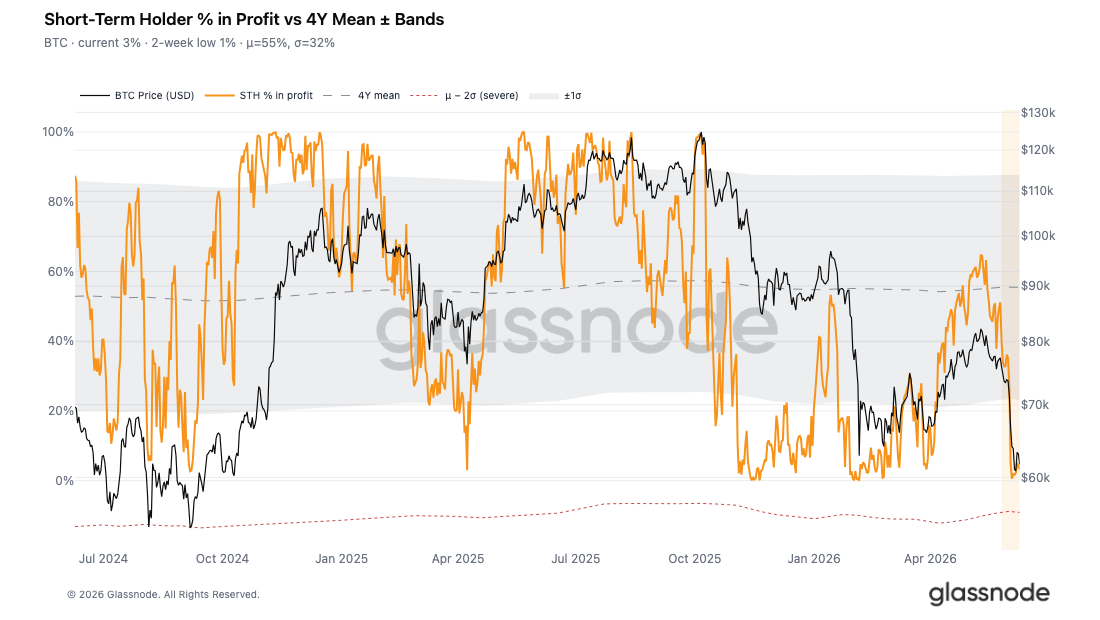
Chart of Short‑Term Holder % in Profit (Glassnode, Jun 10, 2026): shows STH % in profit collapsing to ~3% (i.e., >95% underwater), visually highlighting how recent buyers are the primary cohort currently in loss — a key driver of short‑term sell pressure. — Source: Glassnode
Where support might actually form on-chain
On-chain, support is not just a price level. It is a cluster of cost bases and holder types that decide not to sell. If LTHs in loss hold firm while STHs exhaust, you often see a shelf where dips get absorbed repeatedly.
Signals that a shelf is forming
- STH capitulation eases: fewer realized losses day to day, reduced exchange inflows after spikes.
- LTH discipline: subdued LTH spending and a flat to rising LTH supply share.
- Profit share flipping: STH percent in profit recovers from single digits toward healthier teens or higher without immediate distribution spikes.
- Price respecting prior spend density: repeated hold of zones where lots of coins last moved.
None of these guarantee the bottom. But together they form a testable map. Failures on this map, like a sudden burst of LTH realized losses, tell you the shelf is not ready.
Narratives vs numbers: keeping your balance
News cycles will try to assign one reason for every move. The chain rarely agrees with single-cause stories. Right now, the numbers are blunt. Record loss supply, majority underwater at points, and STHs nearly universally red. LTHs hold most of the coins and a sizable chunk of their own stack is below cost too.
That configuration can build durable bases because the impatient money has little left to sell. It can also crack if external shocks demand cash. The only way to travel this without betting your account is to keep watching who sells and at what cost basis, then let the tape confirm.
If you want steady coverage that connects these on-chain reads with policy and macro, Crypto Daily tracks this story without the hype. Catch the latest at Crypto Daily.
Frequently Asked Questions
Does a record supply in loss mean the bottom is in?
Not automatically. Records tell you stress is high, which often appears near base-building. But these phases can persist. The stronger read is when loss metrics cool while LTHs keep holding and price starts printing higher lows.
Are long-term holders the only real support right now?
They are the main structural support, yes. LTHs control roughly three quarters of supply, and they typically sell less in drawdowns. But they are not invincible. A rise in LTH realized losses would warn that support is weakening.
Why does it matter that more than 95% of STH supply was underwater?
Because short-term holders tend to be the marginal sellers and buyers. When almost all of them are red, rallies face overhead supply from breakeven selling. It also means a single strong bounce can cascade if it flips enough STHs back to profit.
What are the two or three best on-chain metrics to track here?
Supply in loss share, LTH supply change or LTH SOPR, and STH percent in profit. Together they show who is stressed, who is distributing, and whether pain is easing or building.
How do exchange flows tie into this?
Net inflows during drawdowns often precede sell waves. Net outflows, especially after a capitulation day, suggest coins are moving to cold storage and that selling pressure may be fading.
What would invalidate the LTH floor idea?
A decisive uptick in LTH realized losses paired with accelerating exchange inflows and lower highs on price. That says strong hands are selling and buyers are not absorbing it.
Is this the same as 2022?
Patterns rhyme but do not repeat. The mix of holders, liquidity venues, policy backdrop, and institutional participation changes every cycle. Use the framework, not the script.
Disclaimer: This article is provided for informational purposes only. It is not offered or intended to be used as legal, tax, investment, financial, or other advice.
Related Stories