UBS Puts a Structured Note Onchain With LINK, but Chainlink Still Trails Near $8.64
 Alex Carter

Quick Take
- UBS ran a tokenized structured note through a production pilot built with Chainlink, and bulls now eye first resistance near $9.56.
- Reaching that ceiling would take a rise of about 11% for a token that is still sliding.
- An early MACD cross hints that selling is fading, but a daily close below $7.97 would undo the bullish case.
UBS has tested a tokenized product in a live pilot on Chainlink infrastructure, using systems the bank already runs. UBS said settlement could later move through its own digital money products.
The pilot ranks among the clearest bank endorsements LINK has received. The token kept falling anyway, extending a months-long slide. Traders now want to know whether institutional adoption can finally turn into real buying on the chart.
A Swiss Bank Runs Its Structured Note Through Chainlink
The pilot's setup automates issuance and lifecycle management of the note. The Chainlink Runtime Environment, known as CRE, coordinates the workflow.
The system connects existing UBS platforms to blockchains. It extends UBS Tokenize services that already run on public networks such as Ethereum. Users get a real-time view of token balances, coupon entitlements, product status and how close a note sits to its barrier. UBS said it may later automate settlement through its digital money products.
Bulls point to scale. Numerix puts the structured products market at more than $2 trillion in outstanding notional. Broadridge estimates a 2% settlement failure rate can cost firms up to $3 billion.
Johann Eid, Chief Business Officer at Chainlink Labs, said the pilot shows banks can bring existing products onchain using systems they already run. Swift, Euroclear, Mastercard and Fidelity International also use Chainlink.
Sellers Still Own the Trend Below $10.51
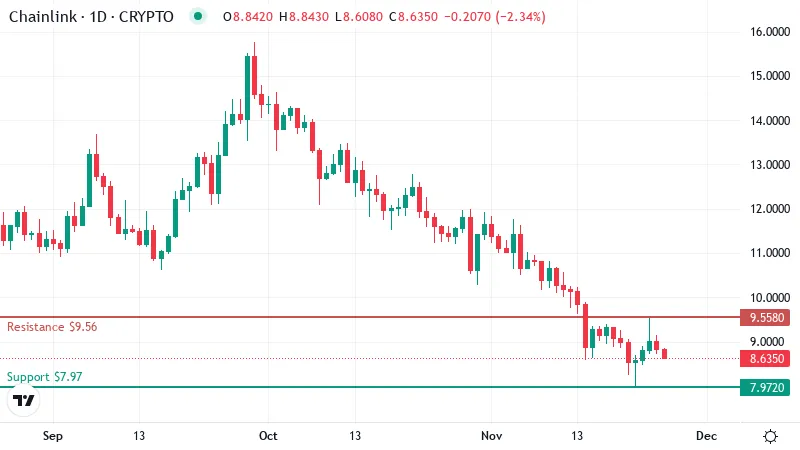
The market has not rewarded the news. LINK traded near $8.64, below its 50-day average at $10.51. The 200-day average sits higher, at $10.73. Those two lines now act as ceilings overhead. Trend strength readings confirm a real downtrend driven by sellers.
Momentum looks tired. RSI, a 0 to 100 gauge of momentum, sits at 33. That is weak and close to the oversold zone below 30. Selling has gone far, yet buyers have not stepped in with force.
One early signal points the other way. MACD, a trend-following momentum tool, has crossed above its signal line. That suggests the selling pressure is starting to ease, though it is far from a reversal.
On the daily chart, the nearest support sits about 8% below the current price. A break there would leave no clear floor in the data. First resistance sits at $9.56. Above that, $10.27 is the next hurdle. The 50-day average lies roughly 22% away, a long climb for a coin still losing ground.
What Other Signals Say About the Adoption Story
LINK traded near $8.66 on Nov 25, the day the pilot became public. It was down almost 4% over 24 hours, LiteFinance data showed. The bank news landed into selling and did nothing to stop it.
The slide has continued at a slower pace. LINK is down roughly 7% over the week. Buyers have yet to treat the UBS pilot as a reason to return.
Longer windows look worse. The token has lost about 24% in a month and roughly a third of its value over the past year. That decline came even as big institutions signed on, so partnerships alone have not lifted the price.
Where the Bank Rally Thesis Wins or Breaks
The bullish case needs proof on the chart. A daily close back above first resistance, with MACD still above its signal line, would show buyers reacting to bank adoption. That would put the next hurdle in play.
The thesis breaks on a daily close below nearest support. With no mapped floor beneath it, sellers would keep control.
Disclaimer: This article is provided for informational purposes only. It is not offered or intended to be used as legal, tax, investment, financial, or other advice.
Disclaimer: This article is provided for informational purposes only. It is not offered or intended to be used as legal, tax, investment, financial, or other advice.
Related Stories