Security Researcher Says Glamsterdam Should Not Ship as ETH Slips Toward $2,100
 Alex Carter

Three Things to Know
- A security researcher said Ethereum's Glamsterdam upgrade should not ship in its current form, as rival fixes emerge to protect old contracts.
- Ether trades beneath both of its long-term moving averages, and momentum still favors sellers.
- Bulls are watching one lone floor, with little mapped support below it.
Ethereum's next upgrade has hit a wall of criticism. Security researchers warn that Glamsterdam's gas changes could break older contracts that hold user funds, and two developers have filed competing drafts to prevent that.
The dispute lands while ether is already under pressure, and testing delays have removed a possible catalyst for buyers. Traders want to know if developers can settle on a fix before sellers push the token toward its last clear support.
Rival Fixes Race to Save Old Contracts From Glamsterdam's Gas Hike
Ethereum's next upgrade, Glamsterdam, bundles two proposals that raise the gas cost of creating and touching stored data. Under EIP-8037 and EIP-8038, the base charge to create a contract jumps to 183,600 gas, up from 32,000. Developers warn that older apps holding user funds could break, because many of them cannot be updated.
Two developers filed rival fixes on Nov 8. Leo Glisic's EIP-8488 keeps the legacy gas schedule for existing contracts, while new contracts would use V2 opcodes. Giulio Rebuffo's draft runs two gas meters, billing at the new prices but executing under the old rules. His design has no implementation or tests yet, and neither draft carries a target date.
Security researcher pcaversaccio was blunt. "Glamsterdam should not be shipped in its current form, period," he said. Developer banteg has already listed about 200,000 affected contracts, including several high-profile protocols, and said his method misses many more.
The schedule is slipping. A testnet rehearsal set for Oct 26 was postponed after those alarms. The next private test is expected Nov 16 to 20 at the earliest.
Ether Trades Beneath Both Long Averages as the Month's Losses Pile Up
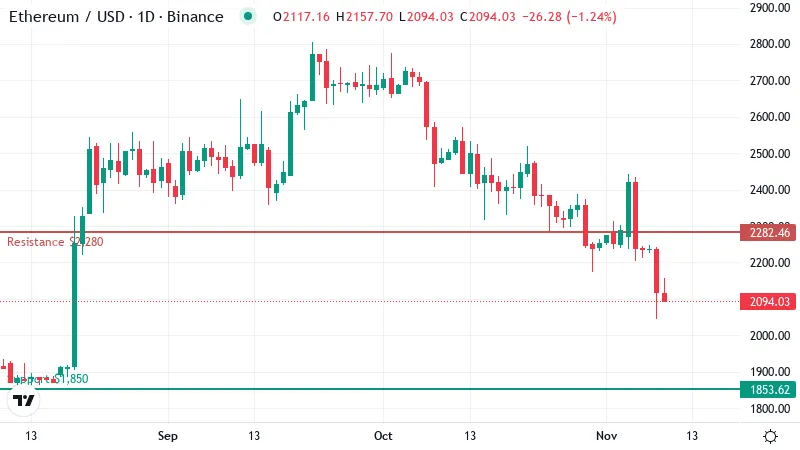
Ether traded near $2,100 on Monday, flat over the past 24 hours. The quiet day follows a heavy stretch. The token is down about 8% over the week and roughly 15% over the past month.
A moving average smooths out daily swings to show the underlying trend. Ether now sits below two of the most watched ones. The 50-day average stands near $2,370. The 200-day average is close to $2,310. When price trades under both, those lines tend to act as ceilings on any bounce.
The order of the two averages matters too. The shorter 50-day line still sits above the longer 200-day line, a leftover from stronger months. Price has already dropped through both, so buyers face two layers of overhead selling before the trend can turn. Rallies into that zone have room to stall.
The slide looks orderly, with lower highs stacking up through the month. A flat session inside that pattern reads as a breather. Sellers have paused, and nothing on the chart shows buyers taking control.
The upgrade fight gives traders little reason to step in. Until the Glamsterdam plan firms up, the path of least resistance stays tilted lower.
Sellers Still Hold the Momentum Without Being Exhausted Yet
RSI, a 0 to 100 gauge of momentum, reads about 32. Readings below 30 count as oversold. Ether is close to that zone, which leaves room for one more leg down before selling looks stretched.
The MACD, which tracks shifts in momentum, sits below its signal line. That means momentum is still pointing down. A separate trend-strength gauge shows a trend starting to form, and sellers are the ones driving it.
Bears have pushed hard and still have fuel left.
Traders hoping for a rebound should watch momentum before the RSI. A low reading alone rarely sparks a rally. Buyers need the MACD to curl back up first, a sign that selling pressure is actually fading.
$1,850 Is the Floor Bulls Cannot Afford to Lose
On the upside, the first barrier sits near $2,280, just under the 200-day line. A close above it would be the first real hint that sellers are tiring. It would also put that long average back within reach.
The next ceiling stands around $2,400, beyond the 50-day average. Clearing that level would mark a genuine recovery. It would also break the pattern of lower highs.
Below, the picture is thinner. Support near $1,850 is the only floor mapped on the chart. Price would have to fall more than 10% to test it, so buyers have some cushion for now.
Losing that level would be a different story. The data shows no clear support beneath it, which means a break could run further before buyers find footing. That gap explains why bulls need to defend this floor.
What Flips the Next Three Days for Ether
Developer news around the next private test could set the tone for the coming sessions.
- Bullish: A daily close above the first ceiling, just under the 200-day line, would open a move toward the higher barrier past the 50-day average. Word of a settled fix for old contracts could supply that push. A drop back below Monday's level would cancel the setup.
- Bearish: A failed test of that first ceiling would keep a slide toward the lone floor in play. Another Glamsterdam delay could add fuel. A break above that ceiling would invalidate this view.
Bears Keep the Edge Until Developers Settle the Upgrade
Until developers pick a fix for old contracts, bears hold the advantage.
The risk runs the other way if consensus arrives fast. Quick agreement on one draft could catch short sellers off guard. That could force a sharp bounce as they rush to cover.
Disclaimer: This article is provided for informational purposes only. It is not offered or intended to be used as legal, tax, investment, financial, or other advice.
Disclaimer: This article is provided for informational purposes only. It is not offered or intended to be used as legal, tax, investment, financial, or other advice.
Related Stories