Schwab Opens SOL to Retail Clients, but Solana Could Still Slide to $70 First
 Alex Carter

Quick Take
- Charles Schwab added Solana to its retail crypto platform, alongside Avalanche and Chainlink.
- SOL sits deep in oversold territory, yet momentum gauges still favor sellers.
- A break of the nearest support floor could open a slide toward $70.
Charles Schwab now lets its retail clients buy Solana. The brokerage added SOL, Avalanche and Chainlink to its crypto service, ending a lineup that held only bitcoin and ethereum.
The timing is awkward for Solana bulls. The token barely moved on the news while rival listings rallied, and its chart still shows a market controlled by sellers. Traders now want to know if new brokerage demand can hold the floor before it gives way.
Schwab Adds Solana as Its Crypto Menu Grows to Five
Charles Schwab added Solana (SOL), Avalanche (AVAX) and Chainlink (LINK) to its Schwab Crypto platform on Nov 9, 2026. The service had offered only bitcoin and ethereum until now. Clients can trade five assets in total.
Schwab Crypto began rolling out in May and reached all eligible retail clients in October. Charles Schwab Premier Bank, SSB, offers the service. Trades carry a fee of 75 basis points on the dollar value of each order. Clients can use Schwab.com, Schwab Mobile or thinkorswim.
The product is not available in New York, Louisiana, US territories or outside the country. The company said it plans to add more coins over time.
Joe Vietri, Head of Digital Assets at Charles Schwab, said the firm wants "to give clients greater choice and flexibility in how they invest in digital assets."
Traders responded unevenly. AVAX jumped about 8% and LINK gained about 2%. SOL slipped about 0.2%, while bitcoin rose about 0.6% and Schwab shares added about 1.4%. Of the three new listings, Solana drew the weakest response.
Solana Trades Well Beneath Both Long Averages
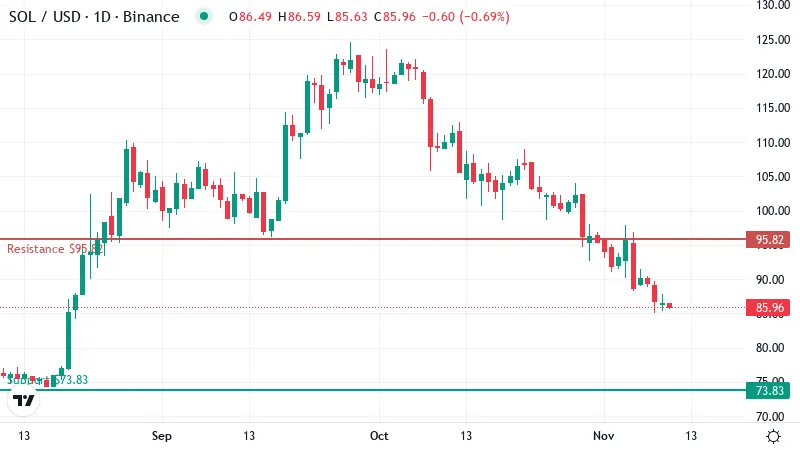
Solana traded near $86 on the latest daily close. That leaves the token well under both of the long moving averages that traders watch to judge the bigger trend. A moving average smooths out daily swings by tracking the mean closing price over a set number of days.
The 50-day average sits near $100. The 200-day average is close to $97. Price below both lines means sellers have controlled the market over the past two months and the past half year. Those averages now act as ceilings. Any bounce would have to clear them before buyers could claim the trend had turned.
Most of the damage came before Schwab made its move. SOL fell about 22% over the past 30 days and roughly 7% over the past week. New retail access did little to change that direction on day one.
Yesterday's session was flat, a breather after weeks of selling. A quiet day can let short-term sellers step back, but it does not show buyers taking charge.
Traders will want a run of higher closes before reading the calm as more than a pause.
Oversold Readings Have Not Stopped the Sellers
RSI, a 0 to 100 gauge of momentum, sits near 27. Readings below 30 count as oversold. That means sellers have pushed hard and fast, and the selling may be stretched.
Still, a floor may not be in. In strong downtrends, RSI can stay low for days or weeks while price keeps grinding lower. Buyers often wait for proof before stepping in.
Other gauges point the same way. The MACD line, which tracks shifts in momentum, remains below its signal line. In plain terms, momentum is still pointing down. Trend strength readings also show a real trend, and sellers are the ones leading it.
A relief rally would likely need momentum to turn first. Traders will watch for the MACD to cross back above its signal line and for RSI to climb out of oversold territory. Until then, rallies may fade quickly.
Why $73.83 Matters More Than the Listing
Nearest support sits near $74, the last floor the data maps. No mapped level lies beneath it, so a clean break would leave little to slow a slide toward $70.
That gap explains why traders care more about this line than about Schwab's move. New retail access cannot help much if price keeps sinking with no clear floor below.
Overhead, resistance sits near $96. Rebounds have stalled under that zone, and it caps any bounce for now. A daily close back above it would be the first real sign of strength from buyers.
The next hurdle is the round number just above. Clearing it would put SOL back alongside both long averages, where the bigger trend gets decided. Until then, sellers keep the upper hand.
Two Paths for Solana Over the Next Three Days
The next three days should show which side tests its line first.
- Bullish: An oversold bounce that ends with a daily close above resistance would open a run toward the round number overhead. A slide back through the current price area toward the support floor would cancel that setup.
- Bearish: Steady selling would bring a test of support, and a break would point toward the lower round number. A reclaim of resistance would undo the bearish case and hand buyers the short-term edge.
Access Is Expanding Faster Than Demand
Schwab's listing puts SOL in front of millions of brokerage clients, and that should help demand over time. In the near term, sellers still control the trend, and support looks like the likelier test.
Short sellers face a real risk. Deeply oversold markets can snap higher fast, forcing bearish traders to buy back positions in a hurry.
Disclaimer: This article is provided for informational purposes only. It is not offered or intended to be used as legal, tax, investment, financial, or other advice.
Disclaimer: This article is provided for informational purposes only. It is not offered or intended to be used as legal, tax, investment, financial, or other advice.
Related Stories