Arthur Hayes Says the Nvidia Pump Is the Worst Thing for BTC, and Wants Stocks to Burn
 Alex Carter

Three Things to Know
- Arthur Hayes said a surging Nvidia is bad news for Bitcoin and that he wants stocks to fall so the Fed prints.
- His next real test for Bitcoin sits around $50,000, a long drop that this month's selling makes easier to picture.
- A daily close below the lone chart support, with the Nasdaq sliding, would back his call, while a reclaim of nearby resistance would undo it.
Arthur Hayes is rooting against the stock market. The BitMEX co-founder said Nvidia's sharp rally hurts crypto holders because strong equities give the Federal Reserve no reason to add liquidity.
His view lands as Bitcoin heads for a painful month and traders price a December rate hike. Bitcoin briefly rallied with tech stocks, then reversed. The question now is whether a weaker Nasdaq would drag Bitcoin lower first, or force the Fed's hand in time.
Hayes Roots Against Nvidia to Get the Fed Printing
Hayes made the case in a post on X, writing that "the $NVDA pump is the worst thing that could happen for our crypto bags." He added: "We need US equities to burn so the Fed prints."
His logic is simple. A lasting rebound in stocks takes pressure off the Federal Reserve. Without that pressure, the central bank has little reason to ease and pump liquidity into markets.
The trigger was Nvidia. Its shares closed 31% higher Monday after the company reinstated Jensen Huang as CEO, and they were up as much as 36% intraday. Bitcoin rose more than 5% that day to a high near $64,440. It then gave it all back. The coin briefly slipped below $60,000 early Tuesday, Nov 24.
Hayes had already set a marker. "If the Nasdaq continues to fail, $50,000 will be the next real test," he said. He also warned of a 1929-style crash. He expects the AI data center buildout to need a bailout, and he believes that rescue would eventually lift Bitcoin.
A Liquidity Trader Who Reads the Fed First
Hayes is one of crypto's best-known traders and a regular voice on macro markets. His views start with central banks. When the Fed adds liquidity, he expects risk assets like Bitcoin to rise. When it holds back, he expects them to struggle.
That lens explains his stance on Nvidia.
A Drop of About 17% Would Bring the $50,000 Test
With Bitcoin near $60K, Hayes's target sits roughly 17% below the current price. That sounds like a long way down. This month says otherwise.
The coin has already lost almost 20% in November. That puts it on track for its worst November since 2018. The 30-day decline reaches about 26%. Another slide of that size would match the pace sellers have already set.
The target would also break new ground. Bitcoin hit a two-year low near $55,254 over the weekend. Hayes's level sits well beneath it.
Sellers Own the Trend While $55K Stands Alone
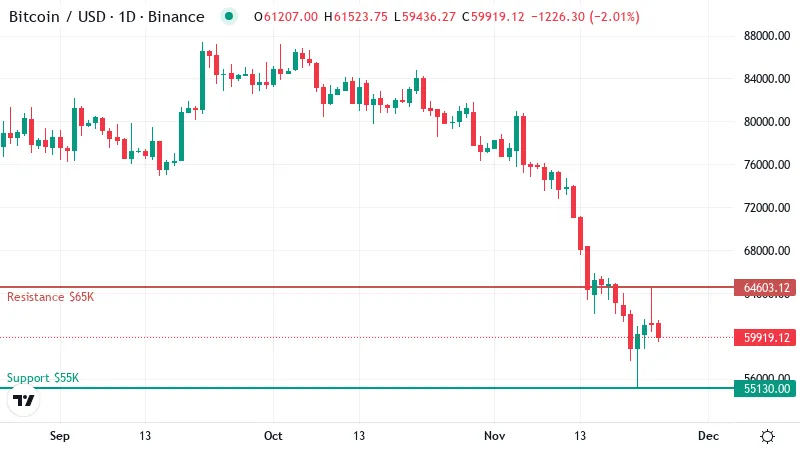
Bitcoin sits below both of its key moving averages. The 50-day average, a gauge of the recent trend, stands near $72K. The 200-day average sits higher at about $75K. Both lines now act as ceilings, and sellers control the trend.
The RSI, a 0 to 100 gauge of momentum, reads 24. Anything under 30 counts as oversold, so a relief bounce could come at any time. Momentum is still pointing down, though, and the coin slipped about 2% over the past day.
On the daily chart, $55K is the only support in the data. Below it, nothing stands in the way until Hayes's target. Above, rebounds face resistance near $65K first. The next cap sits right at the 200-day line.
The Fed backdrop fits his tight-liquidity view. CME FedWatch shows traders pricing a 100% chance of a rate hike on Dec 9, up from 88.6% on Nov 20. Retail traders on Stocktwits still lean bullish anyway.
What Would Prove Him Right, or Wrong
A daily close below the lone support on the chart, with the Nasdaq sliding at the same time, would back Hayes. That break would leave little between Bitcoin and his target.
On the other side, a reclaim of the first resistance would undo the call. A push back toward the 50-day average while stocks keep climbing would show Bitcoin can rise without Fed help. The Fed's December meeting is the date that should settle it.
Disclaimer: This article is provided for informational purposes only. It is not offered or intended to be used as legal, tax, investment, financial, or other advice.
Disclaimer: This article is provided for informational purposes only. It is not offered or intended to be used as legal, tax, investment, financial, or other advice.
Related Stories