15,000 ETH Smart Contracts Could Break as Glamsterdam Storage Gas Nears 6x
 Sophia Bennett

Three Things to Know
- Vitalik Buterin asked Ethereum teams not to rush a Glamsterdam storage fee change that could break thousands of older contracts.
- Ether looks oversold on the daily chart, but sellers still control the broader trend.
- The nearest support zone below the current price is the line bulls cannot afford to lose.
Ethereum co-founder Vitalik Buterin urged developers to slow down on EIP-8037, a Glamsterdam proposal that sharply raises the gas cost of permanent storage. Security firm ChainSecurity said thousands of deployed contracts could be exposed.
The warning lands while Ether sits near its weakest levels in months. Traders now want to know whether teams can fix the problems before the testnet deadline, or whether the worry will feed more selling.
Buterin Urges Patience on a Storage Fee That Could Strand Old Contracts
Buterin has sided with developers who criticize EIP-8037, a proposal set for the Glamsterdam upgrade. He asked teams not to rush its deployment. He still called the change necessary for the network's long-term health.
The proposal separates execution gas from the gas paid for permanent data storage. Under it, the cost of storing data jumps from 32,000 to 183,600 gas units. Ethereum's lead developers have confirmed that the increase stays in Glamsterdam.
ChainSecurity counted up to 15,000 exposed contracts among roughly 90 million deployed on Ethereum. It recorded 200 problems, and 24 of them need urgent upgrades. Older contracts that cannot be changed are the main worry. They could fail or leave funds stuck.
Teams face a Dec. 15 deadline before the final run on the Hoodi testnet. On core developer call ACDC #192, developers assessed Keccak-256 as a universal hash for quantum resistance. They also validated payload verification and postponed a decision on FOCIL.
ETH Trades Far Beneath Both Long Averages After a Brutal Month
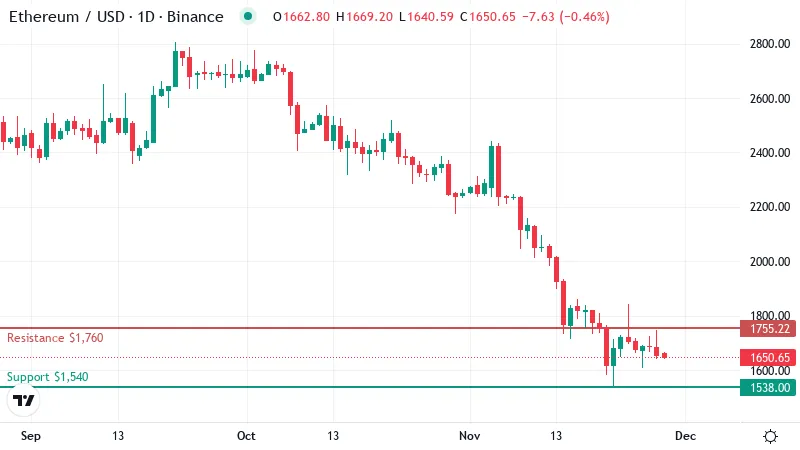
Ether changed hands near $1,650 on Friday, flat over the past 24 hours. The token has lost about 30% over the past month. That slide wiped out most of the gains bulls had built into the fall.
The moving averages show how far the market has fallen. A moving average smooths daily prices into one line, which helps readers see the trend. ETH sits well under its 50-day average near $2,050. It also trades below the 200-day average, which stands around $2,220.
Both lines now hang overhead like ceilings. When price trades beneath the short and long averages at once, the broader trend points down. Buyers would need a long climb just to test the nearer one.
The past week offered some relief. ETH gained about 2% over seven days. That move looks small next to the monthly drop, and it has not broken the pattern of lower highs. A bounce of this size often reflects short sellers taking profits rather than fresh demand.
Uncertainty over Glamsterdam weighs on the price too. Traders now face open questions about which contracts might break and how fast teams can patch them. Large holders tend to wait for clarity before adding exposure, and the Hoodi run is still weeks away.
Sellers Look Exhausted but Still Hold the Wheel
RSI, a 0 to 100 gauge of momentum, reads about 27. Anything under 30 counts as oversold. Readings this low often come before relief bounces, because sellers run short of fresh supply after a long drop.
Momentum is also starting to shift. The MACD, which compares short and longer price trends, has crossed above its signal line. That cross suggests the downside pressure is fading, even if prices have not climbed much yet.
The trend gauge tells a harder story. It still shows a real trend, and sellers remain in charge of it. Any bounce from here would come against that current. A short rally could stall before it changes the bigger picture.
Exhausted selling can spark a lift. Reversing the downtrend would take several strong sessions from buyers.
$1,540 Is the Floor Bulls Cannot Afford to Lose
The nearest support sits around $1,540, only a short drop below the current price. Buyers have defended that zone so far. A clean break would leave little in the way until the next floor near $1,200.
Thin support below means a failed bounce could turn into a fast slide. Holders of older contracts exposed to the storage change would face that risk at the worst moment.
Resistance sits closer to the upside, around $1,760. A close above it would be the first real sign of repair and would confirm the momentum shift.
Beyond that, the next ceiling stands near $2,170. That level sits just above the 50-day average zone. Bulls would need to clear both before anyone could call the downtrend over.
Where the Next Three Days Could Take ETH
Two paths stand out for the days ahead, and each has a clear line that would prove it wrong.
- Bullish: Oversold conditions spark a bounce that closes above the nearest resistance. That move would put the next ceiling, just above the 50-day zone, in play as a target. A daily close back under the support buyers have defended would cancel this setup.
- Bearish: Sellers break that same support before the Hoodi run, as worries about exposed contracts build. The path would then open toward the lower floor. A reclaim of the nearest resistance would invalidate the bearish case.
A Needed Upgrade Meets a Fragile Chart
Ether looks stretched to the downside, yet sellers still set the direction. Until buyers reclaim resistance, any bounce looks like a pause in a falling market.
The Hoodi testnet deadline is the near-term test. Reports of delays or failing contracts could hand sellers the push they need to break support.
Disclaimer: This article is provided for informational purposes only. It is not offered or intended to be used as legal, tax, investment, financial, or other advice.
Related Stories