What a Crypto Casino Live RTP Board Proves
 Crypto Daily
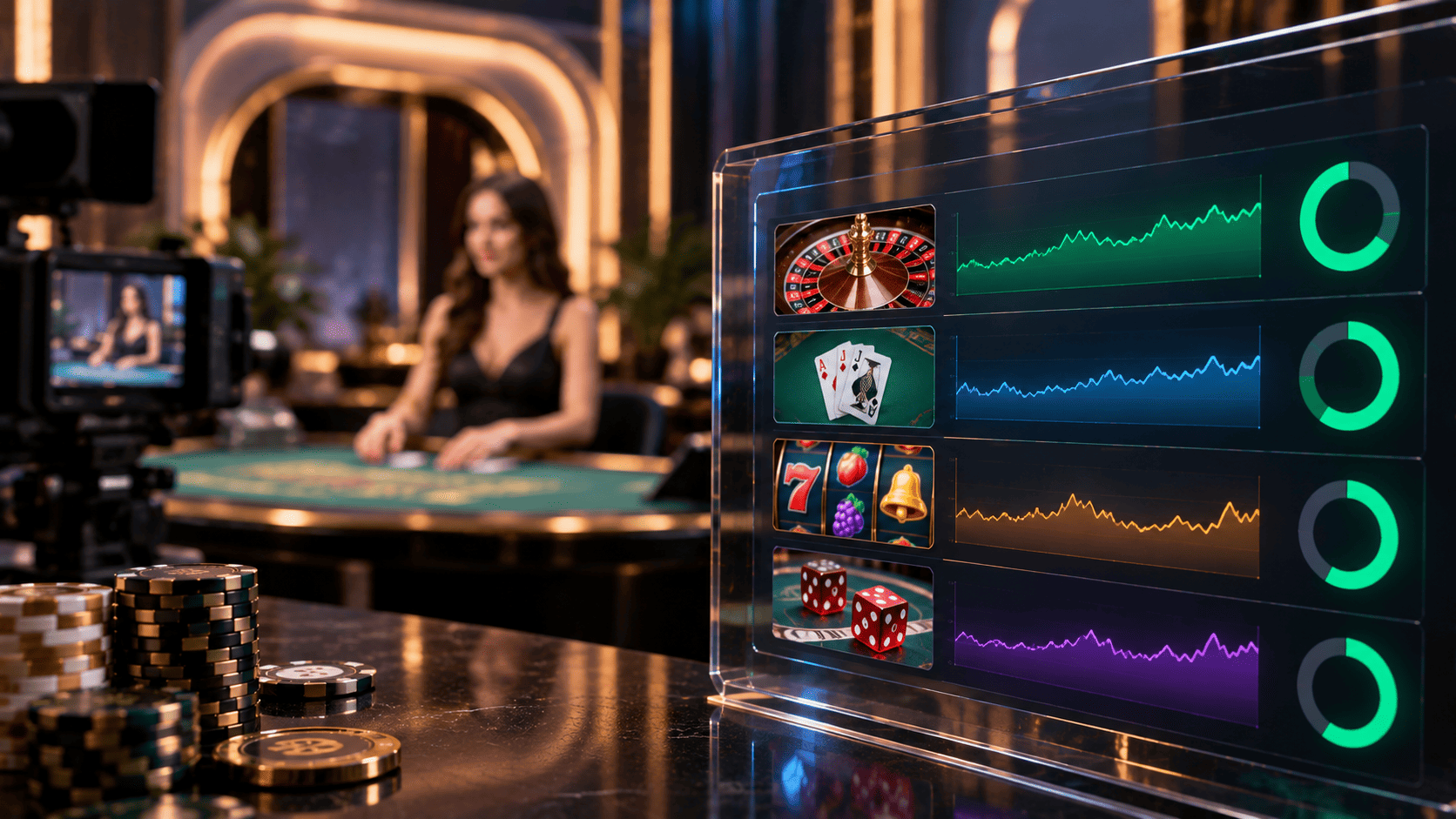
A handful of platforms now display a live return board, showing what a game has actually paid out over the last ten minutes, hour, or day. Roobet built much of its marketing around one.
It is a real disclosure and a narrow one, and the distance between what it shows and what people read into it is worth mapping carefully.
The Display and Its Arithmetic
Five things happen behind that number, and the fourth is where the misreading starts.
-
It sums every stake placed on that game during the window. Not your stakes, everyone's. The board is a house-wide measurement, not a personal one.
-
It sums every payout made on that game during the same window. Again, across all players.
-
It divides the second by the first. That ratio is the observed return shown on screen. If players staked 100,000 and received 96,500 back in the last hour, the board reads 96.5%.
-
The rolling window is short enough that the number swings violently. Over ten minutes, one large win can push a game past 100%. A quiet run of losing spins can drop it to 60%. Neither reading tells you anything about the game, because the sample is far too small to mean anything.
-
The figure resets as the window rolls. What you are watching is a moving snapshot of recent outcomes, not an accumulating record.
So the board answers a specific question: what has this game paid recently, across everybody. That is genuinely a fact, and it is not the fact most players think they are reading.
What It Genuinely Proves
Worth stating clearly, because the disclosure does have value.
A live board proves the operator is willing to publish observed outcomes it does not control. The figure moves on its own, sometimes unflatteringly, and a platform showing it has given up the option of quietly presenting only favourable information.
That is a disclosure choice, and most platforms decline to make it. Choosing to display something you cannot curate is a reasonable signal about how a business treats information generally, which is the same reason publishing licensing and withdrawal terms clearly tends to travel with other good behaviour.
The signal is about the operator. It is not about the game.
Four Things It Cannot Establish
Each of these gets read into a live board regularly, and none of them follows.
-
It does not prove the game is fair. Fairness concerns how outcomes are generated, and a board only reports what those outcomes were. A rigged game and an honest one can produce identical boards over any short window.
-
It does not predict your session. A game reading 104% over the past hour has no memory and no obligation. Your next hundred spins are drawn from the same distribution they always were.
-
It does not reveal the configured build running. Studios ship several certified versions of the same title at different returns, and the operator chooses. The board shows observed outcomes on whichever version is loaded, without naming it.
-
It does not mean the game is well priced. A board can be entirely accurate on a title configured at 94%, and the accuracy of the display does nothing about the cost of playing.
That third point is the important one. The number that actually determines what a game costs you sits in the information panel, not on the board, and the board will never surface it.
Dexsport Runs No Board
Dexsport runs no live RTP board, and it is worth saying so plainly instead of working around it.
Its transparency asset is a different one. Settlement is written to a public on-chain desk, so a resolved bet leaves a timestamped record independent of the account screen.
That answers a question about payouts reaching players, not about game returns, and the two are not substitutes: an on-chain record shows what you were paid, a live board shows what a game paid everyone.
For the game-return question, the practical route on Dexsport is demo mode, available across much of the library.
Open a title, find the information panel, read the configured figure. That number is more useful than any live board because it is the one governing the long run instead of the last ten minutes.
One honest note attached to it: the platform licenses its entire catalogue, so every figure in that panel is a studio build the operator selected. It holds an Anjouan licence, lighter than Curaçao or Malta.
Reading a Board Sensibly
If a platform shows one, treat it as information about the platform and not about the game. Two habits follow:
-
Read the board as a disclosure signal, since it tells you how the operator handles information it cannot curate
-
Then ignore the number itself, because the window is too short to carry meaning
Then go and find the configured return in the panel, because that is the number you are actually playing against, and what a lobby carries determines which figures are available to choose between in the first place.
On a platform without a board, the panel is the whole story. That is the position Dexsport players are in, and it is not a worse one, since the panel figure outlasts any ten-minute window.
Confirm what is legal where you live, keep stakes within a set budget, and play only if you are of legal age, since KYC or AML checks may apply.
Responsible gambling has a specific connection here: a board showing a game running hot is designed to be noticed, and treating recent outcomes as a reason to play is the gambler's fallacy with a dashboard attached.
Disclaimer: The information here is provided for general purposes only and is not legal, tax, investment, or financial advice. Return figures and platform features vary by operator and version, so consult each game's published information before playing. Betting carries risk, and rules vary by country, so check the law where you live. Please gamble responsibly, within your means, and only if you are of legal age.
Related Stories