Chainlink Launches CCIP 2.0 With Custom Security Checks for Cross-Chain Assets
 Darnell Whitaker

Chainlink launched CCIP 2.0 on September 28, making the cross-chain protocol available to institutions and developers distributing digital assets across blockchains. The release adds Cross-Chain Verifiers (CCVs), which let issuers place their own cryptographic approval checks alongside Chainlink’s existing verifier network.
The design shifts CCIP toward an additive, selective verification model: an issuer can require an extra verifier for particular transfers instead of applying identical conditions to every transaction.
CCIP 2.0 also adds configurable transfer speeds and compliance functionality. Chainlink says those controls are intended to support institutional digital-asset distribution, where security, timing and eligibility requirements can differ by asset or transaction.
CCVs add issuer-controlled checks to Chainlink’s verifier network
CCVs independently verify and cryptographically sign transfers alongside Chainlink’s default verifier network, according to the Chainlink developer changelog. Chainlink’s example is an approval requirement for transfers above $1 million.
The CCV configuration is additive. The default verifier remains in place, while issuers can attach an additional approval layer and select checks for transfers meeting their own criteria.
The release does not establish a universal threshold or prescribe the checks every issuer must use. Instead, it describes a system intended to let issuers set transaction-specific security requirements; CoinDesk likewise reported that applications can implement custom security checks on top of Chainlink’s existing verifier network.
For developers, the result is a choice between using the baseline as the only approval path and combining it with an independent signer.
Default committee and transfer speeds
Chainlink said the default Chainlink Committee Verifier comprises 16 independent, security-reviewed node operators. CCIP 2.0 retains that committee as its standard verifier while allowing issuers and institutions to add supplementary verification and security controls selectively.
Those controls can require additional approval for transfers that meet a chosen threshold, such as $1 million, while leaving lower-value activity subject to a different policy. The $1 million example illustrates the mechanism rather than a network-wide operating requirement.
CCIP 2.0 also supports configurable finality speeds. Chainlink’s documentation says faster-than-finality transfers are available, while full source-chain finality remains the default security setting; verifier requirements and transfer timing are therefore separate configuration choices rather than one fixed policy for every asset and route.
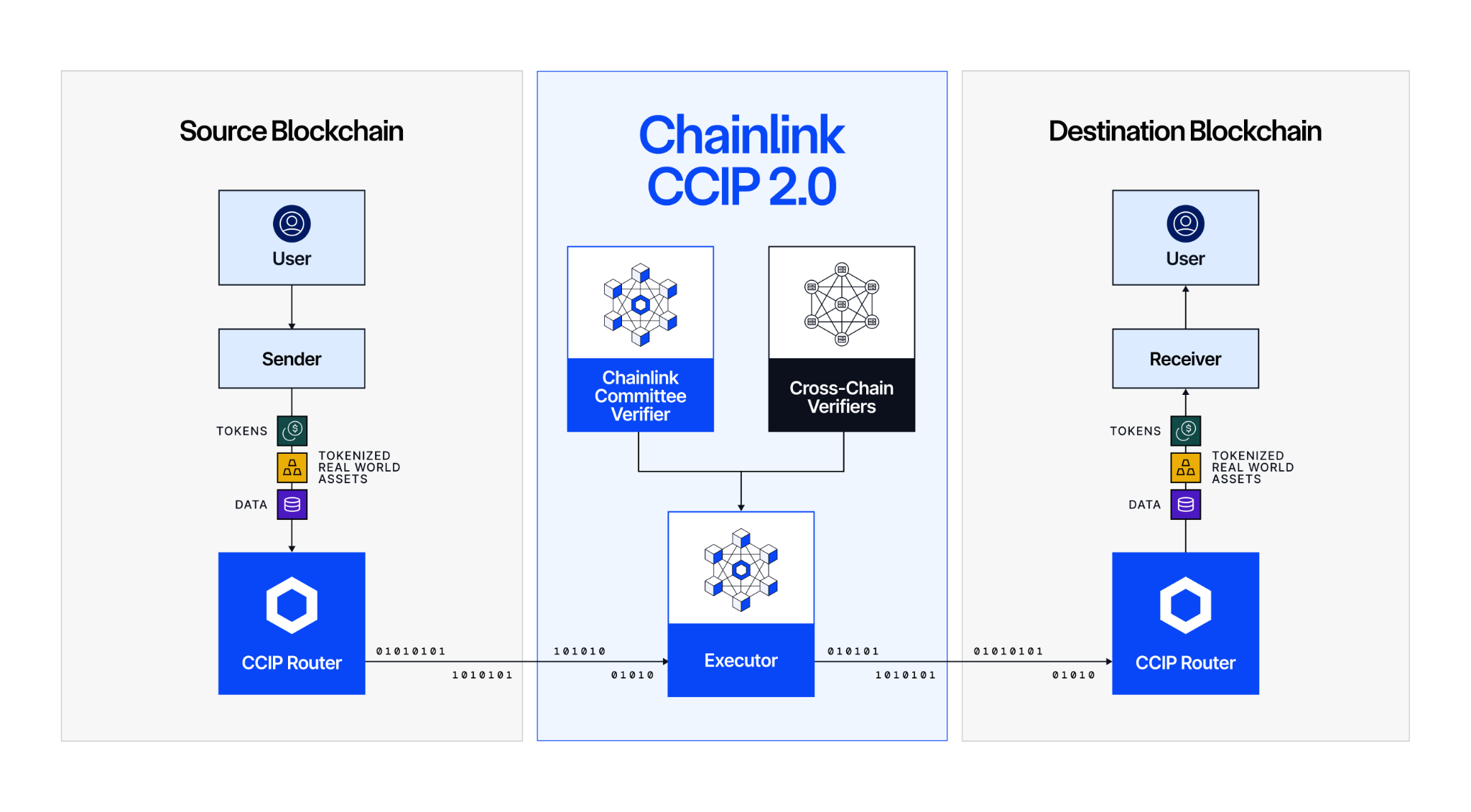
Capabilities of CCIP 2.0, including additive security, configurable transfer speeds, and built-in compliance. — Source: Chainlink
Automated Compliance Engine
Chainlink said CCIP 2.0 includes built-in compliance functionality through its Automated Compliance Engine. According to a release carried by PR Newswire, the engine supports know-your-customer checks, anti-money-laundering controls, sanctions screening and transaction limits.
The compliance tooling is part of a broader package that combines a 16-operator default committee verifier, optional independently signing Cross-Chain Verifiers and configurable finality speeds.
Chainlink has described CCIP 2.0’s focus as the distribution of institutional digital assets across blockchains. Issuers can configure additional checks and transfer-speed settings, shaping the security and operational policies applied to their transfers.
Disclaimer: This article is provided for informational purposes only. It is not offered or intended to be used as legal, tax, investment, financial, or other advice.
Related Stories