Treasury Buybacks vs QE: Why Buying $4B of Bonds Is Different
 Maya Collins

A $4 billion Treasury buyback is not QE. QE creates new bank reserves as the Fed buys assets; Treasury buybacks are financed by issuing other debt or using cash, so they rearrange what’s outstanding without expanding base money, and the Aug. 19 increase to at least $4.0 billion per long-end operation sits far below the trillions associated with QE.
The change is a targeted liquidity step for specific off-the-run CUSIPs, announced by the U.S. Treasury for operations beginning Sept. 9 through the remainder of the current refunding quarter here. Buybacks are a standing fiscal tool under 31 CFR Part 375 that lets Treasury redeem or purchase outstanding, unmatured marketable securities via scheduled operations with posted terms here. Funding comes from Treasury operations, not the central bank—Treasury either issues new securities or draws on cash to pay sellers, which means no fresh reserves are created by policy fiat Treasury. QE is different: the Fed buys securities and expands its own balance sheet, crediting bank reserves in the process, a design built to compress long-term yields across markets NY Fed. Scale drives perception, too—Treasury has run quarters with buyback caps around the tens of billions, such as about $38 billion, while QE has moved the Fed’s holdings by hundreds of billions to trillions Treasury. Same word “buy,” different balance sheet, different macro footprint.
Different balance sheets, different outcomes.
What Treasury buybacks are—and why the $4B increase isn’t QE
Buybacks are Treasury’s option to repurchase outstanding, unmatured marketable securities under its own regulations, usually targeting off-the-run CUSIPs where trading is thinner and dealers carry more inventory. Operations are scheduled, announced in advance, and specify which maturities are eligible, what sizes Treasury will accept, and how offers will be evaluated against prevailing market prices 31 CFR Part 375. The Aug. 19 step adjusts the maximum per-operation size for certain nominal long-end liquidity-support buybacks beginning Sept. 9, a scope limited to the remainder of the current refunding quarter and to the long end of the curve Treasury. The aim is operational: improve trading and intermediation in specific CUSIPs by offering a predictable outlet where holders can sell back to the issuer. It’s a plumbing change in a corner of the market, not an economy-wide pump of new base money.
Financing decides the category. Treasury must pay for bought-back bonds by issuing other securities or using cash on hand, which reshuffles the mix of debt outstanding by tenor and CUSIP rather than conjuring new central-bank liabilities Treasury.
Who creates the money: Fed vs. Treasury balance sheets
The Federal Reserve can create reserves against its asset purchases, expanding the Fed’s balance sheet when it conducts large-scale asset purchases of Treasuries and agency MBS to apply downward pressure on long-term interest rates NY Fed LSAP. Treasury cannot create reserves. When Treasury buys back older CUSIPs, it pays by drawing on Treasury resources or by issuing new securities, so the consolidated public sector isn’t injecting new base money; it’s exchanging one liability for another with different terms. Dealers and investors change the composition of their holdings—cash for an older bond—while the government’s debt stock shifts toward on-the-run issues or desired tenors. On the Fed’s ledger, nothing analogous to a QE reserve credit shows up.
Those mechanics lead to different transmission paths. QE broadens out through the banking system because reserves credited to sellers’ banks are central-bank money that can ease funding and portfolio constraints, with the Fed’s holdings climbing at scale during LSAP waves. Buybacks are narrower: a Treasury financing flow swaps specific lines of debt, can compress bid-ask spreads in targeted off-the-run maturities, and may help dealers warehouse risk with more confidence when a buyer of last resort exists for stale CUSIPs. Same market, separate levers, separate entries in the ledgers. And separate expectations for rates and risk assets.
| Item | QE (Fed LSAP) | Treasury Buybacks |
|---|---|---|
| Buyer | Federal Reserve | U.S. Treasury |
| Funding source | New central-bank reserves | Treasury issuance or cash |
| Balance-sheet impact | Fed assets and bank reserves expand | Debt mix shifts; base money unchanged |
| Primary goal | Ease financial conditions; lower long rates | Support trading in off-the-run CUSIPs |
| Typical scale | Hundreds of billions to trillions | Tens of billions per quarter |
| Likely effect on yields | Broad compression in long maturities | Local spread/tail effects; limited curve impact |
What each tool is built to fix: macro accommodation vs. trading liquidity
QE is a monetary policy tool designed to loosen financial conditions when the policy rate is constrained, with purchases aimed at putting downward pressure on longer-term yields across the economy NY Fed LSAP. Liquidity-support buybacks are Treasury market plumbing—offering a standing, rules-based bid that can improve willingness of dealers and investors to intermediate older CUSIPs and keep trading flowing in less active parts of the curve Treasury/TBAC.

Scale and reach: quarterly caps versus trillions
Size keeps these tools in different universes. Treasury’s recent refunding guidance has pointed to quarters with aggregate buyback caps around the tens of billions, such as up to about $38 billion in off-the-run purchases, with individual operations in the low-single-digit billions Treasury. QE has moved the Fed’s System Open Market Account by orders of magnitude more, as any chart of LSAP-era holdings makes plain NY Fed. That scale gap caps the reach of buybacks into market-wide yields even when they help clean up pockets of dislocation in off-the-run issues. It also explains why dealers treat buyback calendars as micro-liquidity events rather than macro accommodation.
How a Treasury buyback actually runs in practice
Strip it down to one operation and the mechanics are plain.
- Treasury posts an operation schedule naming eligible off-the-run CUSIPs, acceptable maturity buckets, and a maximum size under its buyback rules 31 CFR Part 375.
- Primary dealers and other eligible market participants submit offers to sell specified securities back to Treasury, often via the same electronic venues used for auctions.
- Treasury accepts a set of offers based on price and its stated criteria, targeting a mix that best relieves inventory and trading frictions in those CUSIPs.
- Settlement occurs: sellers deliver bonds; Treasury delivers cash, which it finances from issuance or cash on hand rather than reserve creation Treasury.
- The bought-back securities are retired; the outstanding debt mix tilts toward on-the-run benchmarks after Treasury replaces financing with fresh issuance as needed.
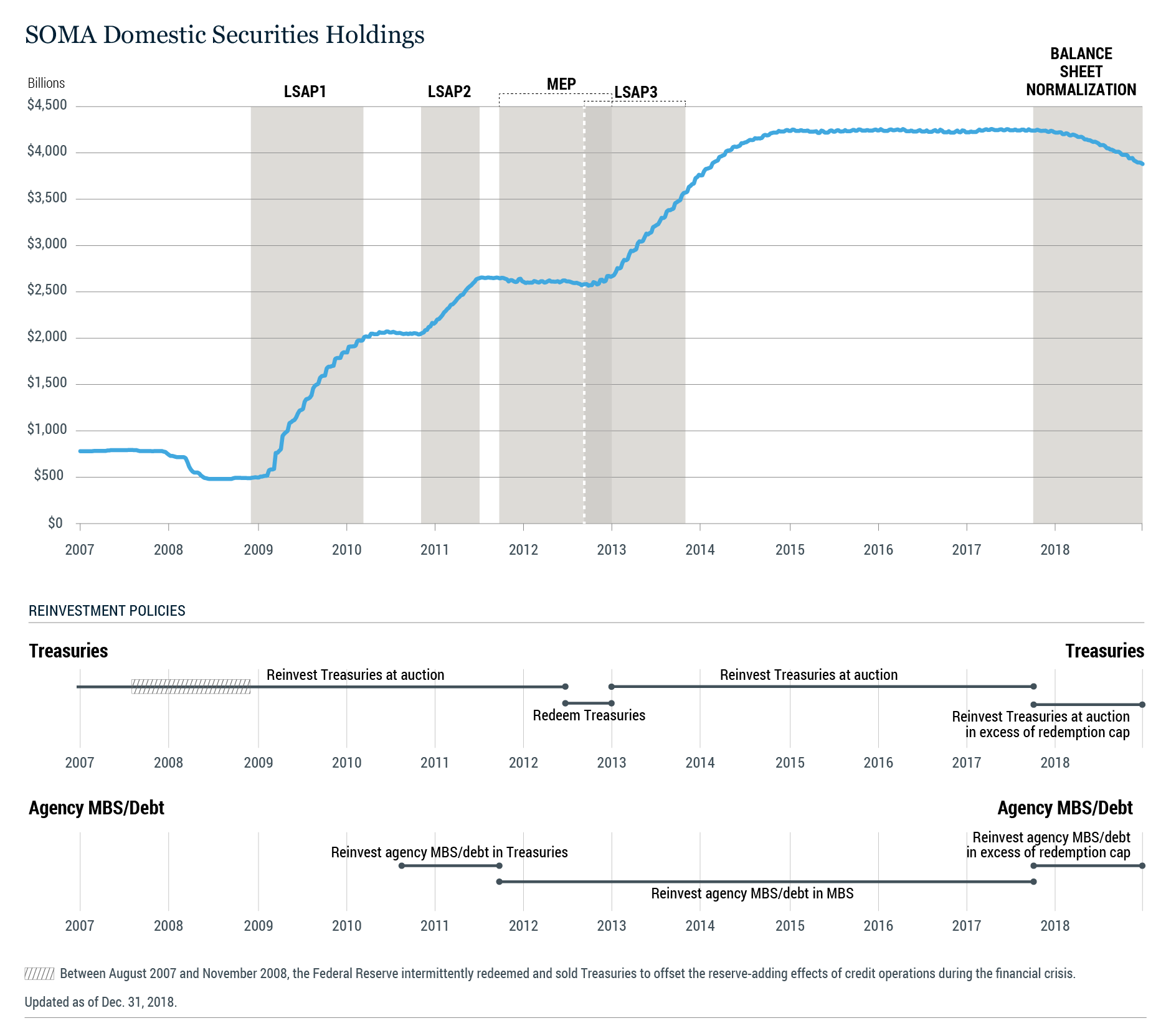
SOMA Domestic Securities Holdings — Fed holdings growth during LSAP (illustrates scale of Fed balance‑sheet expansion under QE versus the much smaller, targeted scale of Treasury buybacks). — Source: Federal Reserve Bank of New York — SOMA Domestic Securities Holdings (LSAP chart)
What buybacks can—and cannot—move in markets and in public finance
Buybacks can tighten bid-ask spreads in targeted off-the-run sectors, help dealers manage balance sheets when older CUSIPs get sticky, and give real-money accounts a cleaner exit path for stale lines. They can nudge relative-value relationships between off-the-run and on-the-run benchmarks inside the affected maturity bucket, especially around operation dates and sizes that dealers anticipate. They do not add central-bank reserves, do not reduce the public debt stock, and do not substitute for monetary policy when the goal is to shift economy-wide borrowing costs Treasury/TBAC. Scale matters, as quarterly caps in the tens of billions limit any curve-wide impact even if local pricing improves Treasury. Mix change, not money printing.
- Misconception: Buybacks are stealth QE. Reality: they are financed fiscal swaps that do not create reserves Treasury.
- Misconception: Buybacks lower the entire yield curve. Reality: effects are local to off-the-run trading; curve-wide moves need much larger flows NY Fed LSAP.
- Misconception: Buybacks shrink outstanding debt. Reality: unless funded by surplus cash without replacement, Treasury typically issues elsewhere, leaving the level similar while shifting composition 31 CFR Part 375.
The newly increased operation size applies only to specified nominal long-end liquidity-support buybacks for the rest of the current refunding quarter and must be financed, not minted Treasury.
Frequently Asked Questions
Does a Treasury buyback reduce the national debt?
No. Treasury usually replaces the repurchased securities with new issuance or pays with cash, so the total debt level isn’t cut by the operation; the mix changes instead Treasury.
Can buybacks push down the 10-year yield like QE?
Unlikely on their own. The operations are capped in the tens of billions per quarter and target specific off-the-run lines, which limits any broad curve impact Treasury.
Who can sell into a buyback?
Primary dealers and other eligible market participants that meet Treasury’s rules can submit offers on named CUSIPs during scheduled operations 31 CFR Part 375.
How does Treasury announce and time buybacks?
Through refunding statements and operation calendars that lay out dates, maturity buckets, and maximum sizes for each session Treasury.
What happens to securities that Treasury buys back?
They are retired and removed from circulation. Treasury then manages its financing with new issues as needed under the standard auction process 31 CFR Part 375.
Disclaimer: This article is provided for informational purposes only. It is not offered or intended to be used as legal, tax, investment, financial, or other advice.
Related Stories