ServiceNow Stock vs Tokenized NOW: Shares, Tokens and Key Differences
 Lena Carter
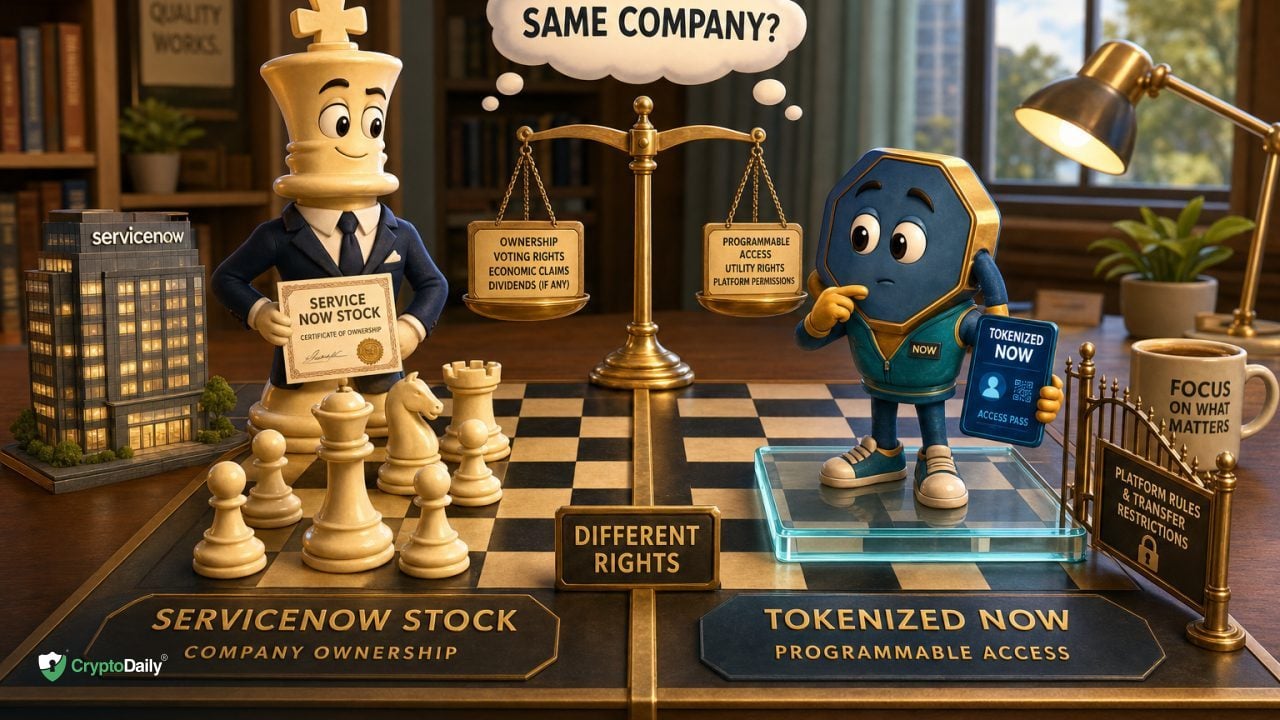
A token backed 1:1 by ServiceNow shares can be designed to follow the price of NOW without giving its holder a share of ServiceNow. That distinction is the central issue in comparing NYSE-listed NOW with NOWx, the token issued under Kraken’s xStocks framework.
NOWx changes the trading and custody wrapper around ServiceNow exposure. It offers small-denomination purchases, on-chain transfers and trading outside regular US equity-market hours. But the holder trades direct equity ownership, including voting and issuer information rights, for a contractual arrangement dependent on the token issuer, custody arrangements, the relevant platform and blockchain infrastructure.
The difference matters especially when the underlying company has operating results and forward demand indicators that equity investors ordinarily own a claim on. ServiceNow reported $12.883 billion of subscription revenue for 2025, up 21% year over year, and ended the year with $12.85 billion in current remaining performance obligations, up 25%.
NOW ownership carries ServiceNow’s operating upside and shareholder rights
NOW is ServiceNow’s common stock listed on the New York Stock Exchange. A direct holder owns equity in the company and has statutory shareholder rights, subject to the rules of their broker and the securities markets, according to the company’s Form 10-K.
That is more than a formal legal distinction. A common share represents a residual interest in the company: its business performance, its capital allocation and, if declared, its dividends. A shareholder’s return can still be negative even when operations are improving, because valuation and market conditions affect the stock price. Yet the ownership claim itself remains directly tied to the issuer.
ServiceNow’s latest reported figures illustrate what that operating exposure encompasses. The company’s full-year 2025 earnings release put total revenue at $13.278 billion, including $12.883 billion in subscription revenue. Current remaining performance obligations stood at $12.85 billion on December 31, 2025, a 25% increase that provides an indicator of contracted forward demand.
The company’s 2025 annual report also said revenue grew 21%, free-cash-flow margin expanded to 35% and the renewal rate was 98%. These measures do not establish a future share-price outcome. They do, however, describe the corporate performance to which a NOW shareholder has direct equity exposure.
For a buyer whose purpose is to hold an ownership interest in ServiceNow, the share is therefore not interchangeable with a price-tracking instrument. The latter may reference the same stock, but it does not confer the same corporate relationship.
NOWx is 1:1 backed price exposure, not a claim on ServiceNow
“Backed” describes the structure of NOWx, not ownership of ServiceNow. Kraken describes NOWx as an on-chain representation of ServiceNow stock within xStocks, backed 1:1 by underlying shares held in third-party custody to support price tracking.
Kraken’s xStocks risk disclosure says the backing does not convert NOWx into ServiceNow common stock or direct equity ownership. The shares in third-party custody support the xStocks arrangement; they do not make the token holder a shareholder registered with ServiceNow. The holder’s claim is defined by the xStocks arrangement.
The legal consequences are set out in Kraken’s xStocks FAQ: holders have no voting rights, direct entitlement to cash dividends, information rights from the underlying issuer, or legal claim on the underlying shares or residual assets if the company is liquidated. Kraken says dividends on dividend-paying underlying shares are handled through automatic reinvestment or an adjustment to the token balance rather than direct cash payments. ServiceNow’s operating performance may be reflected in NOWx market pricing to the extent the token tracks NOW, but token ownership does not create a separate right to ServiceNow’s cash flows, disclosures or governance.

Fractional, on-chain and extended-hours access comes with a geographic limit
The token wrapper has practical advantages for some users. Kraken says xStocks can be purchased fractionally from $1, transferred on-chain to compatible wallets and traded outside regular US equity-market hours. Ordinary exchange trading in NOW does not offer that particular combination through the xStocks product.
Those features can lower the minimum purchase size and make wallet-based movement possible for users who prefer on-chain settlement. Extended-hours availability also changes when an investor can seek exposure, although access outside standard market sessions should not be confused with identical trading conditions to the NYSE-listed share.
There is an immediate limit to the accessibility narrative: Kraken says xStocks are unavailable to US residents. The product’s claimed route around conventional market access therefore does not currently extend to the country where NOW is listed and where ServiceNow is based.
That restriction also frames the comparison correctly. NOWx is not simply a universally available digital version of an American stock. It is a product with a defined eligible-user base, platform terms and technical requirements. For an eligible non-US user, its utility may lie in denomination, timing and wallet transferability; for a US resident, that stated access case is unavailable.
The token wrapper adds risks direct NOW shareholders do not bear
A buyer of either instrument is exposed to ServiceNow’s business performance and the market valuation of that exposure. NOWx adds a second layer of risks associated with the structure used to deliver it. Kraken identifies dependence on the issuer and custodian, smart-contract risk, blockchain compatibility risk, platform restrictions and fees among the relevant considerations.
These are not merely different labels for ordinary stock-market volatility. Direct owners of NOW face company and market risk through the listed security. A NOWx holder also relies on the continued operation of the token framework and the arrangements surrounding the shares said to back it.
Redemption is another material distinction. Kraken’s risk disclosure warns that a redemption outcome may be lower than the return from owning the underlying stock directly. That means even a token intended to track NOW can produce a different economic result from holding NOW itself once the product’s mechanics, restrictions and costs are taken into account.
The custody model also concentrates the importance of disclosures and contractual terms. Since the holder has no legal claim to the underlying shares or ServiceNow’s residual assets, the existence of third-party-held backing does not eliminate issuer, custodian or platform dependency. It defines the route through which the token is meant to obtain its exposure.
For that reason, NOWx is best understood as an additional access product, rather than a replacement for ServiceNow stock. It may suit an eligible user seeking fractional, on-chain or extended-hours price exposure. It does not provide the shareholder rights attached to NOW, and Kraken’s own documentation says its redemption value may be less favorable than the return from direct ownership of the underlying stock.
Disclaimer: This article is provided for informational purposes only. It is not offered or intended to be used as legal, tax, investment, financial, or other advice.
Related Stories