Protocol Revenue Is Not Tokenholder Cash Flow
 Ethan Caldwell

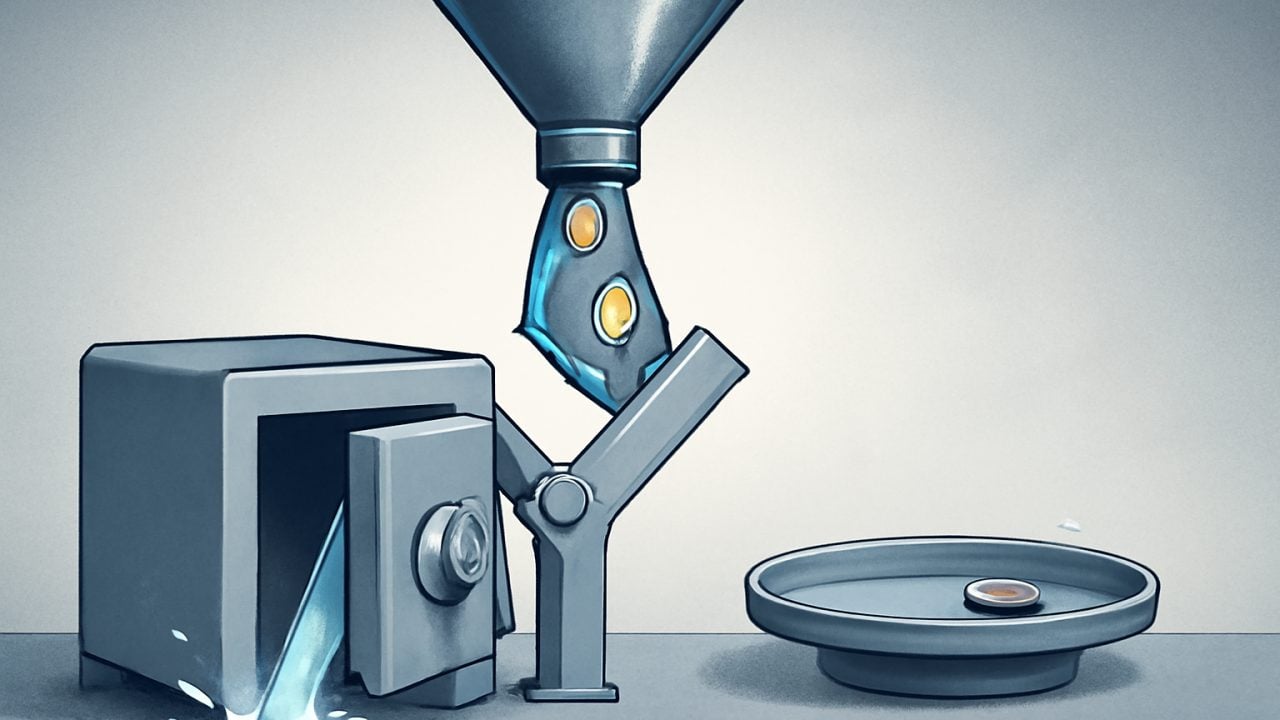
High on-chain fees do not guarantee cash flows for tokenholders. Protocols can capture value while token economics, governance, or law prevent that value from reaching holders. Treating “protocol revenue” as if it were distributable income to tokens is a category error that distorts valuation and risk assessment.
Two developments make the distinction timely. First, aggregate on-chain fees surged into 2025, with research putting them on a roughly $20 billion run-rate, yet only a small fraction of that ends up in tokenholder hands. A 1kx study found that out of 1,244 protocols, only about 20 passed more than $10 million in value to holders. Second, analytics providers and protocol documentation now draw harder lines between fee capture, protocol revenue, and holder accrual. DeFiLlama’s definitions explicitly separate “protocol revenue” from “tokenholder revenue.”
Governance and regulatory constraints further widen the gap. Uniswap’s fee switches require explicit governance action before a single dollar flows to UNI holders, even if pools collect fees. The mechanism is documented in Uniswap’s own governance forum on making protocol fees operational here. On the legal side, an SEC comment letter argues that issuer-controlled revenue shares or buybacks can be indicia of a security, complicating direct distributions to tokenholders (SEC comment).
The conclusion is straightforward: headline protocol revenue is not the same thing as tokenholder cash flow. Analysts, treasuries, and traders need to model the plumbing between gross fees and what, if anything, accrues to the token.
On-chain fees climbed while distributions didn’t
What changed is the scale and visibility of fee capture relative to meager holder distributions. The 2025 revenue pulse documented by 1kx shows protocols can generate large fee volumes without building, or enabling, mechanisms that move value to tokens. That divergence is now measurable, not anecdotal.
At the same time, standards bodies and analytics dashboards have matured. DeFiLlama’s taxonomy separates “fees,” “protocol revenue,” and “tokenholder revenue,” reinforcing that these are different economic layers, not interchangeable terms (definition). The effect is to remove the ambiguity that once let marketing copy gloss over whether revenue reaches holders.
Legal clarity advanced as well. The SEC comment letter cited above states that revenue-sharing features and buybacks controlled by issuers can signal a security. While a comment letter is not binding law, it amplifies a long-running concern: designs that explicitly funnel protocol revenue to tokenholders may import securities risk in major jurisdictions. That risk has made some teams favor supply-based accrual mechanisms over direct distributions.
What the data actually says about cash flows
Three verified datapoints frame the debate:
- DeFiLlama separates protocol revenue from tokenholder revenue, confirming they are different metrics by design (source).
- 1kx reports on-chain fees were tracking to roughly $20B in 2025, but only ~20 of 1,244 protocols pushed more than $10M to holders, illustrating the scarcity of direct accrual (source).
- Uniswap’s fee-switch architecture requires explicit governance activation before any protocol fees reach UNI holders, so fee capture alone is not a payout (source).
| Metric | Value | Source |
|---|---|---|
| On-chain fees run-rate (2025) | ~$20B | 1kx (H1 2025) |
| Protocols analyzed | 1,244 | 1kx (H1 2025) |
| Protocols passing $10M+ to holders | ~20 | 1kx (H1 2025) |
It is also useful to distinguish distribution channels. Ethereum’s EIP-1559 burns the base fee, permanently reducing ETH supply. That is a holder-accrual mechanism via supply effects rather than direct cash distributions, and analytics trackers show multiple millions of ETH have been burned since activation on 2021-08-05 (docs) (tracker). By contrast, Uniswap’s switchable protocol fees require governance execution and operational plumbing to even begin accruing value to the token, and are off by default (source).
Inference: the existence of fees is insufficient. Payout design, governance will, and regulatory posture determine whether and how fees translate into tokenholder outcomes.
Valuation math must follow the cash
Applying equity-style multiples to crypto without tracing the cash path is hazardous. Protocol “fees” are not comparable to company “revenue” if no part of them legally or mechanically reaches the token.
Analytics frameworks make this explicit. TokenTerminal advises distinguishing gross fees, protocol capture, and holder accrual, and to adjust for emissions and unlock schedules when valuing tokens (FAQ). FP Research similarly emphasizes EV-to-holder-revenue rather than EV-to-fees, centering the metric that actually accrues to the token (framework).
Opinion: a defensible workflow starts with a waterfall model:
- Gross fees generated by the protocol or network.
- Protocol capture after LP rebates, validator payments, or subsidies.
- Operating treasury usage versus distributable surplus.
- Mechanism of accrual to the token: direct payout, buyback/burn, supply burn, or none.
- Net to holders after dilution from emissions, unlocks, and incentive programs. >
Only the final line deserves a valuation multiple. Anything higher in the stack belongs in an operating model, not a pricing anchor for the token.
Verified example: EIP-1559’s burn is a supply-side accrual that can support value for ETH holders without creating wallet cash flows (docs) (tracker). Inference: similar designs may be preferable for protocols wary of securities risk but still seeking a credible value-accrual story.
Design, governance, and the legal line
Even when a protocol captures fees, the token’s share depends on technical design and governance action. Uniswap shows how a fee switch can exist on paper but remain off for long stretches pending governance appetite and operational readiness (source). That makes “revenue optionality” a weak foundation for valuation unless there is a concrete, scheduled path to activation.
Regulatory sensitivity compounds the execution risk. The SEC comment letter suggests that issuer-controlled distributions or buybacks tied to protocol revenue can be strong indicators of a security (source). Whether or not a given token would meet that test, the perceived risk often keeps teams from promising or enabling direct revenue shares. The result is a preference for supply-based mechanisms or for confining cash flows to stakers with additional functionality, rather than unconditional holder entitlements.
Inference: in today’s environment, governance tokens are more likely to accrue value through indirect channels (supply effects, utility gating, preferential access) than through direct dividends. Markets should price the difference.
The strongest counterargument: cash flows can be engineered
There are clear counterexamples. Curve’s veCRV and associated gauge systems are designed so that locking the governance token delivers a share of protocol income, a model detailed in public token-transparency materials (Curve overview). Earlier Sushi designs, via xSUSHI/SushiBar staking, likewise channeled a portion of fees to stakers, as reflected in forum documentation and program filings (Sushi forum).
These architectures prove that tokenholder cash flows are possible if a protocol builds the technical plumbing and accepts the governance and legal trade-offs. They also remind us that “holder revenue” can be conditional on staking, lockups, or active participation, which differs from an unconditional dividend. Verified: such systems exist and have operated in the market. Inference: they may remain niche where teams fear regulatory overhang or prefer to reinvest fees into growth.
Opinion: the counterexamples are strongest when the protocol’s core product market fit is durable and when the community openly underwrites the legal and economic implications. Otherwise, the distribution switch tends to stay off.
What would confirm or weaken this thesis
Indicators to watch:
- Governance proposals with precise parameters and timelines to activate protocol fee switches, particularly at large DEXs and L2s. Confirmation would be on-chain votes and subsequent contract calls that route fees to tokenholder mechanisms.
- Tokenomics updates that rewrite accrual from “optional” to “automatic,” including explicit buyback/burn schedules or staking reward policies that are not discretionary. Public documentation and contract deployments would be the tell.
- Regulatory disclosures or rulemaking that clarify whether revenue-sharing tokens are likely securities. The SEC’s public comment docket is a primary source for evolving interpretations (reference).
- Analytics platform changes that separate gross fees, protocol capture, and holder accrual in default dashboards. Wider adoption of these taxonomies by trackers like DeFiLlama would reinforce market discipline (definition).
- Net dilution metrics: emissions, unlocks, and incentive programs that offset any holder accrual. Research frameworks like FP’s EV/Holder-Revenue can highlight whether accrual survives dilution (framework).
- Network-level supply effects that continue to operate as indirect accrual, such as ongoing EIP-1559 base-fee burns, observable on trackers like UltraSound.money (tracker).
Editorial view: the market will close the pricing gap when protocols either harden accrual into code and governance or admit that tokens are utility and control primitives, not cash-flow claims. Until then, protocol revenue is a starting point for analysis, not a valuation endpoint.
Disclaimer: This article is provided for informational purposes only. It is not offered or intended to be used as legal, tax, investment, financial, or other advice.
Related Stories