Mastercard Buys BVNK to Expand Stablecoin Payment Rails
 Maya Collins

If you follow the slow-but-steady march of crypto into payments, this one’s a real moment. Mastercard has officially bought BVNK, a stablecoin payments firm that’s been busy wiring cross-border money over on-chain rails. Here’s what changes, who it helps first, and the boring-but-critical risks to keep in mind.
We’ll keep it practical. You’ll see how these rails actually move funds, what this means next to Visa’s USDC experiments, and where things can still jam up. No hype — just the moving parts you’ll need to evaluate.
Mastercard closed its acquisition of BVNK on August 3, 2026, taking a direct swing at faster, regulated stablecoin settlement for merchants, remittance firms, and fintechs. BVNK brings a global, licensed platform that already handles sizable on-chain flows, while Mastercard gives distribution, compliance muscle, and merchant relationships. Expect pilots and corridor-by-corridor rollouts before anything universal.
- Deal closure is posted on the Mastercard newsroom dated Aug 3, 2026 (Mastercard Newsroom).
- BVNK’s footprint spans 130+ countries with 25+ licences/approvals and roughly $30B annualized stablecoin volume per recent industry coverage (VelaFi).
- Remittance partner LemFi (serving ~2M customers) is rolling out stablecoin settlement market by market (The Paypers).
- Near term: faster cross-border settlement options and treasury flexibility; cardholder experience won’t suddenly change overnight.
- Main frictions: regulation by region, on/off‑ramp capacity, and issuer/chain concentration risks.
What did Mastercard actually buy — and why does BVNK matter?
Mastercard picked up BVNK, a payments platform built to route funds over regulated stablecoin rails. Think of it as the connective tissue that lets a fintech, PSP, or remittance firm settle across borders with stablecoins instead of relying only on bank wires. The pitch is speed, programmability, and better reach into places where bank infrastructure is slow or expensive.
BVNK isn’t starting from zero. Recent industry coverage says the platform operates in 130+ countries with 25+ licences or approvals and processes around $30 billion in annualized stablecoin volume as of mid-to-late July 2026 (VelaFi). That footprint matters because onboarding and compliance rarely scale overnight in payments.
And yes, this is official. Mastercard’s press listings show the acquisition closed on Aug 3, 2026 (Mastercard Newsroom). Strategically, it positions Mastercard closer to on-chain settlement while still operating under familiar compliance obligations. Instead of dabbling from the sidelines, this is a real integration bet.
How do stablecoin rails actually move money?
At a high level, a PSP or remittance provider funds a settlement account, and the platform converts that value to a regulated stablecoin on a supported chain. That token is sent across borders to a receiving partner who either keeps it in stablecoin or off-ramps to local currency. The ledger update is on-chain; the customer-facing part can be just as invisible as a typical fintech app.
Behind the scenes, you still have familiar checks: KYC on senders/recipients, sanctions screening, transaction monitoring, and sometimes travel rule data exchange. The difference is the clearing and settlement layer is a blockchain instead of a patchwork of correspondent banks. When it works well, funds settle in minutes, reconciliation is cleaner, and FX can be handled programmatically or at endpoints.
For remittances, this unlocks more reliable back-end movement. LemFi’s rollout with BVNK is a case in point: stablecoin settlement under the hood while the user interface stays simple (The Paypers). It’s less about crypto buttons in the app and more about cheaper, faster plumbing.
Pro tip: If you’re a fintech, push for net settlement windows (hourly or daily) rather than sending every transaction on-chain. You’ll cut fees, reduce congestion risk, and simplify reconciliation.

What changes for merchants, PSPs, and remittance firms in the near term?
Day to day, card acceptance doesn’t flip to crypto. The bigger near-term impact is optionality for settlement and treasury. A marketplace paying suppliers in multiple countries can settle to a PSP in stablecoins and off-ramp locally, sometimes same day. A remittance firm can reduce pre-funding across corridors and still meet delivery SLAs.
Mastercard’s distribution plus BVNK’s licenced footprint speeds up pilots. But expect a corridor-by-corridor approach, similar to how new payout networks roll out. Each market has its own licensing, tax treatment, and FX rules. That’s why the LemFi deployment is being introduced market by market (The Paypers).
If you’re evaluating integration, this practical checklist helps:
- Define corridors and currencies first; don’t boil the ocean.
- Decide who holds custody of stablecoins (self, PSP, or a qualified custodian).
- Set risk limits for issuer, chain, and on/off‑ramp concentration.
- Map AML, sanctions, and travel rule obligations by jurisdiction.
- Plan net settlement cycles and reconciliation tooling upfront.
- Pre-negotiate FX spread and off-ramp SLAs; test weekend and holiday flows.
- Model gas fees under stress conditions and pick chains accordingly.
- Align accounting treatment and tax documentation before go-live.
How does this compare with Visa’s USDC work and old-school SWIFT wires?
Visa has run real USDC settlement pilots with acquirers and PSPs, and SWIFT remains the universal fallback when nothing else works. Mastercard plus BVNK is another take on the same problem: move value faster and safer across borders, in a way big merchants can actually use. Here’s a simple snapshot to frame the differences.
| Option | Settlement speed | FX handling | Compliance model | Coverage | Chargebacks | Typical use cases |
|---|---|---|---|---|---|---|
| Mastercard + BVNK | Minutes to near‑instant (by chain/corridor) | At endpoints or programmatic | Network compliance plus BVNK licences/controls | Global rollout, corridor by corridor | Card disputes remain; on-chain settlement may not be reversible | Merchant settlement, remittances, B2B payouts |
| Visa + USDC programs | Minutes to near‑instant (pilot corridors) | Often handled by partners/off‑ramps | Visa network rules plus partner compliance | Pilots and partner-driven markets | Visa dispute framework; on-chain legs are final | Acquirer settlements, PSP treasury, cross‑border payouts |
| SWIFT/bank wires | Same day to 3+ days | Bank-driven, opaque spreads | Bank-led KYC/AML, correspondent chains | Nearly universal bank coverage | Traditional recalls possible but slow | High-value transfers, regulatory comfort zones |
In practice, big merchants and PSPs will mix all three. Stablecoins handle speed-sensitive corridors; wires cover regulated or low‑liquidity edges. The winning setup is usually hybrid.
Where could this run into regulatory or operational friction?
Stablecoins live in the gap between payments and securities rules. Regions inspired by e-money or MiCA-style frameworks want reserve transparency, issuance controls, and caps on daily flows. Even with BVNK’s licences and Mastercard’s risk playbook, each corridor has its own tripwires: who’s the issuer, what chain, what reserve, what disclosures?
Operationally, three gotchas show up fast. First, chain congestion and gas volatility can blow up your cost assumptions. Second, on/off‑ramp capacity is still finite in some markets, which turns Friday wind‑downs into a scramble. Third, stablecoin issuer risk isn’t abstract; depegs and redemption queues do happen. You need limits and contingency plans.
There’s also the human side. Finance teams need clear accounting treatment for on-chain settlement. Customer support needs a script for when an on-ramp stalls. Legal needs to bless travel rule messaging. It’s not hard work, just unglamorous — set it up early.
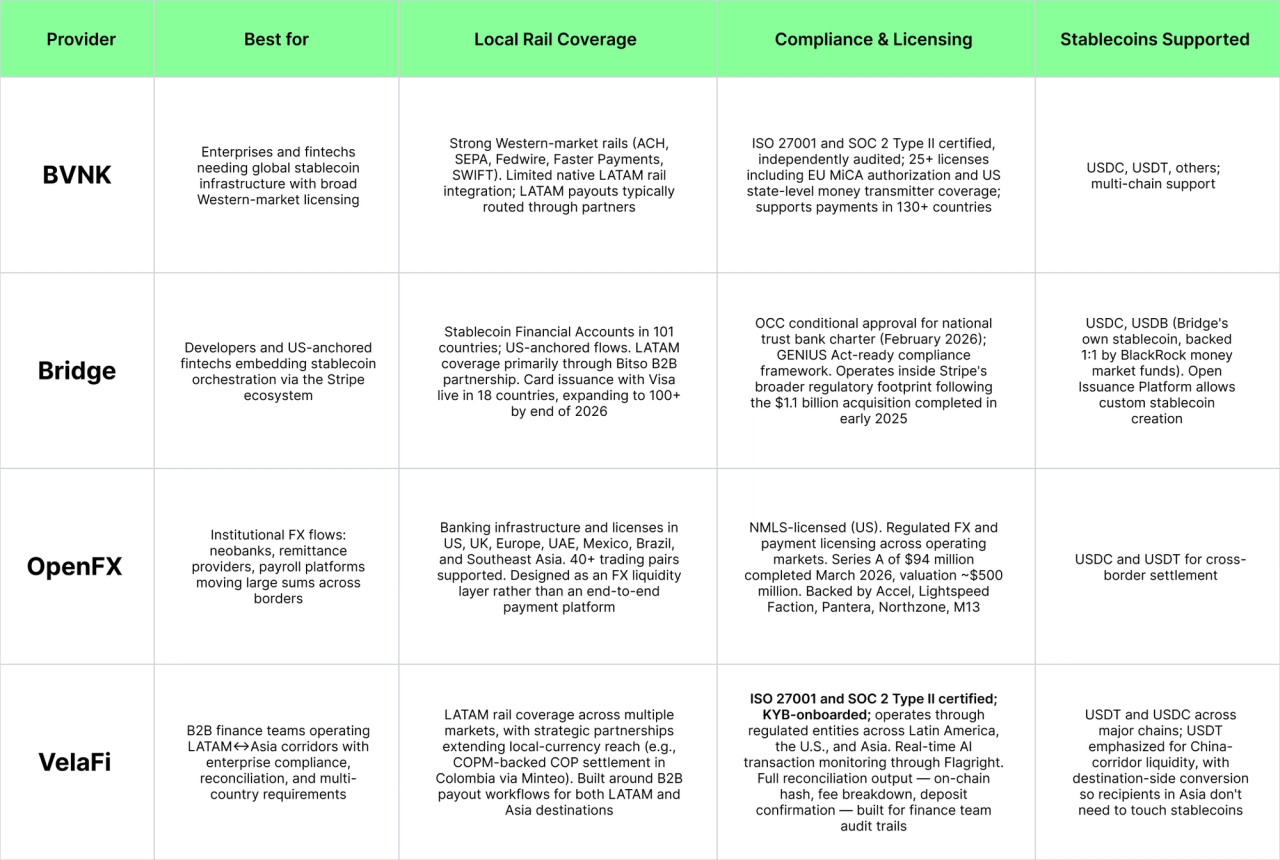
Comparison table (PNG) showing BVNK’s scale and positioning vs. peers — cites BVNK’s ~ $30B annualized volume, 25+ licences and 130+ country coverage (useful to illustrate why Mastercard acquired BVNK). — Source: VelaFi
Who benefits first — and what should we watch next?
Remittance players with active corridors benefit immediately. LemFi’s rollout with BVNK is a live example, serving roughly 2 million customers, with deployment going market by market (The Paypers). B2B marketplaces and gig platforms with lots of small cross-border payouts are next in line.
On the enterprise side, treasury teams will test stablecoin settlement windows as a way to reduce pre-funding and weekend risk. They won’t move everything on day one — just the corridors where it pencils out.
What to watch: which stablecoins are supported, which chains make the cut, issuer diversification rules, SLAs for redemptions, and whether fees actually land below wires at scale. Also keep an eye on how quickly Mastercard opens new corridors versus the typical pace of bank partnerships.
And the macro signal: Mastercard isn’t experimenting from the lab anymore. The acquisition is done (Mastercard Newsroom), and BVNK has real volume in market (VelaFi). That suggests we’re past the warm-up lap.
Common Mistakes
- Assuming card transactions will auto‑settle in stablecoins. They won’t by default. Ask your acquirer/PSP which corridors and currencies are enabled and on what timeline.
- Underestimating compliance lift. Travel rule messaging, sanctions screening, and chain analytics need to be wired in before volume ramps.
- Ignoring issuer and chain concentration. Set hard limits per stablecoin issuer and per chain. Run playbooks for depegs and congestion.
- Skipping treasury and accounting alignment. Decide how to book stablecoin balances, FX timing, and realized vs. unrealized gains or losses.
- Sending every payment on-chain individually. Use net settlement windows and batch transfers to cut fees and simplify reconciliation.
If you want ongoing context without the noise, Crypto Daily tracks these integrations as they move from press release to real corridors. You can follow our coverage at Crypto Daily.
Frequently Asked Questions
Does this mean my Mastercard purchases are now settled in stablecoins?
No. For consumers and most merchants, nothing changes overnight. Stablecoin settlement is likely to roll out in specific corridors, partners, and programs first. Think of it as an extra settlement option behind the scenes.
Which stablecoins will be used?
Mastercard hasn’t publicly committed to specific assets in this announcement. In general, regulated fiat-redeemable stablecoins with transparent reserves are the usual candidates. Expect corridor-specific choices based on regulation and liquidity.
Will fees actually be lower than bank wires?
Sometimes, yes — especially when you’re replacing a slow correspondent chain with on-chain net settlement. But fees depend on gas, off-ramp spreads, and partner pricing. Model under stress scenarios before committing.
What about chargebacks and disputes?
Card dispute rights stay within the card network. The on-chain legs of settlement are final once confirmed. Operationally, your PSP reconciles both worlds so customers still have a familiar dispute path.
Who holds custody of the stablecoins during settlement?
It varies. Some programs keep funds with a licensed custodian or the PSP; others allow limited direct custody. The trade-off is control vs. operational complexity. Many enterprises start with custodial setups to simplify controls.
How does this affect remittances specifically?
It can cut pre-funding and speed up delivery, which improves reliability and sometimes cost. LemFi’s partnership with BVNK — rolling out market by market to ~2M customers — is a live example of how back-end settlement can improve without changing the app UI (The Paypers).
Is this compliant with regional rules like Europe’s stablecoin framework?
Programs are built to meet local licensing and disclosure requirements, but details differ by country. That’s why launches happen corridor by corridor and not everywhere at once. Your legal and compliance teams still need to sign off for each market.
Disclaimer: This article is provided for informational purposes only. It is not offered or intended to be used as legal, tax, investment, financial, or other advice.
Related Stories