Formula 1 Markets Explained for Crypto Bettors
 Crypto Daily
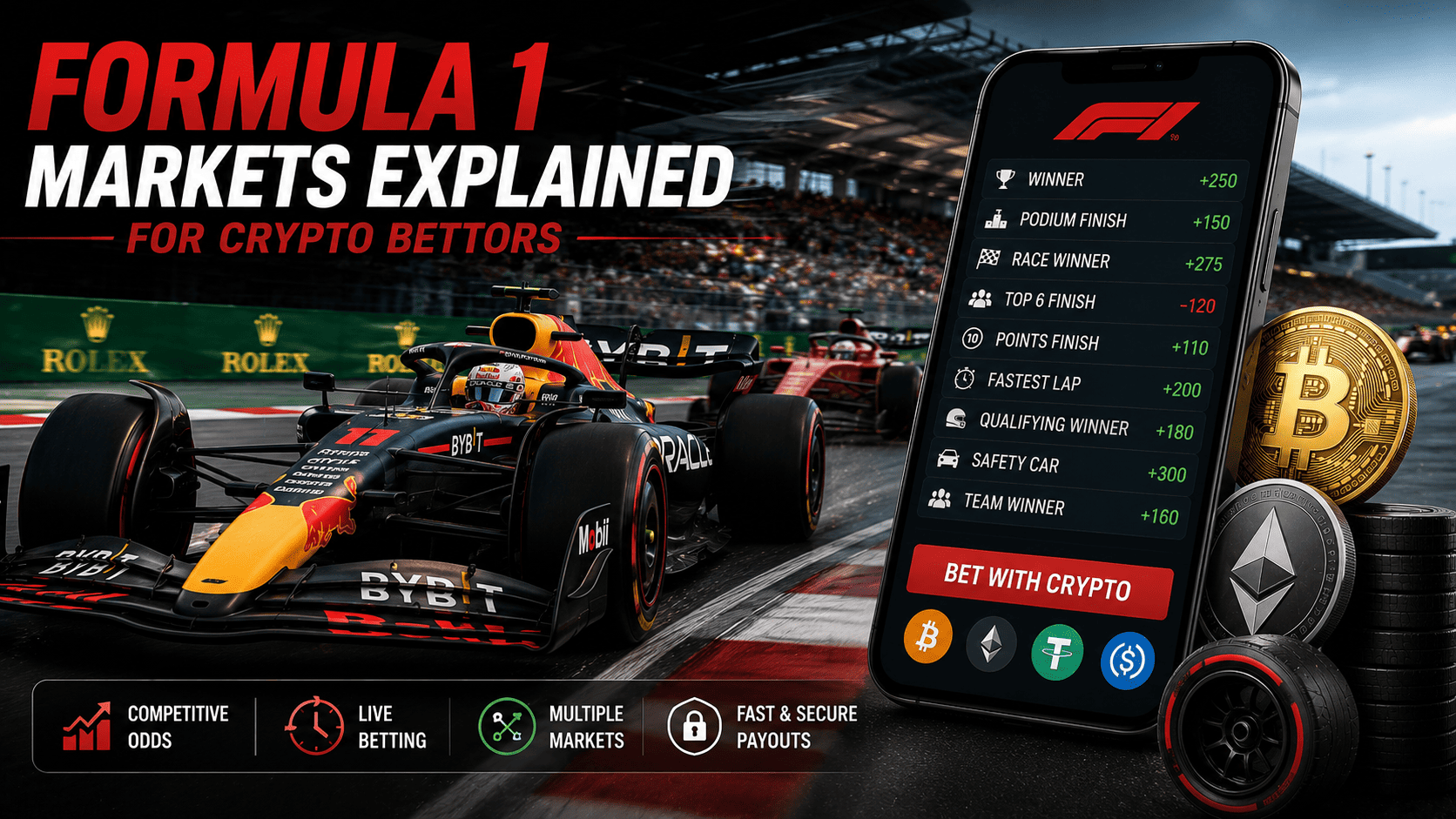
Formula 1 is a championship sport disguised as a race series, and its betting board reflects that. Some markets settle in two hours on a Sunday afternoon; others run for nine months and are decided by consistency across two dozen races. A bettor treating both the same way misunderstands what they are holding.
This explains the F1 market families, the settlement conventions that catch people out, and how coverage varies between crypto platforms.
Six Market Families on an F1 Weekend
-
Race winner and podium. The base markets: the driver to win, and the drivers to finish in the leading three. Podium markets are traded heavily because they offer a shorter proposition than an outright win in a series where the front of the grid is often predictable.
-
Championship outrights. Drivers' and constructors' titles run the full season and reprice after every round. These are the longest-dated positions on an F1 board, and by late season they can become close to settled while still trading.
-
Qualifying and pole position. Saturday has its own market set, priced separately from the race. Grid position matters enormously at circuits where overtaking is difficult, which is why qualifying markets attract genuine attention instead of being an afterthought.
-
Head-to-head matchups. These pair two drivers, or two teammates, and ask only which finishes ahead. They remove the field entirely, which makes them the most focused market on the board and a common choice for bettors with a view on a specific rivalry instead of a race outcome.
-
In-race specials. Fastest lap, whether a safety car appears, the number of classified finishers, and first retirement all price events within the race independent of who wins. Safety car markets in particular vary enormously by circuit.
-
Sprint-weekend markets. At rounds carrying a sprint, the shorter Saturday race has its own winner, podium and head-to-head board, effectively giving the weekend two sets of race markets.
The Settlement Rules Worth Reading
Motorsport has more edge cases than most sports, and three come up regularly.
-
Classification is the first. A driver who fails to complete the required race distance may still be classified, and markets on finishing position usually settle on the official classification and not on who crossed the line. That matters for podium and head-to-head bets where a car retires late.
-
Shortened and suspended races are the second. Red flags can end a race early, and if a race is stopped before a set proportion of the distance is completed, points allocation changes and operators may void certain markets. Rules on what constitutes a completed race for betting purposes vary between books.
-
Post-race decisions are the third. Stewards can apply penalties or disqualifications after the flag, changing the classification hours later. Most operators settle on the official result at a defined point, but which point differs, and how a sportsbook handles settlement is the detail to confirm before a season of motorsport betting.
Why 2026 Is an Unusual Season to Model
Anyone applying historical form to this year's grid should note that the sport reset its technical rules for 2026.
New power unit regulations arrived alongside a revised chassis formula, and the grid expanded with new entrants. Regulation resets historically scramble the competitive order, because teams that adapt quickly to a new formula can leap forward while established front-runners fall back.
For betting, that means multi-year form is a weaker guide than usual and within-season form matters more. Championship outrights taken early in a reset year carry more uncertainty than they would in a stable regulatory period.
Coverage Varies More Than in Mainstream Sports
Motorsport is where crypto sportsbook coverage thins out fastest, and it is worth checking properly.
Many platforms list motorsport as a category without pricing much beneath the race winner. A book offering head-to-heads, in-race specials and qualifying markets is treating the sport seriously; one showing a winner market and a podium is not, whatever the menu suggests.
Dexsport is a case in point for how to check instead of assume. Its own sport list includes Motor Sports, and third-party reviews additionally record motorcycle racing and several racing disciplines alongside references to racing-specific rules in its market descriptions.
What that does not establish is depth on any particular championship, so a motorsport bettor should open an actual race weekend on the platform and count the markets instead of relying on the category appearing in a menu.
Two further points are worth knowing: the platform does not offer a Bet Builder or same-game combinations, which limits how weekend selections can be packaged, and it operates under an Anjouan licence with a published restricted-territory list.
That approach applies to any platform, and comparing books on the sports you actually follow is more useful than comparing headline sport counts.
Two Timescales, One Sport
The practical takeaway is that F1 asks a bettor to hold two clocks at once. Race weekends produce short-dated markets that settle within days; championships produce positions that live for most of a year and reprice every fortnight.
Read the classification and red-flag rules before the first race you bet, and check that your platform prices more than the winner market. Confirm what is legal where you live, keep stakes within a set budget, and play only if you are of legal age, since KYC or AML checks may apply.
Responsible gambling applies across a calendar of two dozen rounds, where a season-long championship position can quietly encourage betting every weekend to stay involved.
Disclaimer: The information here is provided for general purposes only and is not legal, tax, investment, or financial advice, and nothing here is a betting tip or prediction. Regulations, classifications and settlement rules change and vary by operator, so confirm current details before betting. Betting carries risk, and rules vary by country, so check the law where you live. Please gamble responsibly, within your means, and only if you are of legal age.
Related Stories