Crypto Startup Safe Harbors: Faster Fundraising, Weaker Guardrails?
 Darnell Whitaker

Washington is edging toward a rule-based pathway for token launches. The U.S. Securities and Exchange Commission’s Token Safe Harbor Proposal 3.0 would create a time-limited exemption for certain token offerings under proposed Rule 195, conditioned on disclosures and an expectation that a networked token reaches “Token Maturity” within three years. Verified fact: the draft also excludes specific token types, including those regularly bought and burned as a fixed percentage of a centralized business’s profits, narrowing the scope of eligible designs (SEC — Token Safe Harbor Proposal 3.0).
The central conclusion: a carefully bounded safe harbor could pull U.S. crypto fundraising back onshore and improve baseline disclosures, but it risks thinning guardrails if market participants treat a narrow exemption as a broad permission slip. What makes this timely is procedural movement in Washington and stark evidence that today’s token-launch machine often raises money quickly while delivering weak results for public buyers.
Verified facts: the SEC’s broader “Regulation Crypto Assets” package, which includes the safe-harbor framework, moved into White House review in early April 2026, a required Office of Information and Regulatory Affairs step before publication in the Federal Register. The agency’s Unified Agenda shows related crypto-asset rulemakings at the Proposed Rule stage in 2026, including RIN 3235-AN38 and related entries (RegInfo — SEC rule list). Independent market data add urgency: in 2025, 84.7% of 118 tracked token launches traded below their TGE valuation by December 20, with the median fully diluted valuation down roughly 71% (Memento Research).
Industry feedback to the SEC underscores the tension. Verified facts: Andreessen Horowitz urged narrowly tailored safe-harbor paths for airdrops and incentive programs to avoid excluding U.S. users or leaning on ad hoc relief (a16z submission). Coin Center pressed for prospective, notice-and-comment rulemaking rather than selective no-action or exemptive relief. Trade groups such as SIFMA and Fidelity warned the agency to preserve core registration and market-structure safeguards for tokenized markets (SEC Crypto Task Force inputs).
What just changed in the SEC’s process
Verified facts: the safe harbor sits within a broader SEC rulemaking package that advanced to White House OIRA review in early April 2026 and appears on the SEC’s Unified Agenda at the Proposed Rule stage for 2026 (RegInfo). That procedural step is a gateway to public notice, draft rule text, and a comment period. It does not predetermine outcomes, but it signals internal consensus to air the proposal formally.
In parallel, the Token Safe Harbor Proposal 3.0 text circulated within the SEC’s Crypto Task Force describes how Rule 195 could function in practice. Verified facts: the framework covers “Qualifying Transactions,” requires disclosures, and anchors a three-year path to “Token Maturity.” It also proposes companion exemptions under the Exchange Act for the “exchange,” “broker,” and “dealer” definitions, plus a tailored Investment Company Act exemption for certain “Autonomous Systems” that rely on Rule 195 (SEC — Proposal 3.0).
What the recent data say about token launches
Verified facts: Memento Research tracked 118 Token Generation Events in 2025. As of December 20, 2025, 84.7% traded below their launch valuation, and the median fully diluted valuation declined by about 71% (Memento Research).
| Metric (2025 TGEs) | Value |
|---|---|
| Number of TGEs tracked | 118 |
| Share trading below TGE by Dec 20, 2025 | 84.7% (100/118) |
| Median FDV change vs. launch | ~71% lower |
Inference: if most launches underperform shortly after fundraising, then whatever regime has been governing public token sales is delivering fast capital formation but poor outcomes for later buyers. Opinion: that combination strengthens the case for a structured, time-limited disclosure regime that pressures teams to ship real functionality, not just distribution mechanics.

How Rule 195 could reshape U.S. token fundraising
Verified facts: Rule 195 would be a Securities Act exemption for “Qualifying Transactions,” conditioned on disclosures and a good-faith path to “Token Maturity” within three years. The text intentionally excludes some token designs, such as tokens that are regularly “bought and burned” as a fixed percentage of a centralized business’s profits (SEC — Proposal 3.0).
Inference: for founders whose tokens facilitate access to a network or consumer application, a time-boxed exemption could lower the legal friction of involving U.S. participants at launch, provided they meet disclosure and design criteria. A clear “maturity” endpoint could also reduce the ambiguity around when a token stops relying on managerial efforts and starts behaving like a product right.
Opinion: the most useful effect would be competitive pressure on launch playbooks. With a public disclosure regime and a clock to reach functionality or decentralization, teams would have to ship and document progress, not simply manufacture scarcity. If the safe harbor remains narrow and enforced, low-quality financialized designs should stay outside its bounds.
Market-structure implications of the companion exemptions
Verified facts: the package includes draft Exchange Act exemptions addressing when token activity triggers “exchange,” “broker,” or “dealer” status and an Investment Company Act exemption for certain “Autonomous Systems” that rely on Rule 195 (SEC — Proposal 3.0).
Inference: if calibrated, these pieces could let token networks and service providers interact without forcing every surface area into legacy registration buckets while tokens are in the safe-harbor window. That may improve liquidity and user access during the build-out phase, especially if third parties can support routing, listing, or custody without tripping full dealer or exchange obligations for covered assets.
Opinion: this is where the risk of “thinner guardrails” is highest. Narrow, activity-specific relief could smooth critical on-ramps. But if definitions are relaxed too broadly or policed inconsistently, intermediaries might restructure around exemptions rather than compliance, recreating the mismatches that troubled earlier token markets.
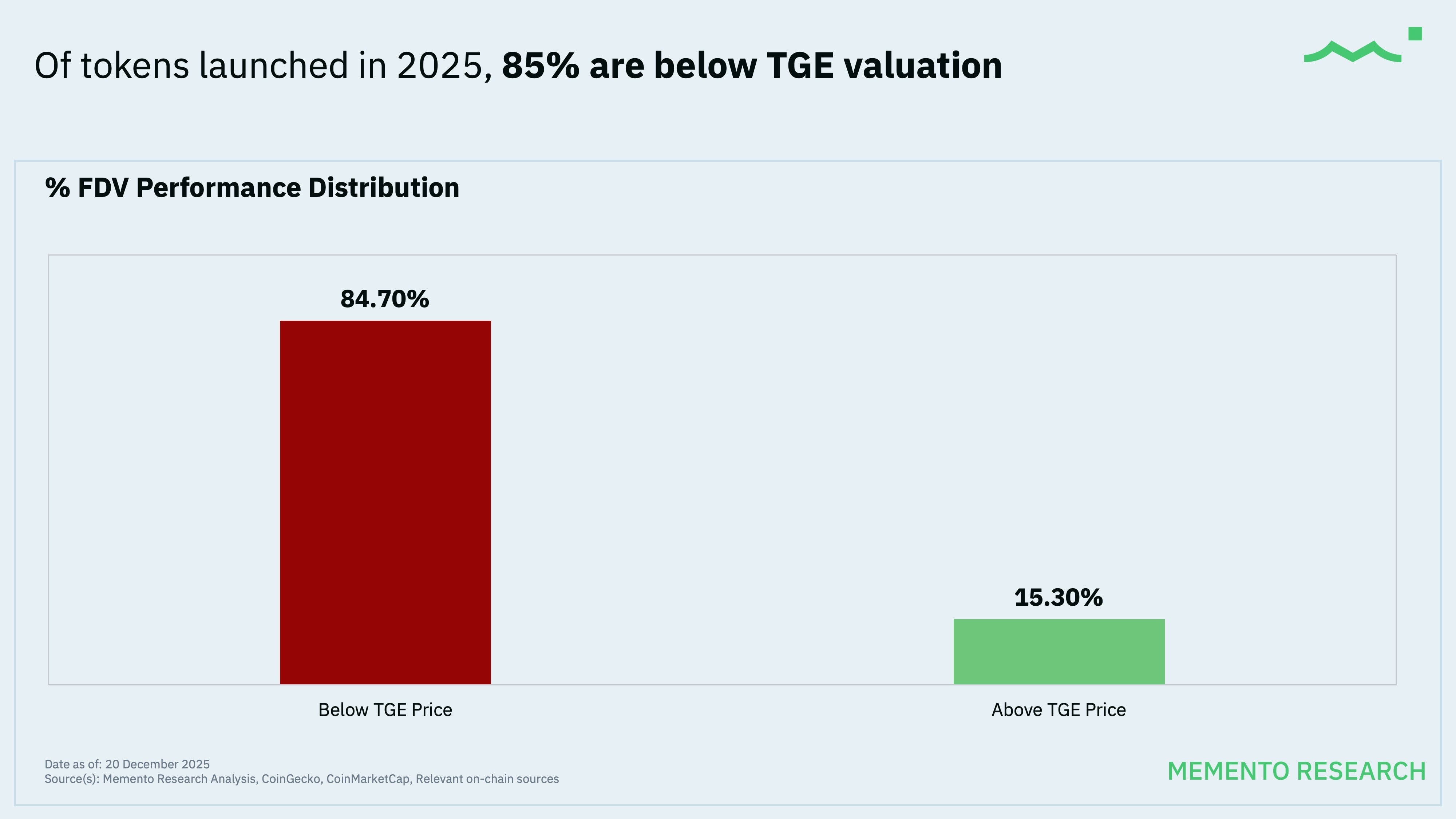
Memento Research chart: % of 2025 token launches below vs. above TGE valuation (84.7% below TGE, data as of Dec 20, 2025). — Source: Memento Research — 'State of 2025 Token Launches' (chart)
Why a safe harbor could weaken guardrails
Verified facts: public input to the SEC shows both support for clarity and insistence on traditional protections. Coin Center advocated rulemaking via notice-and-comment to avoid fragmented, selective relief. Trade groups including SIFMA and Fidelity called on the SEC to preserve core market-structure safeguards (SEC Crypto Task Force inputs). a16z, by contrast, sought narrow safe harbors for airdrops and incentives (a16z submission).
Inference: a safe harbor could be misread as license for riskier distribution mechanics, especially if retail-facing incentives proliferate inside a lighter-touch window. Combined with the 2025 TGE underperformance record, the danger is a faster conveyor belt for offerings that fail to transition from speculation to usable networks.
Verified fact: the proposal’s scope is intentionally narrow and conditioned on design and disclosures; many tokenized fundraising structures would remain outside the exemption (SEC — Proposal 3.0). Opinion: that guardrail is essential. The more the final rule insists on functional access tokens and demonstrable decentralization or utility by maturity, the less room there is for pseudo-equity tokens to sneak through.
What would confirm or weaken this thesis
- OIRA outcome and Federal Register publication: dates, the scope of the notice, and whether crypto-asset RINs advance together or in parts. Verified fact: OIRA review is a prerequisite to publication (RegInfo).
- Final Rule 195 text: the definition of “Qualifying Transactions,” disclosure requirements, the three-year “Token Maturity” pathway, and explicit exclusions such as profit-linked buy-and-burn designs.
- Companion exemptions: how narrowly the Exchange Act and Investment Company Act relief is drawn for exchanges, brokers, dealers, and “Autonomous Systems.”
- Issuer behavior: the share of U.S.-inclusive launches that opt into the safe harbor, the quality and comparability of disclosures, and whether teams publish credible roadmaps to maturity.
- Intermediary responses: policy updates by trading venues, custodians, and brokers for Rule 195-covered tokens; whether they rely on the exemptions or maintain existing registration pathways.
- Market outcomes: post-launch performance dispersion for safe-harbor tokens versus non-covered launches and evidence that networks reach functional milestones before the three-year window closes.
- Enforcement and interpretive actions: clarity on misuse of the safe harbor and signals that profit-like tokens, or designs excluded by the tests, will face traditional registration or enforcement.
Editorial conclusion: a narrow, disclosure-heavy safe harbor can make U.S. token fundraising faster without repeating the excesses of prior cycles. The data argue for change; the rule text argues for limits. Whether the market gets both depends on how tightly the final exemptions are drawn and how faithfully they are enforced.
Disclaimer: This article is provided for informational purposes only. It is not offered or intended to be used as legal, tax, investment, financial, or other advice.
Related Stories