What Is the S&P 500 Equal Weight Index and How Does It Work?
 Andrei Popescu
If you’ve ever wondered why your S&P 500 fund feels like a bet on a handful of mega-caps, you’re not imagining it. The classic benchmark is market-cap weighted, so the largest names drive most of the movement.
The S&P 500 Equal Weight Index flips that script. Every stock gets the same slice. It’s a simple idea that quietly changes a lot: concentration, sector mix, even how often you trade.
Let’s unpack what it is, how the quarterly reset works, where it shines, and the traps that catch people by surprise.
| Point | Details |
|---|---|
| Definition | Each of the 500 constituents gets roughly 0.20% weight, refreshed at a quarterly rebalance (S&P Dow Jones Indices). |
| What changes vs cap weight | Lower concentration in mega-caps; more mid-cap exposure; more even sector footprint; higher turnover. |
| Rebalance schedule | Quarterly: weights reset to equal after component updates and corporate actions. |
| Access | Commonly via ETFs like Invesco’s RSP, which held about $96.8B AUM as of July 18, 2026 (MarketBeat). |
| When it can lead | Often during broad market breadth or when smaller names catch up; lag risk when mega-caps dominate. |
| Main trade-offs | Higher trading and potential tax impact; tracking and fee differences vs low-cost cap-weighted S&P 500 funds. |
What the equal weight version actually is
The S&P 500 Equal Weight Index takes the same 500 companies you know and strips out the size bias. Each stock sits at roughly 0.20% of the index after a scheduled rebalance. That’s it. No fancy optimizer. No factor screen. Just equal slices.
Per the rulebook, the index rebalances quarterly to reset every constituent back to that ~0.20% line, subject to the usual float-adjusted shares and corporate action mechanics. The official profile lays it out clearly (S&P Dow Jones Indices).
What does that do in practice? It reduces the pull of the top names. When Apple or Microsoft double in size, the cap-weighted index leans harder into them. Equal weight refuses to drift that way. It trims the winners and tops up the laggards back to the same starting line each quarter.
How the quarterly reset actually works
Let’s go step by step, because this is where equal weight earns its keep.
Step 1: Update the lineup
S&P Dow Jones Indices maintains the S&P 500 membership. Constituents change over time based on eligibility screens. For example, S&P announced on June 5, 2026 that Marvell Technology and Flex would join the S&P 500, effective prior to the open on Monday, June 22, 2026 to line up with the quarterly rebalance (S&P Dow Jones Indices / PR Newswire).
Step 2: Reset weights to equal
Once the roster is set, the index resets each stock to roughly 0.20% weight. With 500 names, math dictates the small weight. Prices move right after that, of course, but the reset is the anchor each quarter (S&P Dow Jones Indices).
Step 3: Live with the drift
Between rebalances, winners get bigger and losers get smaller. Equal weight doesn’t chase. It waits for the next quarter, then trims what ran and adds to what lagged. That’s a systematic buy-low, sell-high effect. Not magic, just rules.
Why quarterly matters
Quarterly is a middle ground. Monthly would be expensive. Annual risks big drifts. Quarterly keeps the tilt without turning the portfolio into a trading machine.
Pro tip: If you’re using an ETF, the fund handles the trading. That said, big rebalance days can be busier. Avoid placing market orders right at the open if liquidity looks thin.
Equal weight vs cap weight: where returns diverge
You can think of equal weight as an anti-concentration policy. That one rule drives several differences:
- Less top-heavy. Mega-caps don’t dominate the index’s return as much.
- More mid-cap flavor. Because every stock gets a seat, the middle of the S&P 500 matters more.
- Different sector shape. Sectors with lots of smaller names get more voice relative to cap weight.
- Higher turnover. Rebalancing trims and tops up more often, which can lift costs and, in taxable accounts, realized gains.
Performance naturally swings with market leadership. When breadth is wide and the “average stock” is climbing, equal weight often hangs in there or even leads. When a few giants do all the heavy lifting, cap weight can pull ahead.
Case in point: early July 2026 commentary flagged better breadth. As of July 2, 2026, the average stock proxy (the equal-weighted S&P 500 benchmark) was outperforming the cap-weighted index by a bit more than 2 percentage points year to date (Nasdaq / Dorsey Wright). That’s exactly the kind of window where the equal-weight idea shows its teeth.
A quick side-by-side
| Feature | Cap-weighted S&P 500 | Equal-weighted S&P 500 |
|---|---|---|
| Concentration | High in mega-caps | Distributed across 500 names |
| Implicit tilts | Size and momentum of largest firms | More mid-cap, relative value rebalancing |
| Turnover | Low | Higher (quarterly trims/adds) |
| When it tends to lead | When a few mega-caps dominate | When market breadth broadens |
| Common tracker | SPY, IVV, VOO | RSP (largest by AUM) |

How to hold it: ETFs, costs, and liquidity
For most investors, the cleanest route is an ETF that mirrors the index. The largest is Invesco’s S&P 500 Equal Weight ETF (ticker RSP). As of July 18, 2026, MarketBeat showed it at roughly $96.82 billion in assets (MarketBeat), which is a pretty strong signal that liquidity is there.
What to check before you click buy:
- Expense ratio. Equal-weight funds often cost more than the rock-bottom cap-weighted S&P 500 trackers. Verify the current fee on the sponsor’s site.
- Tracking difference. Compare the ETF’s returns against the index. Rebalancing frictions can lead to small gaps.
- Trading spreads. Bigger AUM usually helps, but look at average spreads and volume during your normal trading window.
- Tax profile. Higher turnover can mean more distributions in taxable accounts. Check the fund’s distribution history.
Pro tip: If you dollar-cost average, pick a consistent day and time with healthy volume. If you’re moving a lump sum, consider staging entries around, not directly on, the quarterly rebalance week.
Where it can fit in a portfolio
There isn’t one right answer, but a few common approaches pop up again and again.
Replace a slice of cap-weighted S&P 500
Some investors carve out 20 to 50 percent of their large-cap US equity sleeve for equal weight. You still own the 500 familiar names, just smoothed out for concentration.
Pair it with quality or value
Equal weight already has a small tilt toward the middle of the market. Layering a quality or value factor fund can sharpen the defensive or valuation edge without leaning on the top ten names.
Use it as a breadth bet
If you believe leadership will broaden beyond mega-caps, equal weight is a direct expression of that view. It has a built-in rebalance that buys laggards and trims leaders, which is exactly what you want if the middle is catching up.
Blend across cycles
Rotating in and out based on headlines is hard. Another way is to hold both cap and equal weight all the time, then let market cycles decide which sleeve is on top. Keeps you from guessing the next leadership turn.
Common pitfalls and risks to watch
- Fee complacency. Costs have come down, but equal-weight funds often still carry higher expense ratios than classic S&P 500 ETFs. Over years, that matters.
- Tax surprises. Quarterly trimming can kick up capital gains distributions. In tax-deferred accounts, not a big deal. In taxable, plan for it.
- Wrong regime. If a few giants dominate for long stretches, equal weight can lag for a while. That’s not broken behavior, it’s the design.
- Sector expectations. Equal weight can look heavier in sectors with more, smaller names. Don’t assume sector weights match the cap-weighted index.
- Trading into the rebalance. Spreads can widen briefly on rebalance days. Limit orders help.
Equal weight is not a free lunch. It’s a different bet: less concentration, more turnover, and a steadier hand across 500 names. If you pick it, accept the ride.
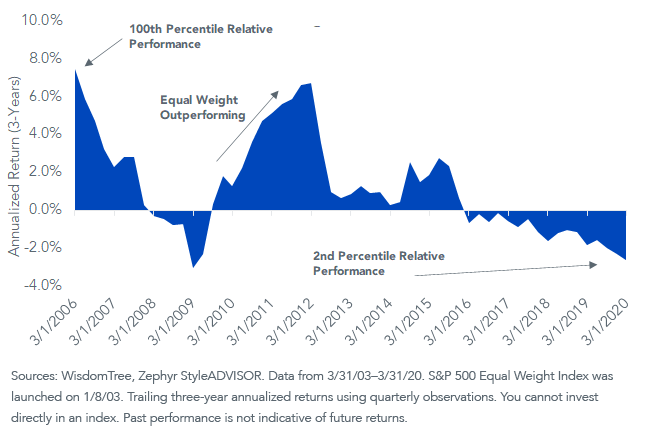
Rolling 3‑year annualized excess returns: S&P 500 Equal Weight minus S&P 500 — shows historical periods when equal‑weight outperformed or underperformed, illustrating the variability of equal‑weight’s advantage. — Source: WisdomTree
A 2026 snapshot: breadth and index changes
Two quick things from mid-2026 that are useful if you’re framing expectations.
- Breadth improved into early July. The equal-weighted benchmark outpaced cap weight by a little over 2 percentage points YTD by July 2, 2026, which lines up with a more even advance across names (Nasdaq / Dorsey Wright).
- Membership matters. Marvell Technology and Flex joined the S&P 500 effective June 22, 2026, synchronized with the quarterly reset (S&P Dow Jones Indices / PR Newswire). Equal weight automatically spreads their weights to the same ~0.20% as everyone else, which keeps new additions from spiking concentration.
Context changes, but the mechanics stay steady: reset to equal, let prices drift, then reset again.
Quick implementation checklist
- Decide the role: core replacement, partial sleeve, or tactical tilt.
- Pick vehicle: ETF or mutual fund that tracks the official S&P 500 Equal Weight Index.
- Check the fee, tracking difference, and distribution history.
- Plan trade execution: use limit orders; avoid the open on rebalance Monday if spreads look wide.
- Tax placement: prefer tax-advantaged accounts if distributions are frequent.
- Revisit annually: confirm it still fits your views on concentration and breadth.
If you want more market structure explainers with a crypto-friendly lens, we cover cross-asset flows and breadth at Crypto Daily without the usual buzzword fog.
Frequently Asked Questions
Is the S&P 500 Equal Weight Index the same as buying 500 stocks equally?
Conceptually, yes. In practice, the index uses float-adjusted shares and a precise rebalancing method. An ETF that tracks it will follow those rules and handle the trading, corporate actions, and quarterly resets for you.
How often does the index rebalance and why that cadence?
Quarterly. That frequency balances drift control with costs. Monthly would churn more; annual would let concentration creep back in. The rulebook resets each constituent to roughly 0.20% each quarter.
When has equal weight tended to outperform?
When market breadth is broad and smaller names participate, equal weight often does better. Early July 2026 was an example, with equal weight up by a bit over 2 percentage points versus cap weight year to date.
What ETF tracks it and how big is it?
Invesco’s RSP is the flagship ETF. As of July 18, 2026, it had about $96.8B in assets under management, per MarketBeat. Size supports liquidity, but always check current spreads and volume.
Does equal weight change sector risk?
It can. Sectors packed with smaller companies can carry more weight relative to the cap-weighted index. That reshapes risk a bit even though you still hold the same 500 names.
Is equal weight more tax efficient?
Not usually. The quarterly trims and adds can create more realized gains than a low-turnover cap-weighted fund. In tax-deferred accounts, that’s less of an issue. In taxable accounts, it’s worth checking distribution history.
What happens when companies enter or leave the S&P 500?
Membership changes are handled by S&P Dow Jones Indices. When new names are added, the equal-weight index sets each to the same starting weight at the rebalance. That keeps new entrants from spiking concentration.
Disclaimer: This article is provided for informational purposes only. It is not offered or intended to be used as legal, tax, investment, financial, or other advice.
Related Stories