From Group Stage to Final: How a World Cup Favourite's Odds Compressed
 Crypto Daily
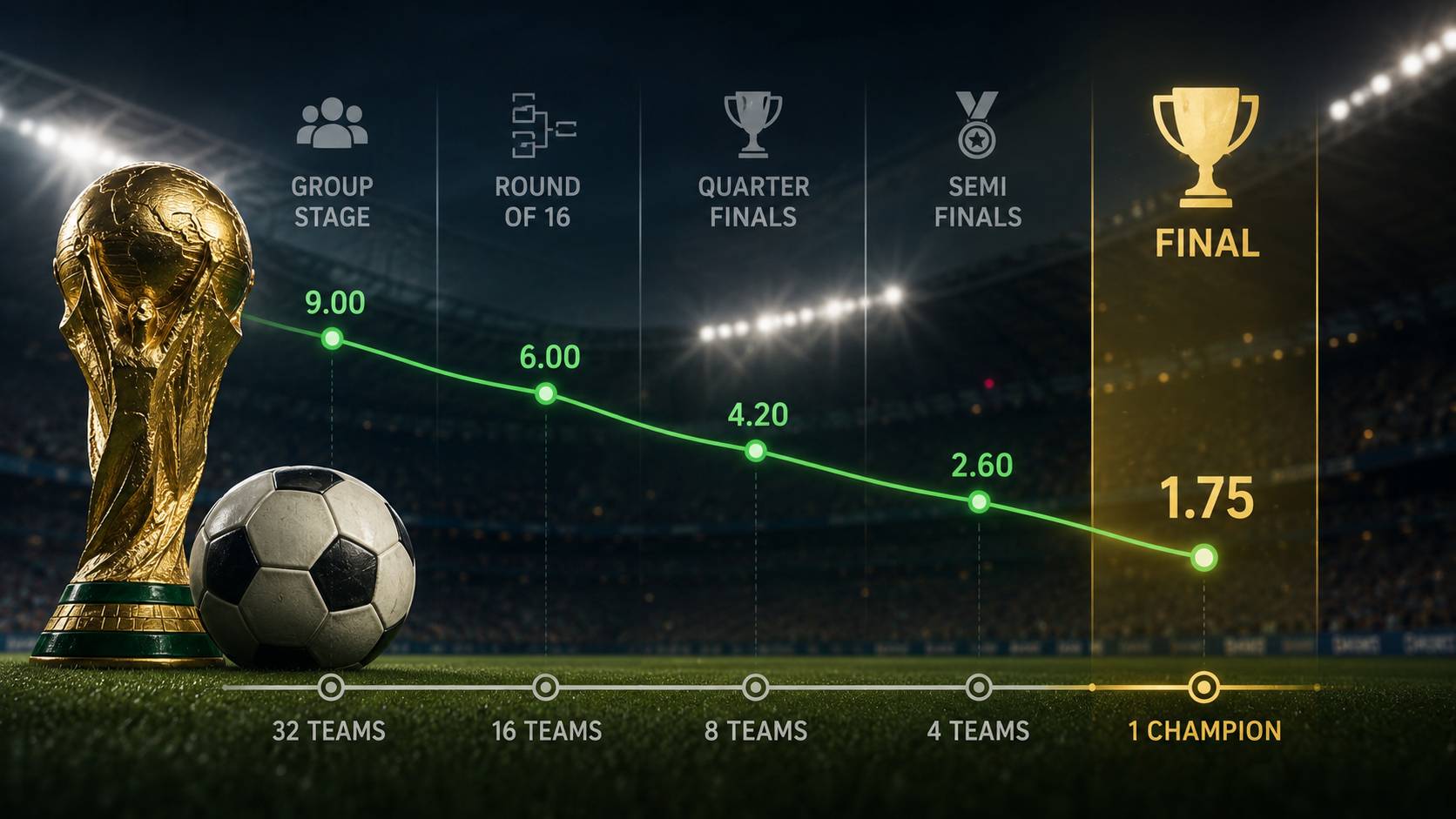
Spain opened the 2026 World Cup at +450 and reached the final at -156. Those two prices describe the same team and the same trophy, five weeks apart, and the distance between them is the clearest illustration a bettor gets of what a futures market actually does.
An outright price is not a prediction that sits still. World Cup outright odds are a running estimate that reprices after every result, and Spain's path from co-favourite to drifting second choice and back to favourite shows the mechanism working in both directions.
An Outright Price Is a Probability in Disguise
American odds look like payout instructions, and they are, but they are also a statement about likelihood. Implied probability is the bridge: a +450 price implies roughly an 18% chance, a -156 price about 61%. The conversion is arithmetic, not opinion.
That is why the number moves. When Spain drew its opener, the market did not decide Spain had become a worse team overnight. It recalculated the probability that Spain would navigate a 48-team bracket, and the price followed the maths.
Spain's Price Journey, Stage by Stage
The table tracks the same outright market across the tournament, with the event that moved it at each point. Prices are drawn from the major books and prediction markets covering the 2026 competition.
|
Stage |
Spain outright |
Implied chance |
What moved it |
|
Tournament opening |
+450 (co-favourite with France) |
Roughly 18% |
Pre-tournament form and squad strength |
|
After 15 June group draw |
Drifted; France sole favourite |
Lower |
A 0-0 draw with Cape Verde |
|
Group H won, quarter-final passed |
Recovering |
Rising |
Beat Belgium 2-1 to reach the last four |
|
Ahead of the semi-final |
+320, second choice |
Roughly 24% |
France is priced at +150 as the favourite |
|
After the 2-0 semi-final win |
-156 favourite |
Roughly 61% |
Beat France; France eliminated |
Two things stand out. The largest single move came from a group-stage draw against a lower-ranked side, not from a knockout defeat, and the return to favouritism came in one afternoon. Since the odds first opened in 2022, only two teams have ever been favourite for this tournament: Spain and France.
Compression Is What Happens When Outcomes Run Out
Every result removes possible futures. That is the whole engine. At kickoff, 48 teams could theoretically lift the trophy, and the probability had to be spread across all of them, which is why even a co-favourite sat at +450.
By the semi-finals, only four remained, so the same total probability was divided four ways instead of forty-eight, and every surviving price shortened. This is why markets tighten in the final four regardless of which teams are involved. Compression is structural, not sentimental.
Prediction markets show the same picture in plainer terms. Spain's chance of lifting the trophy sits near 57.6% on Kalshi with one semi-final still to play, while England and Argentina share what remains.
Every Quote Carries the Book’s Margin
One caveat belongs with every number above. Bookmakers build a margin into the set of prices, so the implied probabilities across all outcomes add up to more than 100%. That excess is the book's edge, and it means an implied percentage always overstates the raw probability slightly.
Books also manage liability, not just likelihood. Traders spoke openly about relief when the United States and then France went out, because both carried large exposure.
A price reflects the money already staked as much as the football, which is why an outright number reads most accurately as the market's working estimate under commercial pressure, and never as a forecast.
A Ticket Already Placed Keeps Its Price
An outright bet keeps the price it was struck at. A ticket taken on Spain at +450 in June still pays at +450 if Spain lifts the trophy on Sunday, no matter that the current price is -156. Later compression does not improve or damage a bet already made.
The reverse is the harder lesson. A France ticket at +150 did not shorten or lengthen when Spain scored; it settled as a loss the moment France was eliminated, because a futures ticket lives until the team wins or is knocked out. Compression only matters to a bet not yet placed.
Where Dexsport Fits a Moving Market
Dexsport carries outright and match markets through a tournament like this one, with more than 100 markets per match and Cash Out on eligible bets, so a position can be closed while a price is still moving instead of waiting on the trophy.
Its structural difference sits in on-chain settlement. Dexsport is non-custodial, so funds settle to a wallet the bettor holds, and bets post to a public on-chain desk where a placed price and its outcome can be checked against the ledger.
When a market has moved this far in five weeks, having the struck price recorded somewhere permanent is worth something.
One boundary keeps that accurate: Dexsport is a hybrid, setting odds off-chain while recording settlement on-chain, so verifiable settlement is a narrower claim than a fully on-chain book.
Reading the Final Price Honestly
Spain's arc from +450 to -156 is a clean demonstration of how a futures market thinks: spread the probability wide at the start, concentrate it as teams fall, and reprice hard when a favourite loses. The compression is the market doing its job.
None of it says who wins on Sunday. A -156 favourite loses often enough that the price exists at all, and the margin baked into every quote means the implied percentage flatters the estimate.
Confirm what is legal where you live, keep stakes within a set budget, and play only if you are of legal age, since KYC or AML checks may apply. Responsible gambling matters more than any line movement.
Disclaimer: The information here is provided for general purposes only and is not legal, tax, investment, or financial advice. Odds move constantly and the prices cited reflect a moment during the 2026 tournament, so confirm current markets before betting. Betting carries risk, and rules vary by country, so check the law where you live. Please gamble responsibly, within your means, and only if you are of legal age.
Related Stories