Crypto Casino Fairness: What Provably Fair Does and Doesn't Prove
 Crypto Daily
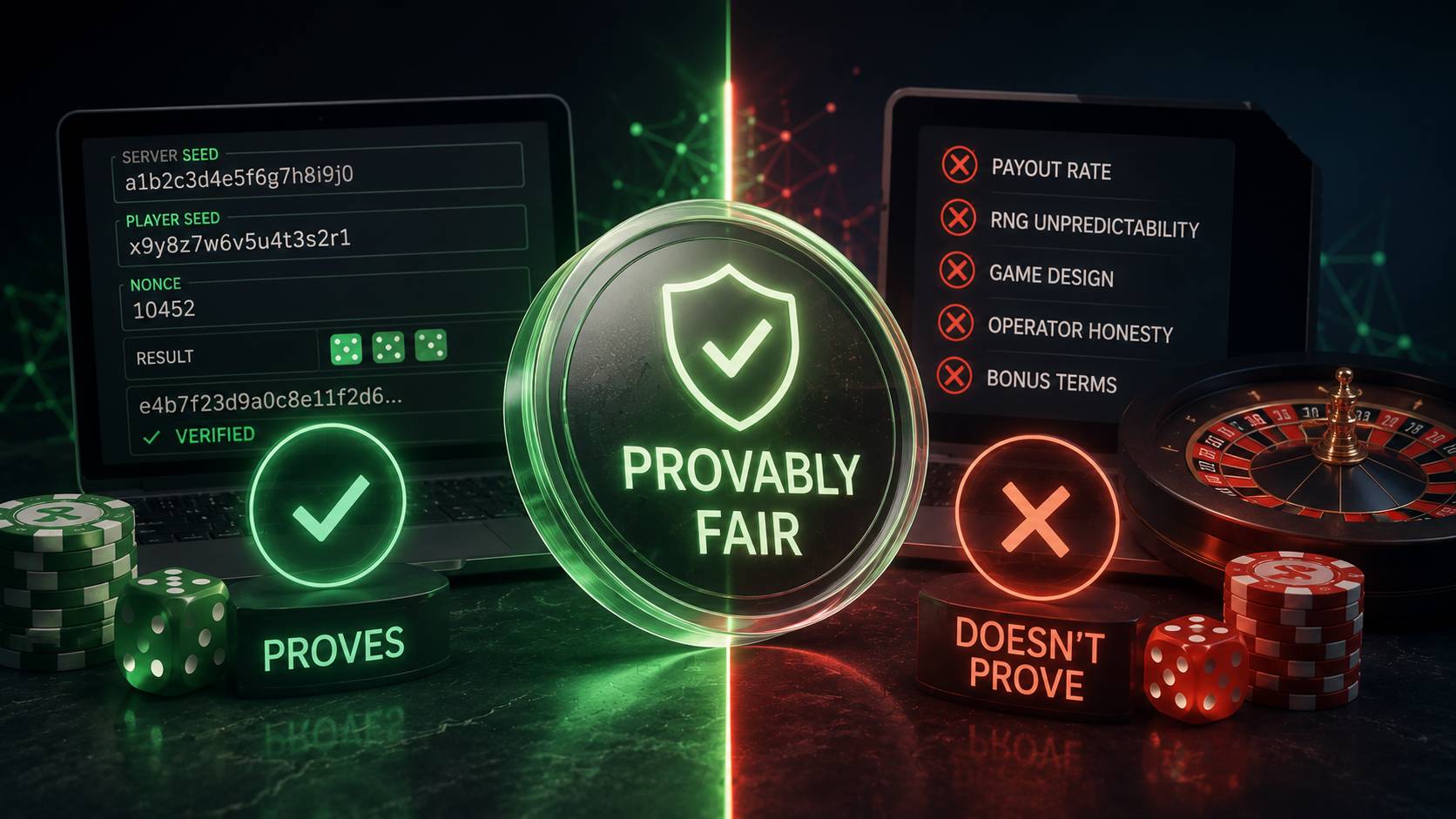
The phrase "provably fair" gets read as a promise that a game is fair to the player, which is not what provably fair proves at all. A provably fair system proves something real, but it is narrower and more specific than the label suggests.
That space between what it proves and what players assume it proves is where most of the confusion sits. The one thing it genuinely locks down is worth separating from the several things it leaves entirely open.
What a Verified Result Actually Proves
Provably fair turns a casino's honesty on a single game round from a claim into something a player can check.
Each outcome is built from three values that no one party fully controls: a server seed the casino commits to as a published hash before the bet, a client seed the player supplies or the browser generates, and a nonce that rises with each bet so identical seeds still produce unique results.
Those three run through a hashing function to produce the result.
The guarantee is precise. Because the server seed hash was published before any bet, the casino could not have changed the seed after seeing the wager, and because the player contributed the client seed, the casino could not have pre-calculated the outcome.
A verified result proves that a specific completed round was committed in advance and not altered afterward. That is a genuine assurance, and a traditional casino cannot offer it.
The House Edge Stays Exactly Where It Was
The most common misreading is that verifiable means favorable. It does not. A game can be provably fair in every round and still carry a house edge that favors the operator over time, exactly as the paytable was designed to.
Provably fair confirms that the result you received was the result the maths produced, not that the maths were ever in your favor. The edge is built into the game and sits entirely apart from the seed-and-hash system that verifies a round.
Proving a coin flip was honest says nothing about the price you were paid to call it.
Coverage Stops at the In-House Originals
The system works only where a single algorithmic calculation decides the outcome, which means the casino's own in-house originals: dice, crash, mines, plinko, and similar titles built around the seed mechanism. Those carry a fairness panel and a per-round check.
Third-party slots and live dealer tables work differently. They run on certified random number generation (RNG), a lab-tested process signed off by an external auditor, not a result a player recomputes personally.
The assurance there comes from certification, not from personal verification. So a platform advertised as provably fair is usually provably fair on its originals and certified elsewhere, and reading the label as a promise about every game on the site overstates it.
Nothing Here Vouches for the Operator
This is the limit that matters most and gets stated least. A provably fair game can sit inside a risky casino. The mechanism proves a round was not tampered with; it says nothing about whether the operator is licensed, solvent, or reliable about paying out.
Verification does not guarantee a withdrawal clears, does not prove a bonus holds any value, and does not confirm the operator holds a license worth the name. It also does not confirm the server seed itself was generated without bias, only that the revealed seed matches the committed hash.
The checks that cover those risks, licensing, reputation, and withdrawal terms, are separate work a player still has to do.
Dexsport Shows the Line Between Features
Dexsport offers provably fair originals, so a player can verify those rounds directly through the seed-and-hash method instead of taking them on trust. That covers the same narrow ground the mechanism covers anywhere: the originals, round by round.
Its more structural traits, a non-custodial design where funds settle to a wallet you control and an on-chain bet desk audited by CertiK and Pessimistic, sit apart from the provably fair claim and answer different questions.
Provably fair speaks to whether an original round was honest. Custody and settlement speak to who holds your money and how a bet resolves. Keeping those separate is the honest way to read any platform, Dexsport included, since one verifiable feature does not stand in for the rest.
Reading the Label Without Overreading It
Provably fair works as a transparency tool, not a shortcut around the odds. It answers one question well, whether a specific in-house round was predetermined and left unaltered, and it leaves the house edge, the game coverage, and the operator's conduct exactly where they were.
That makes it worth having and easy to overtrust. A player who verifies a round has confirmed one honest thing, not cleared the casino on every count.
Check the licensing and terms alongside it, confirm what is legal where you live, and keep stakes within a set budget, since KYC or AML checks may apply. Responsible gambling matters as much on a verifiable game as on any other.
Disclaimer: The information here is provided for general purposes only and is not legal, tax, investment, or financial advice. Fairness mechanisms, game coverage, and operator terms vary by platform and change over time, so confirm current details before depositing. Betting carries risk, and rules vary by country, so check the law where you live. Please gamble responsibly, within your means, and only if you are of legal age.
Related Stories