Amazon Earnings Preview: AWS Growth and Retail Margins
 Lena Carter
Amazon’s earnings days tend to boil down to two questions. Did AWS grow fast enough. And did retail get more profitable. If you can answer those quickly, you’ll usually know why the stock is moving.
This preview gives you a clean framework for Q2: what the Street expects for AWS, how to think about operating margins on both cloud and retail, and where guidance and capex could surprise. Use it to build your own reaction plan before the numbers hit.
No hype here. Just the handful of levers that actually drive the tape.
| Aspect | What to Know |
|---|---|
| AWS revenue bar | Visible Alpha consensus for Q2 2026 sits near $40.5B for AWS revenue (S&P Global (Market Intelligence)). |
| AWS profitability | Consensus AWS operating margin around ~33.8% for Q2 (estimate range roughly 30.9%–38.2%) per the same report (S&P Global (Market Intelligence)). |
| Growth tempo | TD Cowen projects AWS growth could accelerate to about 35.5% year over year in Q2, a step up from the prior year’s pace (MarketBeat citing TD Cowen). |
| Total company bar | Street looks for roughly $196.4B in revenue and about $1.82 in EPS for Q2 2026 (Charles Schwab). |
| Retail margins watch | Focus on North America vs International operating margins, the ads mix lift, and productivity from logistics and automation. |
| Guidance swing factors | AI infrastructure demand, capex cadence, and comments on enterprise budgets can move the out-quarter setup even if Q2 is fine. |
| Other moving parts | FX headwinds or tailwinds, shipping costs, and Prime Day timing color (mostly a Q3 dynamic) can blur trend reads. |
Core mechanics that actually move Amazon
AWS is the profit engine. It can be less than a third of sales but often the majority of operating income. That is why the market obsesses over AWS revenue growth and margin. If growth accelerates while margins hold up, you tend to get multiple expansion. If growth beats but margins sag on investment, the reaction is mixed.
Retail is a grind but a powerful one. Improvements in logistics density, regionalized fulfillment, and third-party services can add up. Ads is the quiet margin booster because it sits on top of retail traffic. A small change in retail efficiency or ads take rate can offset a lot of fuel or wage noise.
AI spending is the new wild card. Training clusters and inference capacity drive both AWS demand and capex. Heavy investment can dilute near-term margins but seed multi-year revenue. Listen for how fast customers are turning commitments into usage, and whether pricing is holding as architectures evolve.
Stock reactions after the print tend to key on two lines: AWS revenue vs consensus and consolidated operating income vs guidance. Everything else feeds those.
Quick glossary
- AWS operating margin: Operating income from AWS divided by AWS revenue. A clean way to see mix and efficiency.
- Retail segment margin: Operating margin for North America and International retail units. Sensitive to shipping, ads mix, and automation.
- Ads revenue: Sponsored listings and brand ads tied to Amazon’s retail surface. High margin and a key offset to delivery costs.
- Capex: Cash invested in data centers, GPUs, logistics, and facilities. Can pressure free cash flow in the short run.
- Free cash flow: Cash generated after capex. Useful for gauging how quickly investments are paying back.
Step-by-step playbook for the print
- Write down the Street bars: Note AWS revenue near $40.5B and ~33.8% margin, plus total revenue and EPS marks (~$196.4B and ~$1.82). Keep those on a sticky note (S&P Global; Charles Schwab).
- Check AWS growth vs trajectory: Compare reported YoY growth to the ~35.5% pace some expect. If growth re-accelerates without margin slippage, that’s clean (MarketBeat).
- Read retail margins line by line: Look at North America and International operating margins. Pair that with commentary on delivery speed, regionalization, and ads.
- Zero in on operating income and guidance: Consolidated operating income often drives the move. Guidance range vs consensus tells you if momentum carries.
- Decode capex and AI: Note data center, networking, and GPU spend. Are customer commitments turning into recognized revenue quickly enough to support margins.
- Watch ads and subscription: Ads growth and Prime subs can smooth retail volatility. If ads slows, retail margin progress has to do more work.
- Adjust for one-offs: FX, legal items, or restructuring can cloud comparisons. Back them out before you react.
What AWS acceleration would mean
The setup is simple to say and hard to nail. If AWS lands above the ~$40.5B line and margins are close to the ~33.8% bar, the market will likely read that as demand strength with good pricing. If growth beats but margins fall several points on heavy AI build-out, you’ll hear a lot of “quality of beat” talk.
On the flip side, an inline or small miss on revenue can still be tolerated if margins are firm and guidance calls for stronger utilization into the back half. Management color on enterprise budget flush or timing of AI workloads can flip the narrative quickly.
| Scenario | Likely market read |
|---|---|
| AWS revenue above consensus, margin in line or better | High quality beat; supports multiple expansion, especially if guidance confirms demand. |
| AWS revenue above, margin below by a few points | Mixed; growth cheered but debate over investment payback and pricing intensity. |
| AWS revenue roughly in line, margin firm | Stable; focus shifts to backlog, new AI instance launches, and guidance cadence. |
| AWS revenue below, margin soft | Weak; concerns about competitive pressure or slower enterprise AI adoption. |
Keep an eye on comments about training vs inference demand. Training ramps are lumpy. Inference growth is steadier and often more margin friendly once platforms mature.

Retail margins: what matters right now
Retail margins ride on speed and density. The more orders a regional node handles per mile driven, the better your cost per package. Amazon’s focus on same-day and next-day gets talked about as a customer perk, but it is also a margin lever when the network is tuned.
Ads is the other quiet driver. If ad load or pricing increases, retail can absorb more delivery and wage costs without blinking. The flip side is ad softness forces retail to show more pure operating efficiency to keep margins moving up.
Pro tip: during the call, write down exact phrases tied to margin levers like “regionalized fulfillment,” “inbound routing,” and “delivery density.” Those clues explain the margin print more than any single cost line.
International can be volatile. Currency swings, economies of scale, and country mix all play games with year-over-year comparisons. When you see a big move, check for FX disclosure and timing of network changes before jumping to conclusions.
AI capex and the shifting profit mix
AI infrastructure is capital hungry. Racks, power, networking, and GPUs eat cash up front. That investment can compress free cash flow in the near term even if lifetime returns look strong. The key question is utilization: are big customer commitments translating into steady, high-margin workloads fast enough.
Watch how management talks about availability of new instance types, multi-tenant vs dedicated clusters, and price-for-performance. If customers are standardizing on a few high-demand SKUs, capacity planning gets easier and margins can stabilize sooner.
Also listen for vendor relationships and supply comments. Tight GPU supply can limit near-term revenue recognition. Over-ordering to secure supply can go the other way and burden depreciation. Both show up in margin math eventually.
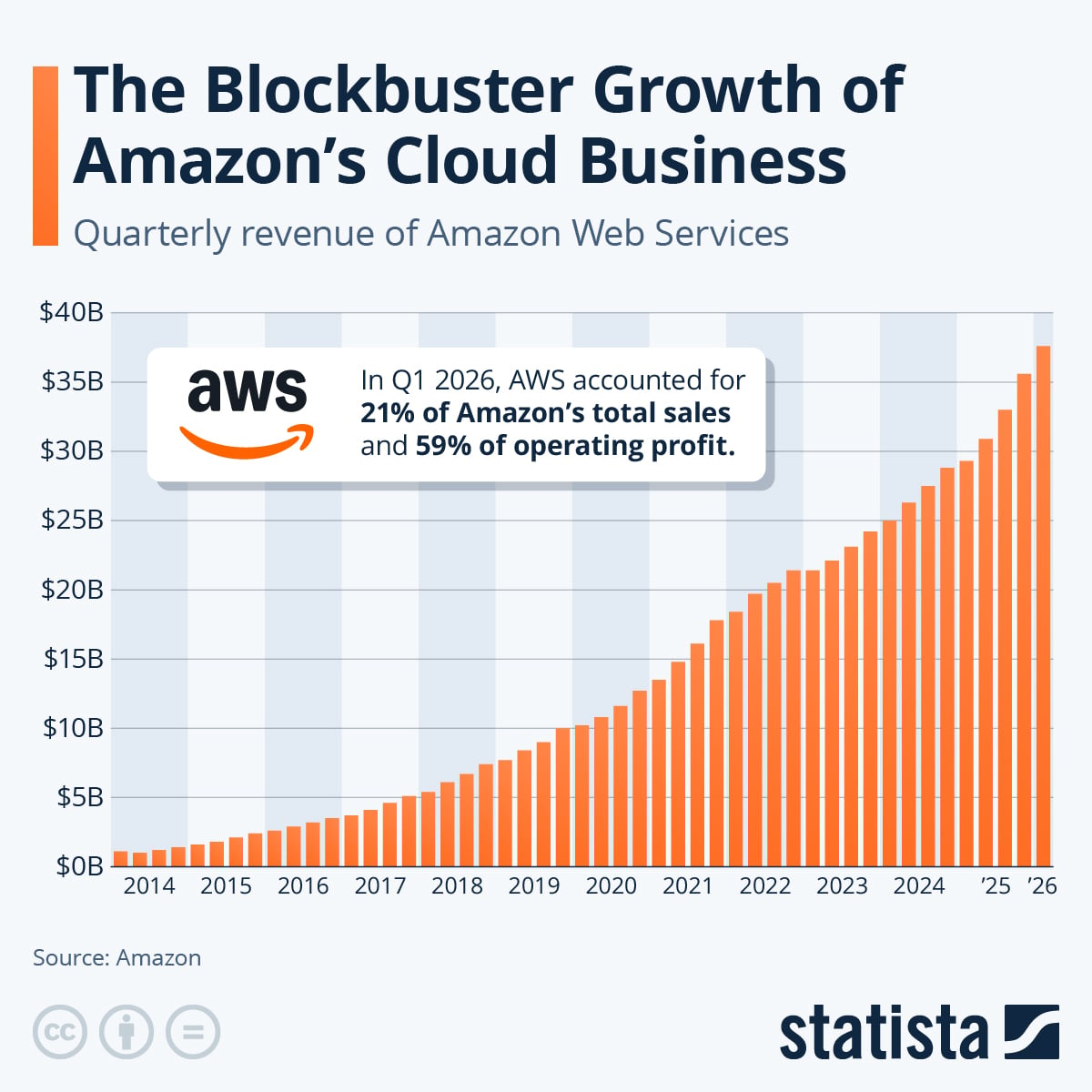
Statista infographic of AWS quarterly/annual revenue (trend chart) — useful to visualize AWS’s multi-year revenue acceleration and context for the upcoming Q2 growth/margin debate. — Source: Statista
Pitfalls and red flags to watch
- Great AWS growth, weak margin commentary: a beat with hand-wavy explanations around pricing or cost can fade fast.
- Retail margin progress stalling: even a small backslide after several quarters of gains will raise questions about sustainability.
- Capex rising without clear conversion: heavy spend with vague timelines on utilization or customer ramps is a warning sign.
- Guidance that punts: if the outlook leans on wide ranges without specifics on demand drivers, the market will assume caution.
- FX and one-offs masking trends: big currency moves or legal accruals can hide the true run-rate. Back them out when you model.
If you want a tight daily read on market structure around reports like this, we cover the cross currents every day at Crypto Daily.
Frequently Asked Questions
What is the Street expecting for AWS in Q2 2026
Consensus pegs AWS revenue near $40.5B with operating margin around ~33.8%, based on Visible Alpha estimates compiled in late July 2026. Those numbers frame the hurdle rate for the print (S&P Global (Market Intelligence)).
Is AWS growth really re-accelerating
Some on the Street think so. TD Cowen flagged a potential step-up to about 35.5% YoY growth for Q2, which would mark a faster clip than the comparable prior period if it lands. The mix of training and inference demand will influence how durable that pace is (MarketBeat citing TD Cowen).
How important are retail margins versus AWS
AWS drives a lot of operating income, but retail margins tell you whether the base business is compounding profitably. Sustained improvement in North America and steps toward breakeven or better in International can support consolidated margin expansion even if cloud investment is heavy.
What are the headline numbers for total company expectations
Analysts surveyed mid-July were looking for roughly $196.4B in revenue and about $1.82 in EPS for Q2 2026. The company’s operating income outlook and AWS metrics typically decide the stock’s first move around those anchors (Charles Schwab).
How should I interpret capex commentary
Think about timing and conversion. Rising capex tied to AI capacity can be fine if management shows credible line of sight to customer usage and stable pricing. If spend goes up while utilization lags, near-term margins and free cash flow can wobble.
What could trigger a negative surprise
The risky combo is AWS missing revenue while margin compresses, plus cautious guidance. Short of that, a strong top line paired with vague or soft margin talk can still leave buyers hesitant.
Disclaimer: This article is provided for informational purposes only. It is not offered or intended to be used as legal, tax, investment, financial, or other advice.
Related Stories