

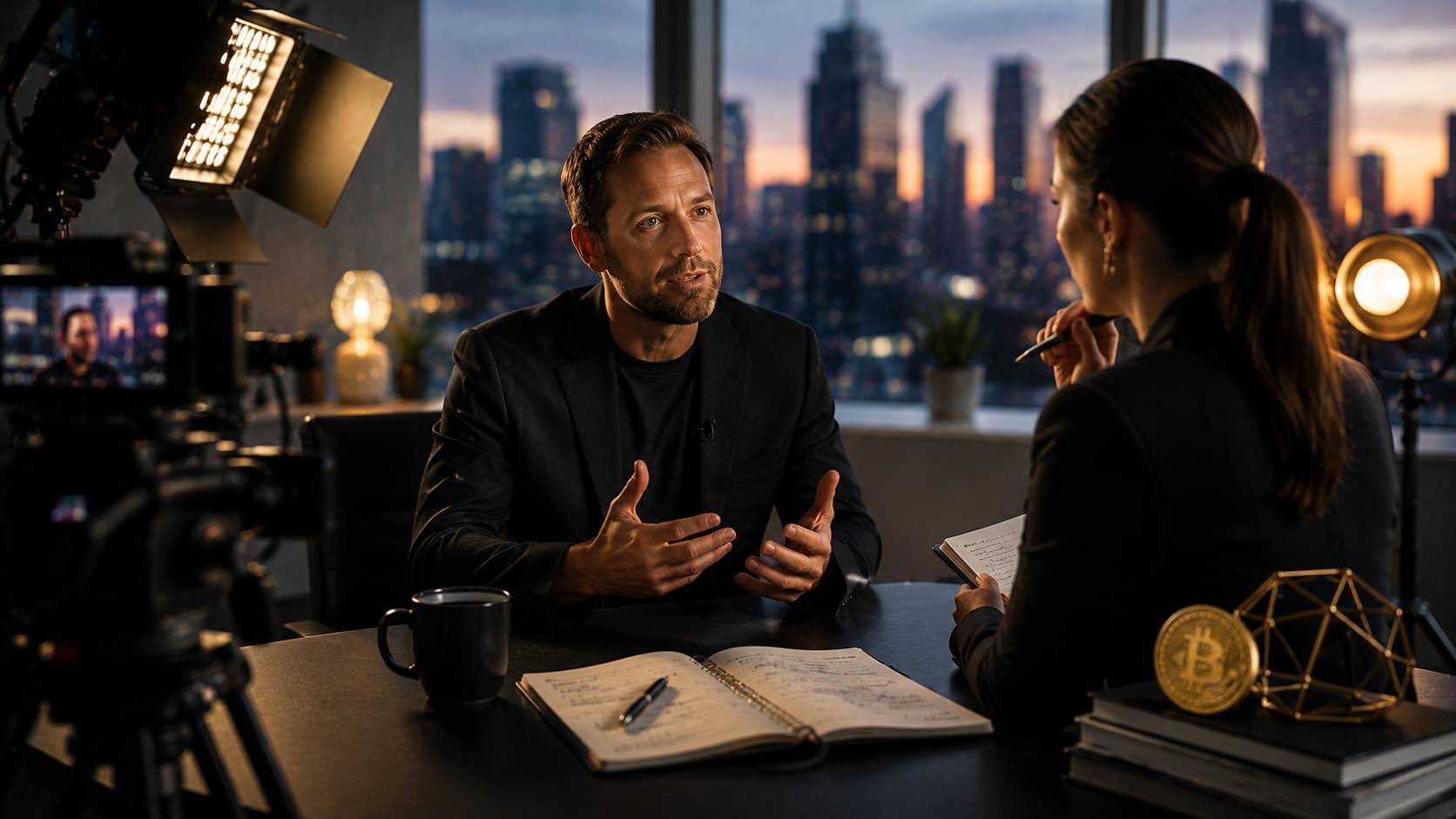
A single tier-1 interview can lift a founder's credibility or undo years of it in one careless answer. The outlet reaches investors, journalists, and users at once, which raises the cost of every sentence.
The category sharpens that risk further. Founders who would handle a business interview cleanly can still walk into traps that general preparation never covers, so crypto founder media training has to run as a process across the days before the recording, not a scramble in the final hour.
Two Weeks Out: Research the Journalist and Set the Message
Strong tier-1 media interview prep begins well before the interview is confirmed on the calendar. The first task is to study the reporter, not the questions.
Build a short dossier on the journalist. Read their recent work to learn their beat, their tone, the angles they return to, and whether they favour collaborative or combative interviews. That reading predicts most of what the founder will face.
Data-led agencies formalise this step. Outset PR studies each outlet's editorial pattern and audience before recommending an interview, so a founder walks in matched to a desk that actually fits the story rather than chasing any tier-1 name.
With the reporter mapped, the team sets a single message. Founder interview preparation works best when it narrows to one core idea backed by two or three proof points, because a founder chasing five messages lands none of them.
One detail decides the rest of the prep. Match the message to the founder's role, since a chief executive is expected to speak to vision and market context while a product lead goes deep on execution and mechanics.
The Week Before: Drill Message Discipline and the Crypto Lines
Rehearsal is where preparation either holds or collapses. Tier-1 interviews rarely air in full, so the founder has to deliver in a way that survives an editor's cut.
Drill the message techniques
The most reliable structure puts the key point first. State the core message, add supporting detail, then restate the message at the close, so the idea lands even if the middle gets trimmed. Sound message discipline interview habits rest on that order.
Three techniques carry most of the load in a high-stakes interview:
-
Primacy and recency: lead with the core message and close on it, so the point survives any edit
-
Bridging: use a short transition to return a drifting answer to the core message without dodging the question
-
Flagging: signal that points matter most, so a reader or editor cannot miss them
Having a colleague play the reporter makes these stick. Run the answers aloud across several short sessions rather than memorising a script, because the goal is muscle memory for redirecting, not a recital.
Drill the crypto lines
This is also the week to drill the crypto-specific lines a founder must never cross. These traps rarely appear in general coaching, yet they sink crypto interviews more often than nerves do:
-
Predicting a price for your own token, which reads as a promotion and can attract regulatory attention
-
Implying guaranteed returns, which risks suggesting an investment contract under securities law
-
Quoting user or TVL figures you cannot defend, since reporters verify claims against on-chain data
-
Touching confidential or unannounced details, which crosses lines around material non-public information
Honesty about past mistakes belongs in the same drill. Web3 culture pushes founders to project flawless success, yet a leader who explains a setback and what changed afterward reads as more credible than one who pretends none occurred.
The Day Before: Rehearse Pressure and Respect the Beat
This final rehearsal targets the hard questions. Every founder eventually faces a hostile or loaded one, and the answer is to address it honestly rather than match the aggression, because a calm reply reads as confidence while a defensive one reads as guilt.
Practice sharpens composure. A colleague throwing tough questions builds the steadiness to stay measured under pressure, and speaking slightly slower than feels natural keeps nerves from surfacing. A short pause before a hard answer reads as thought, not hesitation.
Respect for the beat matters most in crypto. Reporters here often understand the technology better than the founders pitching them, so specificity earns their attention while volume and hype earn nothing.
Julia Magas, co-founder of Magas PR and a former contributor to Cointelegraph, framed the mindset in an interview with Outset PR. She advised speakers to stop treating the media as a promotional channel and start acting as a source of useful market insight.
Founders who enter as a source, not a salesperson, clear the bar most miss. That posture shapes how a reporter weighs every answer that follows.
In the Room: Stay Open, Stay on Message
The interview itself rewards a balance the founder rehearsed all week: openness paired with control. The standard shifted in 2026, and credibility now comes from candour rather than rigid deflection, so a founder coached only to repeat soundbites will read as evasive.
Answer the question that was asked, then bridge to the core message rather than ignoring the question entirely. Effective crypto spokesperson training prepares a founder to engage honestly while still steering the conversation, and handling hard questions media practice should rehearse exactly that balance.
Treat every microphone as live. Many of the worst media moments happen when a founder assumes the interview has not started or has already ended, so professionalism holds from arrival to exit.
Format shapes delivery too. A television hit, a long-form podcast, and a print quote each demand a different pace and depth, even when the core message stays fixed.
Outset PR coaches founders across these formats as part of its organic PR work, so the same message holds whether it runs on camera or in print.
After the Mic Is Off: Protect the Record
Preparation does not end when the recording stops. Any founder still on the premises is still on the record, and an offhand remark in the hallway can outrun the careful answers that preceded it.
Following up well also builds the next opportunity. Sending a short note that offers to clarify a figure or supply a data point keeps the founder on the reporter's source list, which is where future coverage starts.
Agencies that prepare founders this way tend to work from data rather than instinct. Outset PR builds interview readiness into its wider organic PR work, pairing journalist research with message coaching and reactive follow-up.
That continuity matters most after the interview. A single placement feeds an ongoing media presence rather than ending as a one-off, which is how a good interview becomes a source relationship a reporter returns to.
The Difference Preparation Makes
Founders who run this process arrive with a clear message, a read on the reporter, and the judgment to avoid the lines that sink crypto interviews. One who improvises gambles hard-won credibility on a single live answer.
Tier-1 interviews reward the disciplined and punish the unready, and the difference shows in the headline that follows. The founders who treat preparation as the work, not the warm-up, turn each interview into authority that compounds long after the segment airs.
Disclaimer: This article is for informational purposes only and does not constitute financial, investment, legal, or business advice. Quoted material reflects published commentary and is attributed to its source.